

That feeling of dread when a food safety auditor walks through your door? For any Sydney food business, a single pest sighting can jeopardise your reputation, your compliance, and your entire operation. The stakes are incredibly high, and simply spraying for pests isn’t enough to protect you. To be truly audit-ready, you need a documented, preventative system that meets the world’s most rigorous food safety standards.
This is where understanding professional HACCP compliant pest control Sydney becomes absolutely critical. Don’t let confusion about compliance put your business at risk. In this essential guide, we cut through the jargon to show you exactly what an audit-proof pest management plan looks like. You will learn how to identify critical control points, maintain flawless documentation, and implement a strategy that gives you complete peace of mind. Let’s ensure your business is protected and always ready for inspection.
What is HACCP and Why is Pest Control a Critical Prerequisite?
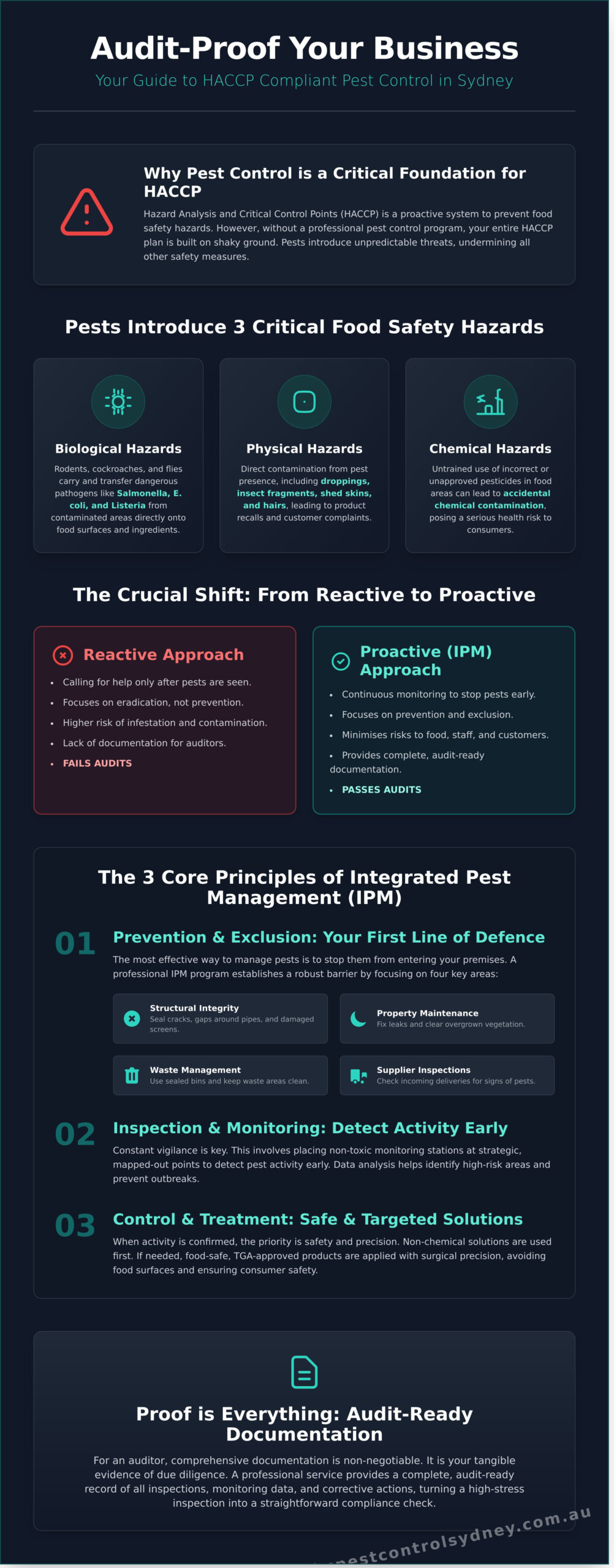
In Sydney’s competitive food industry, compliance isn’t optional-it’s essential for survival. At the core of food safety is Hazard Analysis and Critical Control Points (HACCP), a globally recognised system designed to prevent food safety hazards before they happen. Think of it as a proactive roadmap for identifying and controlling risks at every stage of food production and handling.
However, before you can manage specific control points like cooking temperatures, you must establish a solid foundation. This is where prerequisite programs come in. These are the essential practices, like sanitation and staff training, that must be in place first. Of these, pest control is arguably one of the most critical. Without it, your entire food safety system is built on shaky ground, exposed to unpredictable threats.
Pests as Critical Food Safety Hazards
Pests are not just a nuisance; they are mobile contamination risks that introduce severe hazards into your controlled environment. For any Sydney food business, understanding these threats is the first step towards mitigating them. The dangers they pose are typically categorised into three groups:
- Biological Hazards: Rodents, cockroaches, and flies are notorious carriers of dangerous pathogens. They can easily transfer bacteria like Salmonella, E. coli, and Listeria from drains and bins directly onto food surfaces, ingredients, and finished products.
- Physical Hazards: The presence of pests leads to direct physical contamination. This includes rodent droppings, insect fragments, shed skins, and hairs ending up in the food you serve, leading to product recalls and customer disgust.
- Chemical Hazards: A desperate, untrained attempt to control pests using incorrect pesticides in food preparation areas can lead to accidental chemical contamination, posing a serious health risk to consumers.
The Role of Pest Control in Your HACCP Plan
Effective pest management is far more than just spraying for bugs. For a food business, it must be a fully documented, systematic program that integrates seamlessly with your overall HACCP plan. Auditors don’t just want to see a pest-free facility; they need to see documented proof of a proactive management system. They will scrutinise your records, looking for evidence of regular inspections, monitoring station data, and corrective actions.
This is why choosing a partner for HACCP compliant pest control Sydney businesses can trust is so important. It marks a crucial shift from a reactive approach (calling an exterminator when a pest is seen) to a proactive one. A professional plan focuses on prevention, exclusion, and continuous monitoring to stop infestations before they can ever take hold, ensuring you remain compliant and your reputation remains protected.
The Core Principles of an Integrated Pest Management (IPM) Program for HACCP
HACCP isn’t just about reacting to problems-it’s about preventing them. That’s why Integrated Pest Management (IPM) is the global standard for food safety. This proactive approach aligns perfectly with the preventative controls outlined in the official HACCP guidelines. Instead of relying solely on chemical treatments, IPM focuses on understanding pest behaviour and creating an environment where they cannot thrive. This sustainable cycle minimises risks to your food products, staff, and customers, forming the foundation of effective HACCP compliant pest control in Sydney.
Prevention and Exclusion: Your First Line of Defence
The most effective way to manage pests is to stop them from entering your premises in the first place. A professional IPM program establishes a robust barrier by focusing on four key areas:
- Structural Integrity: Identifying and sealing all potential pest entry points, including cracks in walls, gaps around pipes, damaged screens, and open drains.
- Property Maintenance: Ensuring the building is in good repair, with no leaking taps or overgrown vegetation that could provide pests with water and shelter.
- Waste Management: Implementing strict protocols for rubbish disposal, including using sealed bins and maintaining clean waste storage areas to reduce food sources that attract pests.
- Supplier Inspections: Checking all incoming deliveries for signs of pests before they are brought inside, preventing infestations from being carried in with stock.
Inspection and Monitoring: Finding Problems Before They Escalate
Constant vigilance is critical for HACCP compliance. An expert technician will implement a systematic monitoring program to detect pest activity early. This involves placing non-toxic monitoring stations, such as insect traps and rodent bait stations, at strategic points throughout your facility. Every device is recorded on a detailed site map, allowing us to analyse trends over time, identify high-risk areas, and pinpoint the source of a potential outbreak before it impacts your business.
Control and Treatment: Safe and Targeted Solutions
When pest activity is confirmed, our approach prioritises safety and precision. We always start with non-chemical solutions like physical traps or environmental adjustments. If chemical treatments are necessary, we use only TGA-approved, food-safe products specifically formulated for sensitive environments. Our highly trained specialists apply these treatments with surgical precision, targeting pest harbourages and avoiding any contact with food preparation surfaces. This targeted approach is essential for a truly HACCP compliant pest control program, effectively eliminating stubborn pests like German cockroaches, rodents, and flies while guaranteeing food safety.
What a HACCP-Compliant Pest Control Service Report & Documentation Includes
In a food handling environment, what happens between service visits is just as crucial as the treatment itself. For an auditor, proof is everything. Comprehensive documentation isn’t just paperwork; it’s your tangible evidence of due diligence and a proactive commitment to food safety. A professional pest management system provides a complete, audit-ready record that transforms a high-stress inspection into a straightforward compliance check.
When you partner with an expert in HACCP compliant pest control Sydney businesses trust, you get more than just a service-you get a robust documentation system designed to protect your reputation and your customers.
The Essential Pest Management Folder
Your HACCP program requires a dedicated pest management folder or digital portal, which acts as the central hub for all compliance evidence. This isn’t just a collection of invoices; it’s a detailed logbook of your proactive pest management strategy. At a minimum, it must contain:
- A Detailed Site Map: A clear, current floor plan showing the precise location of all bait stations, insect monitors, and other control devices, each with a unique identifier.
- Service & Inspection Reports: A complete record of every technician visit, detailing observations, pest activity levels, conditions conducive to pests, and all actions taken.
- Pest Activity Logs & Trend Analysis: Data-driven reports that track pest sightings and trap captures over time, allowing for early identification of potential hotspots or seasonal trends.
- Credentials: Copies of your pest control company’s licenses, insurance policies, and technician certifications, proving you’ve engaged a qualified and insured professional.
Chemical Usage and Safety Documentation
Auditors will scrutinise any chemical use on your premises. Your documentation must provide absolute transparency and prove that every application is safe, necessary, and compliant. This includes maintaining up-to-date Safety Data Sheets (SDS) for any product used on-site, ensuring immediate access for your staff and health inspectors. Your records must show exactly what product was used, the quantity applied, where it was applied, and the specific date and time, guaranteeing full traceability.
Action Plans and Recommendations
A true pest management partnership goes beyond treatment. It involves collaboration to strengthen your defences. Your service reports should include clear, actionable recommendations for your team. This creates a transparent record of communication and demonstrates a continuous improvement cycle. This approach aligns with food safety frameworks like the UK’s Safer Food, Better Business (SFBB) guide, which emphasizes proactive risk management. Look for documented advice on structural repairs, sanitation improvements, and staff practices to minimise pest risks for good.
Choosing ABC Pest Control for Your HACCP Needs in Sydney
When your business’s reputation and compliance are on the line, you need more than just an exterminator-you need a specialist. At ABC Pest Control Sydney, we have a deep understanding of HACCP principles and NSW food safety regulations. With over 20 years protecting Sydney’s cafes, restaurants, and food processing facilities, we are the trusted experts in HACCP compliant pest control sydney. Our technicians are specifically trained in Integrated Pest Management (IPM) for sensitive environments, ensuring we use safe, eco-friendly, and highly effective solutions. We provide a comprehensive, audit-proof documentation package, giving you complete peace of mind.
Our Proven Process for Sydney Food Businesses
We follow a meticulous, four-step process designed to keep your facility pest-free and fully compliant. There are no shortcuts when it comes to food safety. Our process includes:
- Initial Site Assessment: A thorough inspection to identify your unique risks, potential entry points, and operational challenges.
- Customised IPM Plan: We don’t use a one-size-fits-all approach. We design a strategic plan tailored specifically to your facility and its pressures.
- Strategic Monitoring & Prevention: We install and maintain a system of monitoring stations and preventative measures to provide an early warning against pest activity.
- Ongoing Service & Reporting: Regular, scheduled services combined with detailed digital reports ensure you have the necessary documentation for any audit.
Tailored Solutions for Your Industry
Different food environments face different threats. Our extensive experience allows us to provide expert, industry-specific strategies to keep you protected:
- Restaurants & Cafes: We implement targeted programs to control and eliminate high-pressure pests like German cockroaches and rodents, focusing on kitchens, storage, and dining areas.
- Food Processing Plants: Our protocols are built around a zero-tolerance policy for contamination, ensuring production lines and raw materials are secure.
- Warehouses & Storage: We protect your bulk goods from stored product pests like beetles and moths, safeguarding your valuable inventory from infestation.
Don’t risk your HACCP certification. Partner with a team that understands the demands of your industry. Protect your business. Book a HACCP site assessment today.
Partner with Sydney’s HACCP Experts for Total Peace of Mind
Maintaining HACCP compliance is non-negotiable for protecting your customers, products, and brand reputation. A proactive Integrated Pest Management (IPM) program, backed by meticulous, audit-ready documentation, forms the bedrock of any successful food safety plan. Choosing the right expert is crucial to achieving and maintaining these standards without fail.
When you need a specialist in HACCP compliant pest control sydney, you need a team that understands the high stakes. With over 20 years serving Sydney businesses, ABC Pest Control is your trusted partner. Our fully licensed and insured technicians provide more than just pest elimination; we deliver the comprehensive, audit-proof documentation you need to face any inspection with absolute confidence.
Don’t leave your compliance to chance. Don’t risk your reputation. Get your free HACCP compliance assessment now. Let us be your expert partner in food safety and secure your business today.
Frequently Asked Questions
How often do I need a HACCP pest control service?
The required frequency depends entirely on your business’s specific risk assessment. High-risk food preparation areas typically require monthly or even more frequent services, while lower-risk storage areas might be serviced quarterly. Our expert technicians will conduct a thorough site analysis of your Sydney premises to develop a customised, proactive schedule that guarantees continuous compliance and keeps you audit-ready at all times, preventing pest problems before they can start.
Are the chemicals you use safe for my commercial kitchen?
Absolutely. Your safety and compliance are our top priorities. We exclusively use products approved by Australian authorities for use in sensitive food environments. Our treatments are low-toxicity, eco-friendly, and applied with precision by highly trained specialists. We target pests directly at their source, ensuring there is no risk of contamination to food, surfaces, or equipment. You get guaranteed results without compromising your food safety standards.
What happens if a pest problem is found during one of your inspections?
Don’t wait for a small issue to become a compliance breach. If our technicians discover any pest activity, we take immediate, decisive action. We will identify the root cause, implement a targeted and documented treatment, and advise on corrective actions to prevent recurrence. This rapid response is a critical part of our HACCP compliant pest control Sydney service, ensuring any threat is neutralised swiftly with minimal disruption to your operations.
How quickly can you respond to an urgent pest sighting at my business?
We understand that a pest sighting in a food business is an emergency. We offer a rapid response service across Sydney to protect your reputation and prevent operational shutdowns. Need help fast? Our team is structured for urgent call-outs, often providing same-day service to address the problem quickly, discreetly, and effectively. Our goal is to resolve your pest issue immediately, ensuring your business remains safe and compliant.
What documentation will I receive to show a health inspector?
You will be provided with a comprehensive HACCP pest control logbook, available in a physical binder or secure digital format. This folder contains all the evidence an auditor needs, including detailed service reports, pest activity logs, site maps showing device locations, and Material Safety Data Sheets (MSDS) for all products used. This professional documentation demonstrates your due diligence and ensures you are always prepared for an inspection.
How is HACCP pest control different from standard commercial pest control?
Standard pest control is often reactive, focusing on eliminating pests after they appear. In contrast, HACCP pest control is a proactive and preventative system designed for the food industry. It is built on risk assessment, continuous monitoring, and meticulous documentation. The focus is not just on killing pests, but on creating an environment where they cannot thrive, ensuring you meet the strictest food safety standards and audit requirements.