Is that nagging thought in the back of your mind? The one that wonders if silent invaders are eating away at the structure of your Sydney home right now? The fear of hidden damage and devastating repair bills is a real worry for any homeowner, especially when you’re not sure what to even look for. Taking control starts with knowing the facts, and learning how to check for termites yourself is the most powerful first step you can take to protect your property and gain crucial peace of mind.
Don’t wait until the damage is undeniable. This expert guide is designed to empower you. We will give you a clear, easy-to-follow DIY inspection checklist that reveals the critical warning signs of termite activity-from tell-tale mud tubes to hollow-sounding wood. By the end, you’ll feel confident in your ability to spot a potential problem early, saving you money and anxiety. You’ll know whether you can rest easy or if it’s time to call in a professional for an expert opinion.
Key Takeaways
- Learn to spot the 5 most common red flags of a termite problem, from mud tubes to hollow-sounding timber, before serious damage is done.
- Our guide shows you how to check for termites yourself using a simple toolkit, starting with a crucial inspection of your home’s exterior.
- Follow a systematic room-by-room checklist to methodically inspect interior walls, skirting boards, and window frames for hidden activity.
- Understand what to do if you find something suspicious and why an immediate professional inspection is the most important next step for your Sydney home.
The 5 Telltale Signs of Termites You Can Spot Yourself
Termites cause millions of dollars in damage to Australian homes every year, often working silently and out of sight. Don’t wait for the damage to become a costly disaster. Knowing how to check for termites yourself starts with spotting a few key red flags. If you see even one of these signs, it’s a serious warning that demands immediate, professional investigation from experts like ABC Pest Control Sydney.
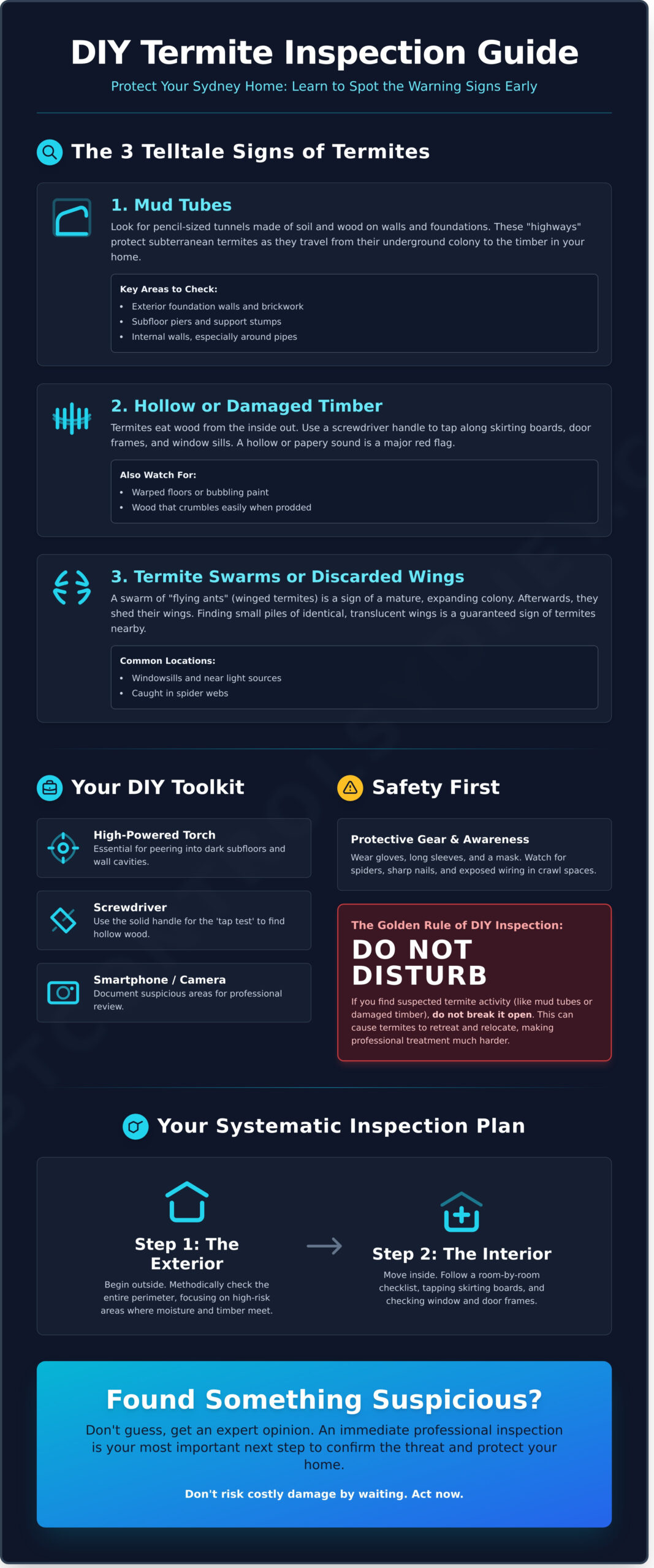
Here are the top three signs of termite activity that any homeowner can identify:
Sign 1: Mud Tubes on Walls and Foundations
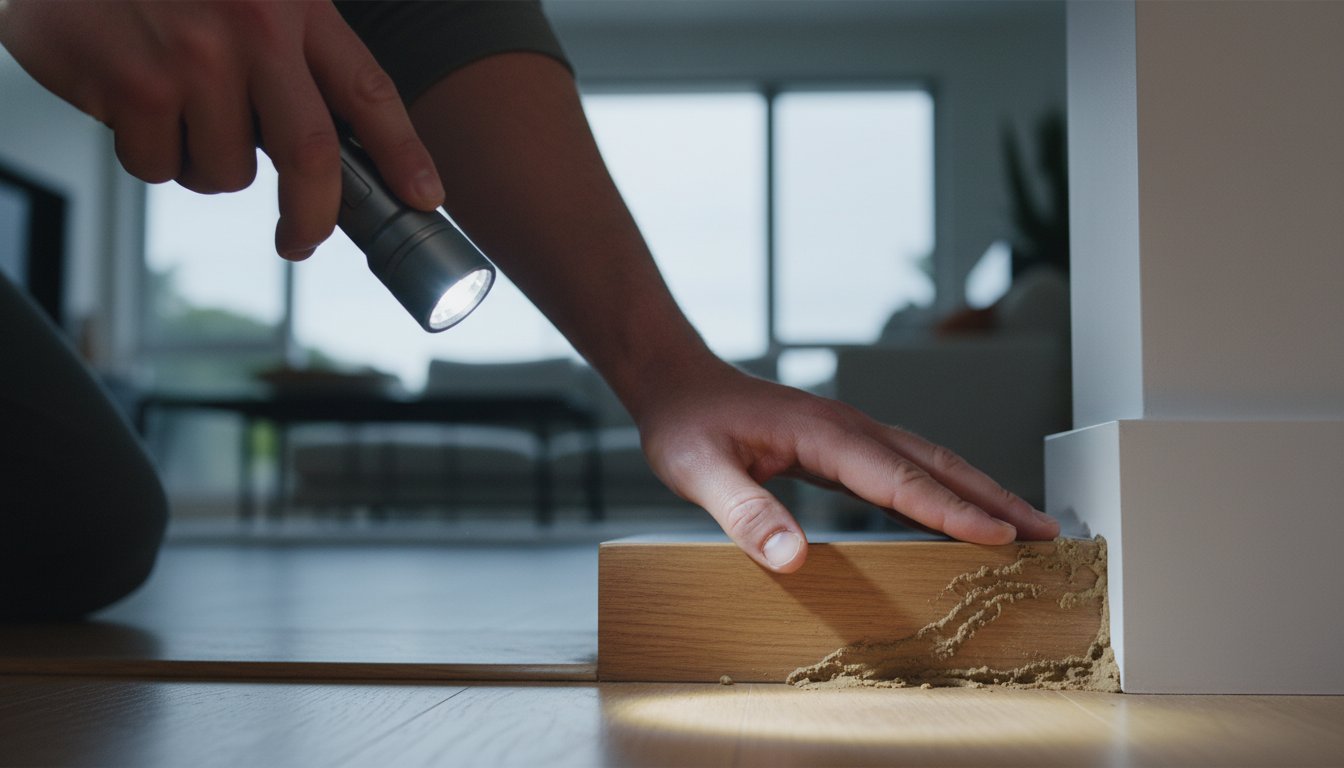
These pencil-sized, earthy tunnels are the clearest sign of a subterranean termite infestation. Termites build these “highways” from soil, wood, and saliva to protect themselves from dry air as they travel from their underground colony to the timber in your home. These tubes are a classic sign of subterranean termites, which must maintain contact with the soil. Highly destructive subterranean termite species common in Sydney are notorious for building these extensive networks to access food sources. Check for them in these key areas:
- Exterior foundation walls or brickwork
- Subfloor piers and support stumps
- Internal walls, especially around plumbing penetrations
Sign 2: Hollow-Sounding or Damaged Timber
Termites eat wood from the inside out, leaving a thin, paper-like veneer on the surface that can look completely normal. A simple ‘tapping test’ is an effective way to check. Use the handle of a screwdriver to firmly tap along skirting boards, door frames, and window sills. Solid timber will have a sharp, solid sound, while infested wood will sound hollow or papery. Also, look for warped floors or blistering paint, which can indicate termite damage and moisture underneath.
Sign 3: Termite Swarms or Discarded Wings
A termite swarm is a sign that a colony is mature and looking to expand. These winged termites, known as alates, are often mistaken for flying ants. They typically emerge on warm, humid days. While you might miss the swarm itself, you won’t miss the evidence they leave behind. After a brief flight, they shed their wings. Finding small piles of identical, translucent wings on windowsills, in spider webs, or near light sources is a guaranteed sign of a nearby termite colony.
Your DIY Termite Inspection Toolkit & Preparation
To effectively check for termites yourself, you need to think like a professional. The good news is, you don’t need expensive, high-tech gear for a preliminary inspection. A successful check comes down to thoroughness, safety, and a clear plan. Don’t rush this process; set aside at least an hour to do it right. Proper preparation is the first step toward protecting your home from silent destroyers.
Essential Tools You Already Own
Arming yourself for an inspection is simple. Most of what you need is likely already in your garage or home. Gather these basic items before you start:
- A high-powered torch: A bright, focused beam is essential for peering into dark subfloors, roof voids, and wall cavities. Your phone’s light won’t be strong enough.
- A screwdriver: Choose one with a solid, plastic handle. You’ll use it to tap on timber frames and skirting boards, listening for a hollow sound that could indicate termite damage.
- A camera or smartphone: Document anything that looks suspicious. Clear photos of potential damage, mud tubes, or insects will be invaluable if you need to consult a professional later.
Safety First: What to Wear and Be Cautious Of
Your safety is the number one priority. Crawl spaces and attics can contain hidden hazards, so it’s vital to protect yourself. Before entering any confined space, ensure you are wearing the right gear and are aware of your surroundings.
- Wear protective gloves, long sleeves, sturdy closed-toe shoes, and a dust mask.
- Watch out for spiders, sharp nails, fallen debris, and exposed electrical wiring.
- Important: If you find what you suspect is termite activity, do not disturb it. Breaking open mud tubes or damaged timber can cause the termites to retreat and relocate, making a professional treatment more difficult.
Creating Your Inspection Plan
A methodical approach ensures you don’t miss anything. The key to learning how to check for termites yourself is to be systematic, not random. Start by sketching a simple map of your property, including the house, garage, and any garden sheds. As you inspect, you can mark areas of concern on your map. For more detailed strategies, expert resources like the University of Kentucky’s guide to termite control offer valuable insights into termite behaviour and inspection points.
Begin your inspection on the outside of your property and work your way in. Focus first on high-risk areas where moisture and timber meet, such as garden beds against the house, leaking taps, support stumps, and plumbing penetrations.
A Step-by-Step Guide to Inspecting Your Home’s Exterior
Your home’s exterior is the frontline in the battle against termites. Because subterranean termites almost always invade from the soil, this inspection is the most critical part of learning how to check for termites yourself. A thorough exterior check helps you find their entry points before they cause serious structural damage. Pay close attention to any area where timber structures are close to or in direct contact with the ground.
Checking the Foundation and Subfloor
Start at your front door and conduct a systematic walk around the entire perimeter of your home. Keep your eyes focused on the foundation slab or piers, looking for thin, branching lines of dried mud. These are termite mud tubes, which they build for safe passage from the soil into your home’s framework. This methodical approach is a cornerstone of any effective inspection, as detailed in professional resources like the University of Florida’s guide to termite inspections. Also, be sure to inspect subfloor ventilation grilles and weep holes for any mud packing or damage.
Inspecting Decks, Fences, and Outbuildings
Termites don’t stop at your house walls. Any timber structure on your property is a potential target. Carefully examine timber posts supporting decks, stairs, and pergolas, especially where they meet the ground. Use your screwdriver to firmly probe the base of fence posts and timber retaining walls. If the wood feels spongy, soft, or crumbles easily, it’s a major red flag for termite activity. Don’t forget to give sheds, cubby houses, and even stacks of firewood the same level of attention.
Identifying Moisture Hotspots
Termites need moisture to survive, and they are actively drawn to damp environments. A crucial part of how to check for termites yourself is finding and fixing these high-risk areas. A quick scan of your property can reveal problems that make your home a prime target. Look for:
- Leaking outdoor taps, hoses, or irrigation systems.
- Broken or clogged downpipes and gutters that cause water to pool.
- Poor drainage creating persistently damp soil against the foundation.
- Areas around air conditioning units that are constantly wet.
Eliminating these moisture sources is a simple but powerful step in making your home less attractive to destructive termites. Don’t wait until it’s too late.
Your Room-by-Room Interior Termite Checklist
Now that you’ve checked the exterior, it’s time to bring your inspection inside. Termite damage often starts from within, hidden behind walls and under floors. Move slowly and methodically through each room. This part of learning how to check for termites yourself requires you to use your eyes, ears, and even your sense of touch. Arm yourself with a torch and a screwdriver with a solid handle for tapping timber.
Walls, Skirting Boards, and Architraves
Your walls and timber trims are a primary target for termites. Pay close attention to these surfaces, as the signs can be subtle. Don’t rush this step; check every wall, especially those adjoining wet areas or the exterior of your home.
- Tap and Listen: Gently but firmly tap along all skirting boards, architraves, and timber wall panels. Listen for a hollow, papery, or empty sound, which can indicate that termites have eaten the timber from the inside out.
- Look for Paint Damage: Check for any rippled, bubbling, or peeling paint. This is often caused by the moisture termites bring into the walls, which damages the paint from behind.
- Inspect the Plasterboard: Look closely for tiny, unexplained pinholes in the plaster. You might also see faint dirt or mud-like marks appearing on the wall, which is a sure sign of termite activity.
Window and Door Frames
Timber window sills and door frames are highly vulnerable, as they are often entry points from the outside. The damage here can compromise the security and function of your home.
- Press for Softness: Use your thumb or the screwdriver handle to press firmly on wooden window sills and door jambs. If the wood feels soft, spongy, or crumbles easily, it’s a major red flag.
- Check for Tightness: Have your doors or windows become tight and difficult to open or close recently? Termite damage and moisture can cause timber to warp and swell.
- Examine the Corners: Inspect the corners where frames meet the wall. Look for any new cracks or evidence of mud tubes being built in these tight spaces.
Kitchens and Bathrooms: High-Risk Wet Areas
Termites need moisture to survive, making your kitchen and bathrooms prime targets. A small leak you haven’t noticed can be an open invitation for a termite colony. This is a critical part of how to check for termites yourself.
- Inspect Under Sinks: Carefully check all plumbing penetrations and the cabinetry under your kitchen and bathroom sinks. Look for water stains, damaged wood, or mud trails.
- Check Around Toilets and Showers: Inspect the area behind the toilet and around the base of your shower or bathtub. Check for any damaged skirting boards or soft floor coverings.
- Find the Source of Leaks: Any sign of a water leak-past or present-should be inspected closely for associated termite damage. Fix leaks immediately to make your home less attractive to pests.
If your DIY inspection uncovers any of these warning signs, it’s crucial to act fast. What you can see is often just the tip of the iceberg. Don’t wait for the damage to get worse. For a professional, expert assessment, contact the team at ABC Pest Control Sydney today.
Found Something? Why a Professional Inspection is Your Next Step
First, take a breath. Finding potential signs of termites doesn’t mean your home is about to collapse. It means your proactive check has worked. You’ve identified a serious risk early, and now you can take decisive action. A DIY inspection is an excellent first-alert system, but it’s not the final word. To protect your property, the next step is to call in a professional for a definitive assessment.
While knowing how to check for termites yourself is a crucial skill, it’s important to understand the difference between a visual spot-check and a comprehensive, expert inspection.
The Limitations of a Visual DIY Check
A DIY inspection is limited to what you can see and reach. Termites are masters of concealment, operating deep within the structure of your home. A professional technician overcomes these limitations because they know exactly where and how to look.
- Hidden Activity: You can’t see inside your walls, under concrete slabs, or within structural roof timbers where termites cause the most damage.
- Expert Identification: It’s easy to mistake termite damage for wood rot or water damage. Furthermore, a professional can identify the specific termite species, which is critical as different species require different treatment methods.
- Incomplete Picture: You might find one area of concern, but a professional can determine the full extent of the infestation and identify all entry points.
Professional Tools: Seeing What the Naked Eye Can’t
At ABC Pest Control, our highly trained technicians don’t just rely on a sharp eye. We use specialised, non-invasive technology to get a complete picture of what’s happening inside your home’s structure.
- Thermal Imaging Cameras: These devices detect the heat signatures generated by large, active termite colonies hidden within walls and floors.
- Moisture Meters: We use these to find areas of high moisture in timber-the perfect environment for termites to thrive.
- Borescopes: A tiny, flexible camera that allows us to look directly inside wall cavities with minimal disruption to find live activity.
What to Expect from an ABC Pest Control Inspection
When you call our expert team, you get more than just a quick look-around. You get a guaranteed, thorough assessment that gives you total peace of mind. Our inspection process is designed to be clear, comprehensive, and professional.
- A complete top-to-bottom inspection of your property, including the interior, exterior, roof void, and subfloor areas.
- A detailed report documenting our findings with clear photos, analysis, and expert recommendations.
- A transparent, no-obligation quote for any necessary treatments, fully explained by our technician.
Your effort in learning how to check for termites yourself has brought you this far. Let our experts take it from here.
Don’t guess. Get certainty with a professional inspection.
Protect Your Home: Turn Your DIY Findings into Action
Knowing how to check for termites yourself is a powerful first step in safeguarding your biggest investment. By regularly inspecting for the key signs we’ve covered, from mud tubes to hollow-sounding wood, you can catch potential problems early. However, what you can see on the surface is often just a fraction of the issue. Termites are masters of concealment, and the true extent of an infestation requires expert evaluation.
If your inspection has uncovered anything suspicious, or if you simply want complete peace of mind, don’t wait for the damage to get worse. The professional team at ABC Pest Control is your trusted partner in termite management. With over 20 years of experience protecting Sydney homes, our fully licensed and insured technicians use the latest technology like thermal imaging to find what you can’t see.
Found signs of termites? Don’t wait. Book your professional inspection online in under 60 seconds!
You’re in expert hands. Take the decisive step to secure your home’s future today.
Frequently Asked Questions
What is the difference between flying ants and termite swarmers?
It’s easy to confuse them, but the differences are clear. Termite swarmers have a broad, straight waist, straight antennae, and two pairs of wings that are equal in length. In contrast, flying ants have a distinctly pinched waist, bent antennae, and a front pair of wings that are much longer than the back pair. Misidentifying them can be a costly mistake, so if you’re unsure, it’s best to get an expert opinion immediately.
How often should I check my home for termites myself?
We recommend a thorough visual check every six months, especially during warmer, wetter seasons when termites are most active. Learning how to check for termites yourself is a proactive step in protecting your property. However, this should not replace a comprehensive annual inspection by a licensed professional. Our experts use specialised equipment like thermal imaging to detect activity that is invisible to the naked eye, ensuring your complete peace of mind.
Can termites eat through concrete to get into my house?
No, termites cannot eat through solid concrete. However, they are relentless and only need a tiny crack-as small as 1.5mm-to get inside. They expertly exploit gaps in your foundation slab, expansion joints, and spaces around plumbing pipes to gain concealed entry into your home’s timber framework. This is why a professional assessment of your foundation and subfloor is a critical part of any effective termite management plan.
Does finding a few termites mean my entire house is infested?
Finding even a few termites is a serious red flag that requires immediate action. While it may not mean your entire house is infested yet, it confirms an active colony is nearby and is likely targeting your property. These scout termites are searching for food sources for their colony, which can contain millions of individuals. Don’t wait for visible damage; treat any sighting as an urgent warning and call for a professional inspection.
Is it a good idea to use a DIY termite spray if I find them?
We strongly advise against using DIY termite sprays. These products typically only kill the few termites you can see and fail to eliminate the hidden nest. This can cause the colony to move to a different, undetected area of your home, making the problem much worse. Effective termite control requires professional-grade termiticides and strategic application by a trained specialist to guarantee the entire colony is eradicated for good.
What are the most common types of termites in Sydney?
Sydney is a high-risk area for several destructive termite species. The most common and aggressive is the subterranean termite, Coptotermes acinaciformis, responsible for the majority of damage to homes. Another prevalent species is Schedorhinotermes intermedius, which is also highly destructive. Both types build large, hidden colonies and can cause extensive structural damage in a short amount of time, making professional protection essential for Sydney homeowners.