

It’s a moment every Sydney homeowner knows well: a large, long-legged spider appears seemingly out of nowhere on your living room wall. Your heart races as questions fly through your mind-is it dangerous? Are my children and pets safe? How do I get it out? More often than not, this startling visitor is the common huntsman spider. While their size can be genuinely alarming, reacting with panic isn’t the solution. Before you do anything, it’s vital to understand what you’re dealing with to ensure your family’s safety and your own peace of mind.
Rest assured, this guide is here to help. We are local Sydney experts, and we’ve designed this resource to give you back control. You will learn exactly how to identify a huntsman spider, understand its real threat level, and follow a simple, safe, and effective method for removing it from your home. We’ll also provide professional advice on how to prevent more spiders from entering in the future. Read on to handle any huntsman encounter with confidence and keep your home protected.
First, Is It Really a Huntsman Spider? A Simple Identification Guide
That heart-stopping moment when a large, fast-moving spider appears on your wall is a common experience for Sydney homeowners. Your first question is likely, “What is that?” Before you panic, it’s crucial to identify if you are dealing with a huntsman spider, as they are often misunderstood. Correct identification is the first step toward securing your peace of mind.
Key Physical Features to Look For
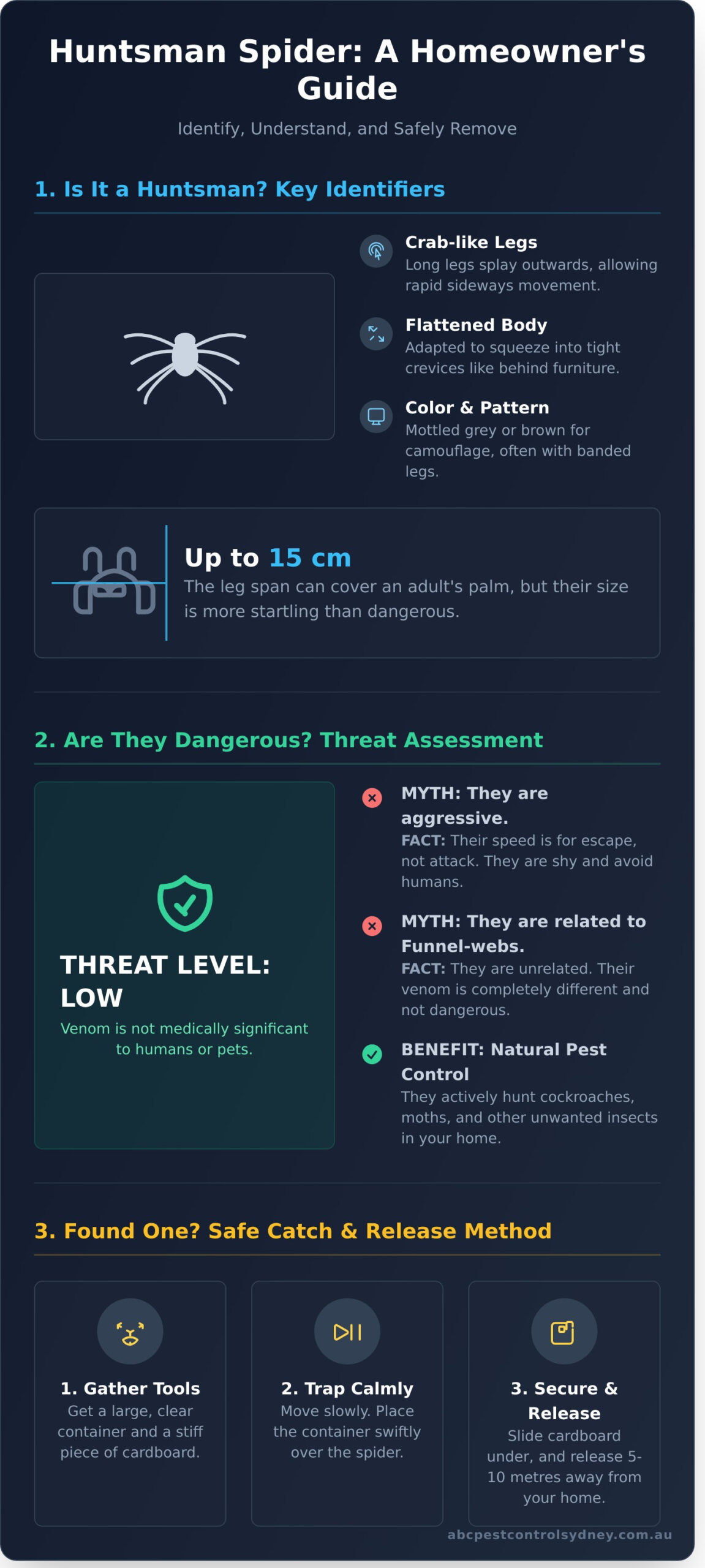
From a safe distance, you can look for several distinct features. Belonging to the Sparassidae family, Huntsman spiders have a unique build that sets them apart from other common spiders in Sydney. Here’s what to look for:
- Flattened Body Shape: Their bodies are noticeably flat, an adaptation that allows them to squeeze into tight crevices under bark, in wall gaps, or behind furniture.
- Crab-Like Legs: This is a key identifier. Their legs are long and splay outwards from their body in a crab-like fashion (a stance known as laterigrade). This allows them to move forwards, backwards, and sideways with incredible speed.
- Colour and Pattern: Most are a mottled grey or brown, providing excellent camouflage. You may also notice dark, banded patterns on their legs.
- Eye Arrangement: While you don’t want to get too close, they have two rows of four forward-facing eyes.
Size and Leg Span: Just How Big Do They Get?
The most intimidating feature of a huntsman is its sheer size. With a leg span that can reach up to 15 cm in larger species, they can easily cover the palm of an adult’s hand. Females are typically larger and heavier-bodied than males. While their size is alarming, it’s important to remember that this appearance is far more threatening than their actual nature. Their large size makes them look scary, but they are not considered dangerous to humans.
Common Huntsman Lookalikes in Sydney
It’s easy to mistake other large spiders for a huntsman, but knowing the difference is vital for assessing any potential risk.
Wolf spiders, for instance, are also large and brown but have a bulkier, less flattened body and hold their legs differently. Large Black House Spiders are often found in messy, funnel-shaped webs around windows and eaves, whereas a huntsman is a nomadic hunter and does not build webs to catch prey. Correctly identifying the spider in your home is the first step toward implementing a safe and effective solution.
Are Huntsman Spiders Dangerous? The Truth About Their Bite and Behaviour
The sudden appearance of a large, fast-moving spider on your wall is enough to startle anyone. The primary concern for most Sydney homeowners is simple: is this huntsman spider dangerous? Rest assured, while their size is intimidating, huntsman spiders are not considered a threat to humans or pets. Their reputation is far more fearsome than their reality. Let’s separate fact from fiction to give you peace of mind.
The Huntsman Spider Bite Explained
First and foremost, huntsman spiders are extremely reluctant to bite. A bite is a last resort, typically only happening when they are provoked, feel trapped against your skin, or are defending their egg sacs. In the unlikely event of a bite, the effects are generally minor and not medically significant. You can expect temporary, localised pain, mild swelling, and perhaps some itchiness, but the venom is not dangerous to humans.
Debunking Common Myths and Fears
Much of the fear surrounding these spiders comes from common myths. It’s important to understand their true behaviour to reduce anxiety:
- Myth: They are aggressive and chase people. This is false. A huntsman’s incredible speed is purely a defensive tool used for escape, not attack. If one runs towards you, it’s likely disoriented and seeking the nearest dark place to hide.
- Myth: They are related to funnel-webs. Huntsman spiders are not related to highly venomous spiders like the Sydney funnel-web. Their venom composition is completely different and poses no serious risk.
- Myth: Huntsman spiders can ‘scream’. Spiders lack the vocal cords to scream. The occasional hissing sound you might hear is a defensive warning when they feel threatened.
Understanding Their Shy and Beneficial Nature
Far from being a menace, a huntsman spider can be a helpful, albeit eight-legged, houseguest. They are natural pest controllers, actively hunting cockroaches, moths, and other insects you don’t want in your home. As detailed in the Australian Museum’s guide to huntsman spiders, they prefer to stay hidden in quiet, dark places and do their best to avoid human interaction. While their presence can be unsettling, they are a sign of a healthy ecosystem, even within your home.
Found a Huntsman? Safe & Simple Steps for DIY Removal
Spotting a large huntsman spider on your wall can be alarming, but there’s no need to panic. These spiders are generally timid and not considered dangerous to humans. The most effective and humane approach is a simple catch-and-release, which protects both you and this beneficial creature. Here’s our professional, step-by-step guide to safely relocating your eight-legged guest.
The ‘Catch and Release’ Method: Step-by-Step
This method is the gold standard for safe, humane removal. It requires a little courage but ensures no mess and no harm. Stay calm and follow these simple steps:
- Gather Your Tools: Find a large, clear container (like a takeaway container or a large jar) and a stiff piece of paper or thin cardboard that is larger than the container’s opening.
- Approach Slowly: Move towards the spider calmly and without sudden movements to avoid startling it. Huntsman spiders are incredibly fast when scared.
- Trap the Spider: Swiftly and confidently, place the container over the spider, trapping it against the wall or floor.
- Secure and Release: Carefully slide the cardboard under the container’s opening, ensuring there are no gaps for legs to escape. Hold it firmly and carry the spider outside, at least 5-10 metres away from your home, before letting it go.
What NOT to Do When Removing a Huntsman
In a moment of fear, it’s easy to react poorly. However, some common methods are ineffective, cruel, or create more problems. To ensure a clean and safe removal, avoid the following:
- Don’t Use a Vacuum Cleaner: This is a cruel way to kill the spider and it may not even be effective.
- Don’t Use Chemical Sprays: Spraying insecticides indoors can expose your family and pets to unnecessary chemicals. Plus, a dying spider can move erratically.
- Don’t Swat or Squash It: This is an unnecessarily messy and inhumane option that can leave a significant stain on your wall or furniture.
- Don’t Handle It: Never attempt to pick up a huntsman spider with your bare hands. While a bite is rare and not medically significant, it can be painful.
Feeling Uneasy? When to Leave It to the Pros
We understand completely. For many people, especially those with arachnophobia, dealing with a spider this large is simply not an option. Your feelings are valid, and your peace of mind is the top priority. If the thought of getting close to the spider is causing you distress, don’t force it. A professional can provide a fast, safe, and stress-free solution. If DIY isn’t for you, our team can handle it safely.
How to Keep Huntsman Spiders Out of Your House for Good
While our team can safely remove an unwanted guest, the best long-term solution is to stop them from getting inside. Shifting from reaction to prevention is the key to maintaining a spider-free home. These proactive, professional strategies will help you secure your property and give your family lasting peace of mind.
Seal Cracks and Gaps Around Your Home
A huntsman spider can squeeze through surprisingly small openings. The most effective way to keep them out is to make it physically impossible for them to enter. Conduct a thorough inspection of your home’s exterior and seal any potential entry points. This process, often called ‘pest-proofing’ or exclusion, is a cornerstone of professional pest management.
- Windows & Doors: Check for worn-out seals and install new weather stripping to close any gaps.
- Utility Lines: Use caulk or expanding foam to seal spaces where pipes, wires, and cables enter your home.
- Fly Screens: Immediately repair any rips or holes in your window and door screens.
- Weep Holes: These small gaps in brickwork are essential for ventilation but are an open invitation for pests. Cover them with dedicated, fine stainless steel mesh covers.
Manage Outdoor Lighting and Clutter
Your goal is to make the area immediately surrounding your home less attractive to spiders and their prey. Huntsman spiders are drawn to areas with an abundant food source, which often means other insects. By controlling the insect population near your house, you make it a less appealing hunting ground.
Start by switching your outdoor lights to yellow-toned or sodium vapour bulbs, which are far less attractive to moths and other flying insects. Additionally, clear away any clutter that could provide shelter. This includes woodpiles, garden debris, and unused pots. Trim back any trees or shrubs that are touching the walls or roof of your house, as these act as a direct bridge for pests.
Natural Deterrents: Do They Really Work?
You may have seen DIY tips online suggesting peppermint oil, eucalyptus, or vinegar as natural spider repellents. While these strong-smelling substances may have a minor, temporary effect, there is little scientific evidence to support their long-term effectiveness. They evaporate quickly and are not a guaranteed method for keeping determined pests out. For reliable, lasting results, physical exclusion and professional barrier treatments are always the most effective strategy.
For a comprehensive home assessment and guaranteed pest prevention solutions, contact the certified team at ABC Pest Control today.
When One Spider Becomes a Problem: Signs You Need Professional Help
Seeing a huntsman spider in your Sydney home can be startling, but usually, it’s just a solitary visitor passing through. However, there are times when one spider is a sign of a much larger issue. Knowing how to tell the difference between a random guest and a potential infestation is key to keeping your home safe and your family comfortable. Making the call for professional help isn’t an overreaction-it’s a smart decision for your peace of mind.
Signs of a Spider Infestation
While a single huntsman spider isn’t cause for alarm, several signs indicate a more persistent problem. Don’t wait for the issue to escalate. Look for these clear indicators:
- Frequent Sightings: Spotting multiple large spiders over a short period suggests they are living and breeding on your property.
- Egg Sacs: Finding a large, white, papery egg sac tucked away behind furniture, in wall crevices, or under eaves is a definite sign a female has settled in.
- An Increase in Other Pests: Spiders go where the food is. If you’ve noticed more cockroaches, crickets, or other insects, spiders will soon follow.
- Spiderlings: Discovering a cluster of tiny spiders is proof that an egg sac has recently hatched, releasing dozens of new spiders into your home.
Why Professional Treatment is More Effective
Store-bought sprays offer a temporary fix, but they rarely solve the root cause of an infestation. A professional approach from a trusted pest control team is designed for lasting results and complete safety. Here’s why it’s the superior choice:
- Targeted Solutions: Our experts identify the source of the problem, from entry points to nesting sites, ensuring we treat the cause, not just the symptoms.
- Family & Pet-Safe Products: We use advanced, eco-friendly treatments that are highly effective against pests but safe for your loved ones.
- Protective Barrier: We apply a comprehensive treatment around your home’s perimeter, creating a barrier that stops spiders from getting inside in the first place.
- Guaranteed Peace of Mind: Our services come with a satisfaction guarantee, so you can rest assured your home is protected long-term.
What to Expect from an ABC Pest Control Visit
When you call ABC Pest Control, you’re choosing a reliable, local Sydney team dedicated to your safety. Our process is simple and effective. A certified technician will conduct a thorough inspection to identify the species and locate any nests or entry points. Based on these findings, we create a tailored treatment plan using safe, environmentally friendly solutions. Our experienced professionals work efficiently to eliminate the problem and provide you with expert advice to prevent future issues.
Don’t let spiders take over your home. Protect your home from spiders. Get a free quote today.
Regain Your Peace of Mind: Your Final Word on Huntsman Spiders
Encountering a large spider in your home can be unsettling, but now you’re equipped with the knowledge to handle the situation confidently. The key takeaways are simple: a single huntsman spider is generally more frightening than it is dangerous, and safe DIY removal combined with proactive prevention are your best first steps. However, recognising the signs of a recurring problem is crucial for maintaining long-term control over your environment.
For guaranteed protection and complete peace of mind, the expert team at ABC Pest Control is ready to help. As local Sydney experts with over 20 years of experience, we understand how to effectively eliminate spiders from your property. Our treatments are specifically designed to be safe for your family, pets, and the environment, and we stand by our professional work with a 100% satisfaction guarantee. Don’t let spiders take over your home. Book a safe and effective spider treatment with ABC Pest Control today.
Take the next step towards a secure and pest-free home you can feel comfortable in.
Frequently Asked Questions About Huntsman Spiders
Do huntsman spiders jump at you?
While a huntsman spider’s sudden, rapid movements can be alarming, they do not aggressively jump at people. They are known for their speed and may drop from a ceiling or wall when startled, which can look like a jump. This is a defensive escape tactic, not an attack. Rest assured, their primary instinct is to flee from threats, not confront them. If their unpredictable movements are a concern, a professional can safely remove them.
What attracts huntsman spiders into a house?
Huntsman spiders are drawn indoors searching for two main things: food and shelter. They prey on other common household pests like cockroaches, moths, and insects, so an underlying pest issue can attract them. They also seek shelter from the weather, entering through gaps under doors, open windows, or cracks in the foundation. Sealing entry points and managing other pests is key to keeping them out of your Sydney home and ensuring your peace of mind.
Can a huntsman spider kill a dog or a cat?
No, a huntsman spider cannot kill a dog or a cat. While their bite can be painful and cause temporary, localised swelling, their venom is not considered medically significant for pets or humans. A curious pet might get a defensive bite, but it poses no fatal risk. For complete peace of mind, our treatments are designed to be safe for your family and pets while effectively managing unwanted spiders and giving you one less thing to worry about.
Is it true that huntsman spiders scream?
This is a common urban myth. Spiders lack the vocal cords or lungs needed to scream. The sounds occasionally associated with a threatened huntsman are actually a hissing or defensive stridulation noise, created by rubbing parts of their legs or body together. While it might be startling, it’s not a scream. It’s a clear signal that the spider feels cornered and wants to be left alone, reinforcing its non-aggressive nature.
Do huntsman spiders lay eggs inside the house, and what do they look like?
Yes, a female huntsman may lay eggs inside your home if she finds a suitable, sheltered location. The egg sac is a distinctive flat, oval-shaped disc made of thick white silk, often looking like a small, papery parcel. You might find them tucked away behind curtains, furniture, or in wall crevices. The mother guards her sac fiercely, so discovering one indicates a potential future problem. It’s best to call a professional for safe and guaranteed removal.
Is it bad to have a huntsman in your room?
While a single huntsman is not dangerous and can even help by eating other pests, its presence in your room can be unsettling and cause significant anxiety. Their large size and incredible speed can be frightening, especially if they appear unexpectedly. Don’t let pests compromise your family’s comfort. If you’re not comfortable sharing your space, our local Sydney team can provide a fast, safe, and effective removal solution, guaranteed.