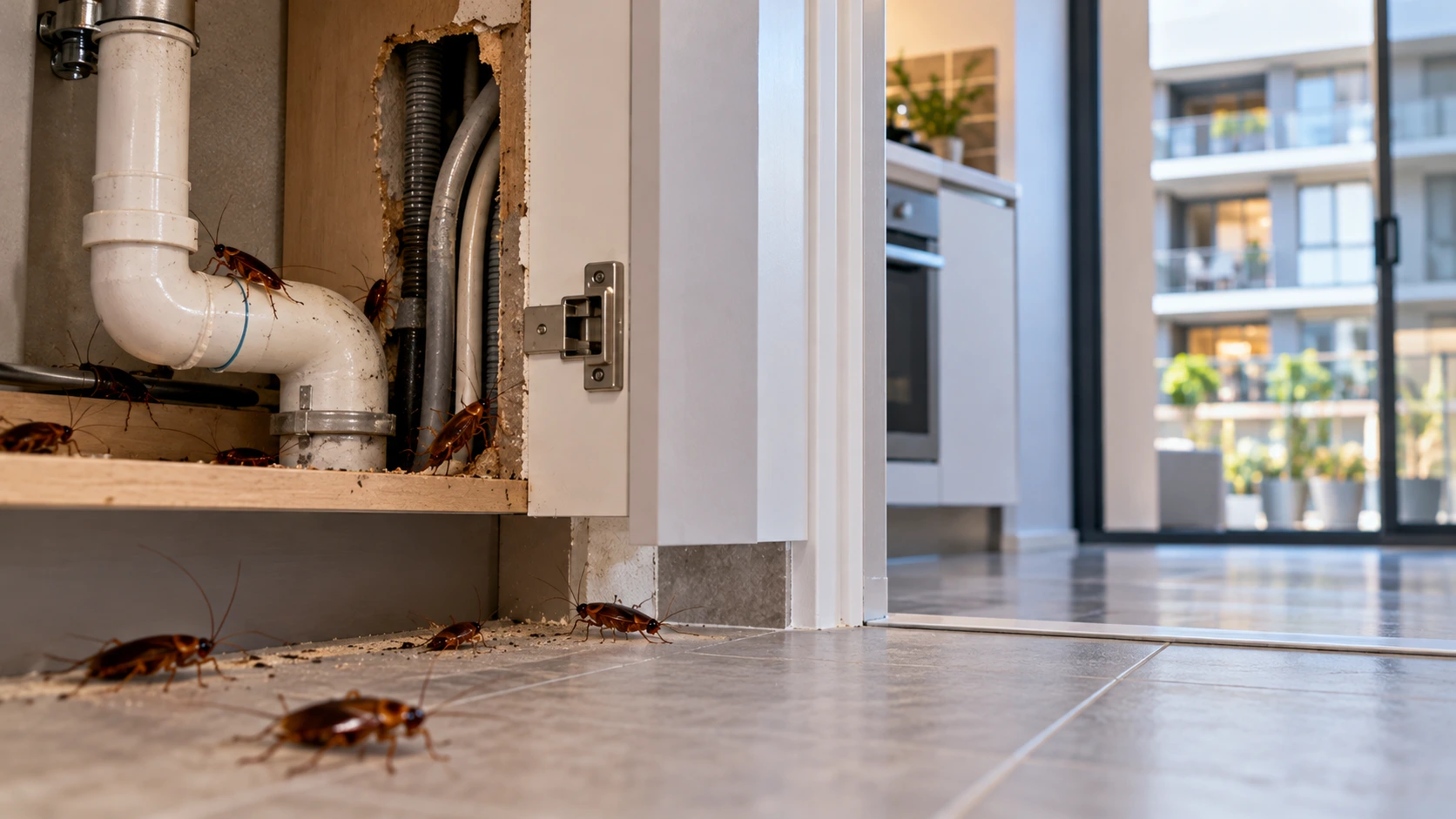
Treating your unit alone can reduce cockroach numbers, but it won’t resolve the infestation if the source is a neighbouring unit. German cockroaches re-enter through shared plumbing chases, electrical conduits, and pipe penetrations within days of treatment. A lasting result requires either coordinated multi-unit treatment or a barrier strategy that intercepts re-entry points inside your unit.
Key Takeaways
- Treating one unit in an active multi-unit building slows the problem but rarely stops it without addressing entry points or neighbouring units.
- German cockroaches breed entirely indoors and spread through shared building infrastructure, making them the primary culprit in Sydney apartment blocks.
- Coordinated treatment across multiple units in a single visit is more cost-effective than repeated single-unit treatments over time.
- Gel bait applied at pipe penetrations, wall voids, and electrical runs creates an active interception barrier even when neighbours haven’t treated.
- Strata managers and body corporates have a direct role to play: a building-wide pest management plan changes the outcome entirely.
Living in an apartment block and watching cockroaches reappear days after a treatment is one of the more demoralising experiences a Sydney renter or owner can have. You’ve done everything right. The pest controller came. The cockroaches didn’t get the memo.
Why Does the Cockroach Keep Coming Back After Treatment?
The cockroach you’re killing isn’t the problem. The colony feeding route behind your walls is.
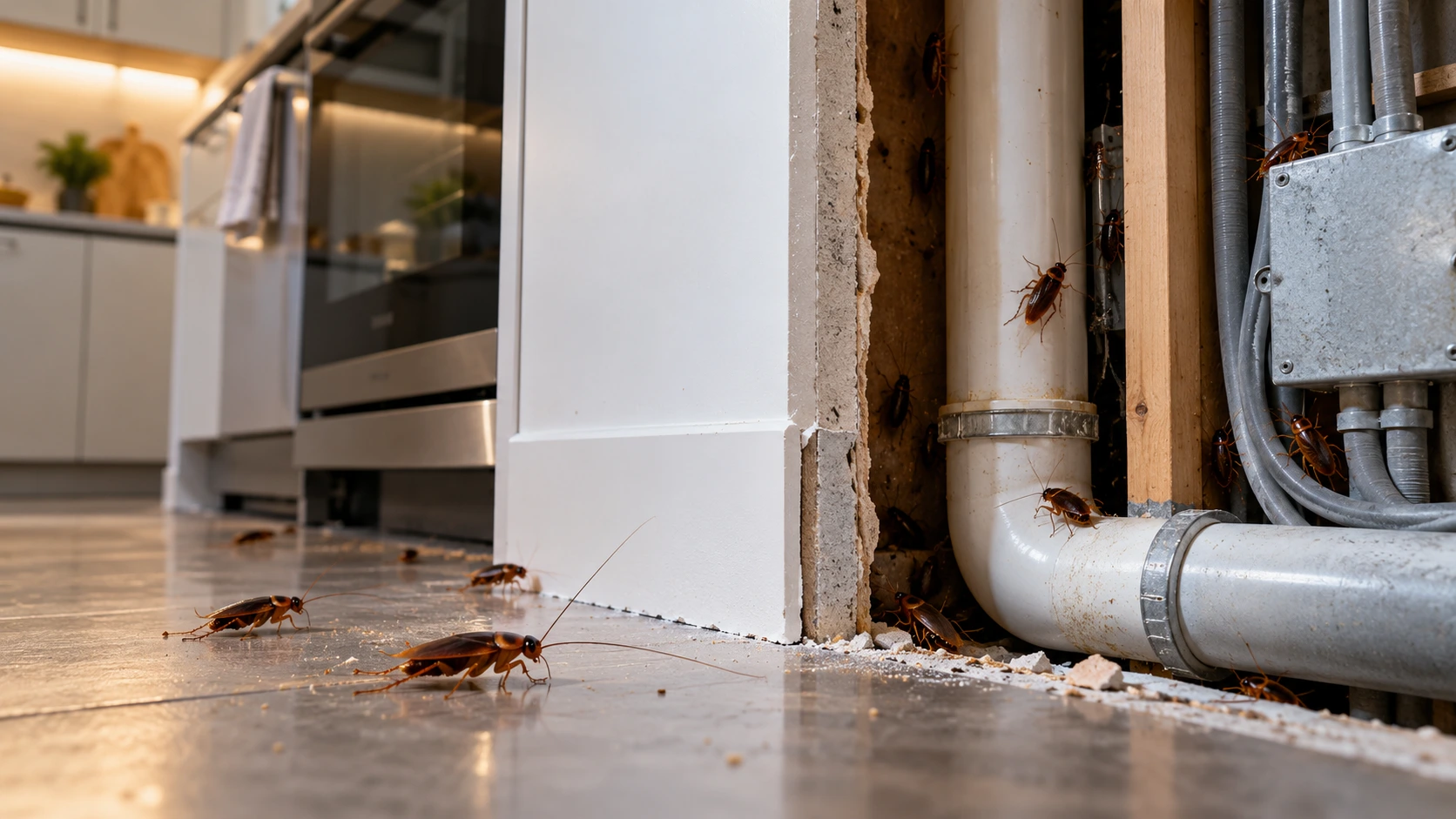
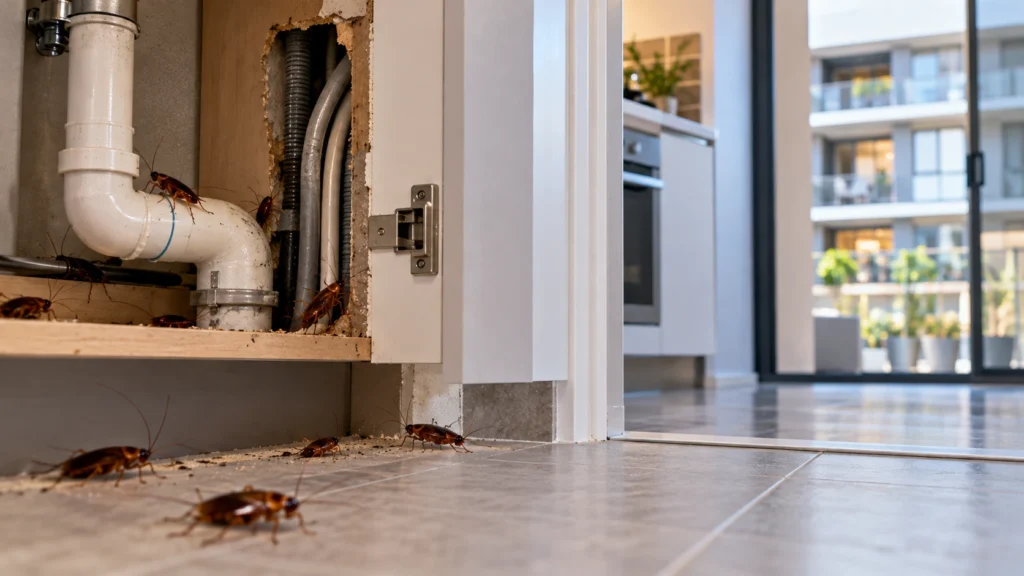
German cockroaches don’t live outside and wander in the way a spider or mouse might. They live inside, breed inside, and travel through a building’s internal infrastructure. Shared plumbing chases, electrical conduits, exhaust fan ducts, and the gaps around every pipe penetration in your kitchen and bathroom are open corridors connecting your unit to every other unit on that riser.
When a treatment kills the cockroaches present in your unit, the colony in the neighbouring unit simply expands back into the vacated space. The treatment didn’t fail. It just addressed the symptom, not the source.
The re-infestation isn’t bad luck. It’s predictable building biology.
This is why a single-unit treatment in a block with an active infestation typically produces temporary relief rather than resolution. The cockroaches return because the infrastructure connecting the units was never part of the treatment plan.
What Actually Changes the Outcome in a Multi-Unit Building?
Three conditions determine whether treating your unit alone can hold.
The infestation is genuinely isolated to your unit.
If the cockroaches arrived via a piece of furniture, a grocery delivery, or a one-off event, and there’s no evidence of activity in adjacent units, a thorough single-unit treatment can break the cycle. This is the exception, not the rule, in established Sydney apartment blocks.
Entry points are sealed as part of the treatment.
Gel bait placed directly at pipe penetrations, behind kickboards, inside electrical switch boxes, and along wall-floor junctions creates an active interception layer. Cockroaches travelling through from adjacent units encounter the bait before they establish in your space. This doesn’t eliminate the source, but it can hold the line while strata-level action is pursued.
Coordinated multi-unit treatment happens within the same visit or a short window.
This is the condition that actually resolves the problem. When multiple units in a building are treated at the same time, the cockroach population has nowhere to retreat. The breeding cycle breaks across the building rather than just in one unit.
ABC Pest Control Sydney services apartment blocks across the Sydney metropolitan area with this exact approach, treating multiple units in a single visit to maximise impact and reduce cost per unit. It’s one of the most efficient ways to manage German cockroach infestations in strata buildings, from Inner West apartment blocks to high-density towers in Parramatta and Blacktown.
If you’re managing a building or dealing with a recurring problem, reach out to ABC Pest Control Sydney to discuss a coordinated treatment plan for your block.
How Do You Diagnose Whether You Have a Neighbour Problem?
Before calling anyone, it’s worth working through three questions that clarify what kind of treatment plan you actually need.
When did the cockroaches first appear?
If they appeared shortly after a new tenant moved in nearby, after a unit was renovated, or after a long-vacant unit was re-occupied, the source is almost certainly external to your unit. Single-unit treatment won’t hold.
Where are you seeing them?
Cockroaches appearing near plumbing (under sinks, behind the toilet, inside the dishwasher cavity) or near electrical outlets and switchboards are travelling through shared infrastructure. Cockroaches appearing in pantries or near food sources are more likely to reflect an isolated infestation.
How quickly do they return after treatment?
Re-appearance within two to three weeks of a professional treatment is the clearest signal that the source is external. Re-appearance after several months suggests the original treatment worked and a new introduction has occurred.
Work through these questions before your next conversation with a pest controller or strata manager. They tell you which argument to make and what kind of treatment to request.
What Can You Do If Your Neighbours Won’t Treat?
This is the question most people ask next, and it’s a fair one. You can’t force a neighbour to treat their unit, but you can make your unit significantly less hospitable to cockroaches arriving from theirs.
The most effective single-unit strategy when neighbours are uncooperative is a combination of gel bait at all entry points and a residual spray along the internal perimeter. Gel bait works because cockroaches carry it back to the harbourage site, killing cockroaches your treatment never directly reached. It’s one of the few products that extends its effect beyond the treated area.
Sealing pipe penetrations with expanding foam or silicone is also genuinely effective. Many apartments in older Sydney buildings have gaps around pipe penetrations large enough to pass a pencil through. Closing those gaps removes the primary travel route and, in many cases, doesn’t require strata approval.
The honest limitation: if the neighbouring unit has a heavy, established infestation, even a well-executed single-unit treatment with sealed entry points will be under constant pressure. You’re managing the problem, not solving it. That distinction matters for setting realistic expectations.
For apartment residents across the Sydney metro area, the pest prevention strategies that work in standalone homes need to be adapted for shared-infrastructure buildings. The principles are the same; the entry points are different.
How Does the Treatment Approach Differ for German Cockroaches Specifically?
German cockroaches are not the same pest as the large American or Australian cockroaches you might see outside. They’re a different problem entirely.
German cockroaches breed exclusively indoors, produce multiple generations per year, and develop resistance to insecticides faster than almost any other pest species. A spray-only treatment for a German cockroach infestation is often the wrong tool. It disperses the population without killing the harbourage, which means cockroaches scatter into wall voids and re-emerge once the residual effect fades.
The mechanism that makes gel bait effective against German cockroaches is horizontal transfer. A cockroach that feeds on bait returns to the harbourage and contaminates other cockroaches through contact and faecal matter. This breaks the colony from the inside rather than just killing the individuals you can see.
ABC Pest Control Sydney’s treatments comply with Australian Pest Standards, and Warren Bailey, Operations Manager, has been featured in Yahoo News and the Daily Mail for his expertise in hard-to-treat infestations exactly like this. The approach for German cockroaches in apartment buildings is specifically calibrated around gel bait placement, harbourage identification, and entry point management, not surface spraying alone.
For a broader look at what drives repeat pest problems in Sydney apartments and homes, the facts about pest control page covers the underlying biology that most treatments miss.
Single-Unit Treatment vs. Coordinated Building Treatment: What You’re Actually Comparing
| Factor | Treating One Unit Only | Coordinated Multi-Unit Treatment with ABC Pest Control Sydney |
|---|---|---|
| Addresses the colony source | No, if source is in a neighbouring unit | Yes, eliminates the population across units |
| Cost over time | Higher: repeat treatments add up | Lower per unit when multiple units treated in one visit |
| Speed of resolution | Weeks to months, often recurring | Faster resolution through a single coordinated treatment cycle |
| Strata cooperation needed | No | Yes, or building manager coordination |
| Realistic outcome | Temporary reduction, ongoing management | Breaking the breeding cycle across the building |
Repeated single-unit treatments over several months cost more than a single coordinated visit across multiple units. The economics favour building-level action, not just the outcomes.
Who This Approach Matters Most For
If you’re a strata manager, property manager, or body corporate with multiple tenants reporting cockroach activity, a building-wide treatment plan isn’t optional. It’s the only approach that protects you from ongoing complaints and the compounding spread that follows.
For individual tenants dealing with an uncooperative neighbour or a strata committee that won’t act, the realistic path is maximising your unit’s defences while documenting the problem formally. Strata legislation in NSW gives body corporate obligations around pest management in common areas, and persistent documented complaints create a record that supports formal action.
ABC Pest Control Sydney covers the entire Sydney metropolitan area, from the Northern Beaches and Eastern Suburbs through to Western Sydney suburbs including Parramatta, Penrith, and Blacktown. The team works directly with strata managers and property managers to coordinate building-wide treatments efficiently.
For property managers dealing with recurring issues across multiple sites, the rodent control Sydney page and the main ABC Pest Control Sydney services page outline maintenance package options that make ongoing management predictable rather than reactive, including treatments up to three times per year.
If you’re ready to stop treating the symptom and address the actual source, you can book with ABC Pest Control Sydney in under 60 seconds. The longer a German cockroach infestation runs in a shared building, the more units it reaches and the harder it becomes to break.
Request a free quote and ask specifically about coordinated apartment block treatments.
Frequently Asked Questions
Will cockroaches just come back from my neighbour’s unit after I treat mine?
Yes, if the neighbouring unit has an active infestation and the entry points between units aren’t addressed. Treating your unit creates temporary relief, but cockroaches travelling through shared plumbing and electrical conduits will re-establish within weeks. The most effective counter is gel bait at entry points combined with physical sealing of pipe penetrations.
Can I ask my strata manager to organise a building-wide treatment?
You can, and in many cases you should. In NSW, body corporates have obligations to maintain common property in a condition that doesn’t contribute to pest problems. Persistent documented complaints from multiple tenants build a stronger case for building-wide action. A written assessment from a licensed pest controller that outlines the infestation’s scope is useful evidence for that conversation.
Is gel bait safe to use in a kitchen with children and pets?
Gel bait products used by licensed pest controllers are formulated at concentrations that are effective against cockroaches but present minimal risk to humans and pets when applied correctly. The bait is placed in small amounts at harbourage sites and entry points rather than across open surfaces. All products used by ABC Pest Control Sydney comply with Australian Pest Standards.
How do I know if the cockroaches in my apartment are German cockroaches?
German cockroaches are small (roughly 1.5cm), light brown with two dark parallel stripes running from behind the head toward the abdomen, and they’re almost always found indoors near kitchens and bathrooms. If you’re seeing large, dark cockroaches near drains or outdoors, those are a different species with a different treatment approach. German cockroaches in apartment buildings are the species most associated with multi-unit spread through shared infrastructure.
How many treatments will I need before the problem is resolved?
For an isolated infestation in a single unit with no external source, one thorough treatment followed by a follow-up inspection is often sufficient. If the source is a neighbouring unit or the building has a widespread infestation, the number of treatments depends on whether coordinated building-level action is taken. Treating one unit repeatedly without addressing the source is an ongoing cost, not a solution.
Does treating common areas like the bin room or laundry help?
It helps, but it’s not sufficient on its own. Common areas can be a secondary harbourage site, particularly bin rooms and areas near food waste. Treating them reduces overall population pressure in the building, but the primary breeding sites for German cockroaches are inside individual units, particularly in kitchen and bathroom cavities. Common area treatment works best as part of a coordinated plan rather than as a substitute for unit-level treatment.
What should I do if my neighbour refuses to allow treatment of their unit?
Document the infestation formally in writing to your strata manager or body corporate, including dates, locations, and photos where possible. Focus your own treatment on sealing entry points and using gel bait at the boundary between units. If the strata committee won’t act, NSW Fair Trading handles disputes about strata obligations. A written assessment from a licensed pest controller strengthens any formal complaint significantly.
If you’re dealing with a recurring cockroach problem in a Sydney apartment and single-unit treatments haven’t held, the source is almost certainly in the building’s shared infrastructure. The answer isn’t more of the same treatment. It’s a different treatment plan.
Talk to the ABC Pest Control Sydney team about coordinated apartment block treatments across the Sydney metropolitan area.
About the Author
Warren Bailey is the Operations Manager at ABC Pest Control Sydney, with over 20 years of experience in residential and commercial pest management across the Sydney metropolitan area. He specialises in termite inspections, bed bug treatments, rodent control, cockroach extermination, and integrated pest management strategies, and has been featured in Yahoo News and the Daily Mail for his expertise in hard-to-treat pest infestations. ABC Pest Control Sydney services the entire Sydney metro area, from the Northern Beaches and Eastern Suburbs to Western Sydney suburbs including Parramatta, Penrith, and Blacktown.