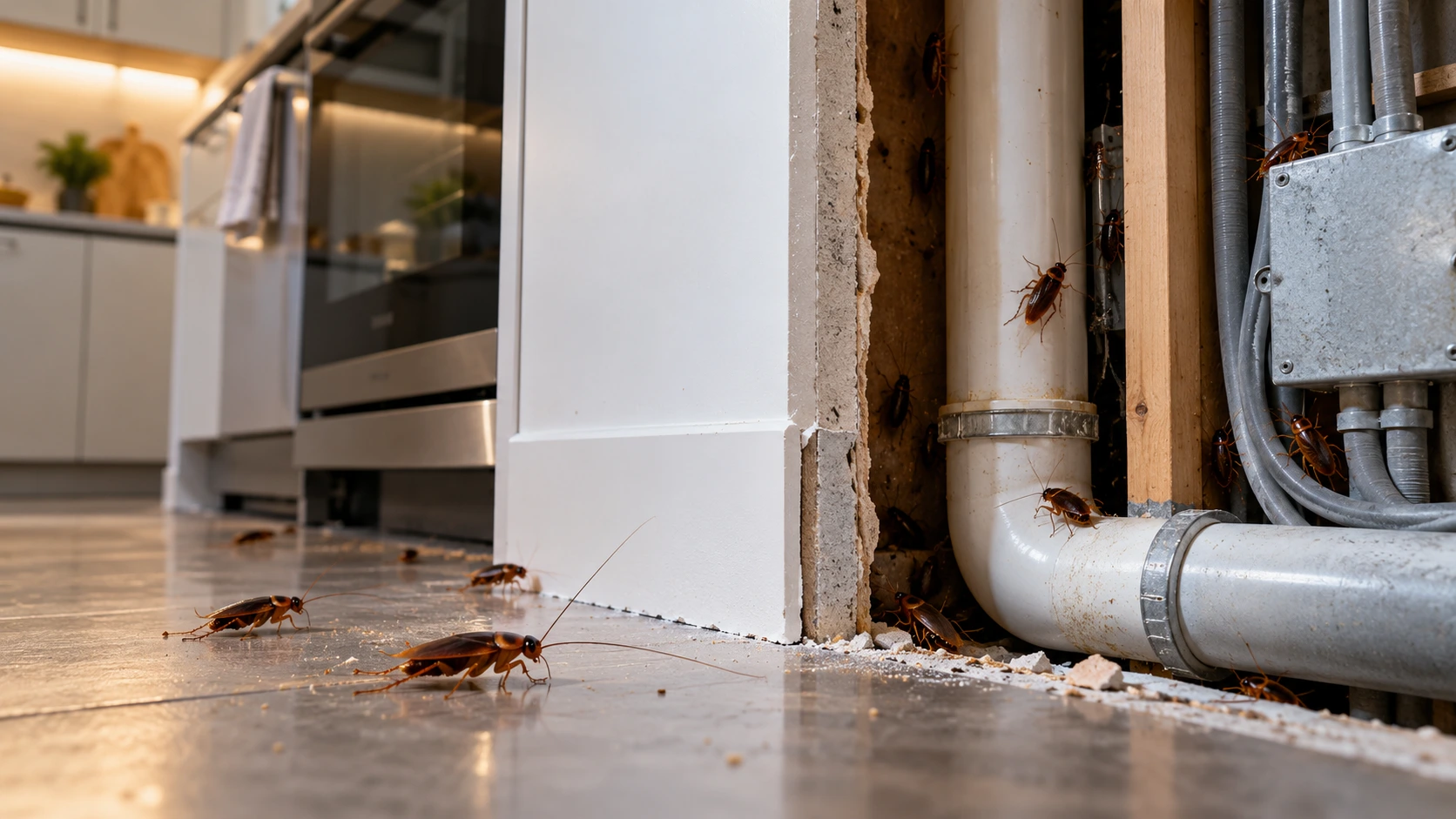
Treating your unit alone won’t resolve a cockroach infestation that’s living in shared building infrastructure. German cockroaches travel through pipe penetrations, wall cavities, and electrical conduits connecting your unit to the ones next door. Without addressing those shared spaces and the adjacent units feeding the problem, re-infestation is virtually certain.
Key Takeaways
- A single-unit treatment is a holding action, not a fix, when the breeding colony sits in shared building infrastructure
- German cockroaches are the primary apartment pest in Sydney because they live and breed inside walls rather than entering from outside
- Entry points such as pipe penetrations, power outlets, and exhaust vents must be treated and sealed, not just the visible surfaces
- Coordinated multi-unit treatment is significantly more effective than staggered individual treatments because it removes the population’s ability to relocate
- ABC Pest Control Sydney treats multiple units in a single visit across the entire Sydney metro area, covering up to 15 different pests with products that comply with Australian Pest Standards
Why Does the Same Apartment Keep Getting Cockroaches After Treatment?
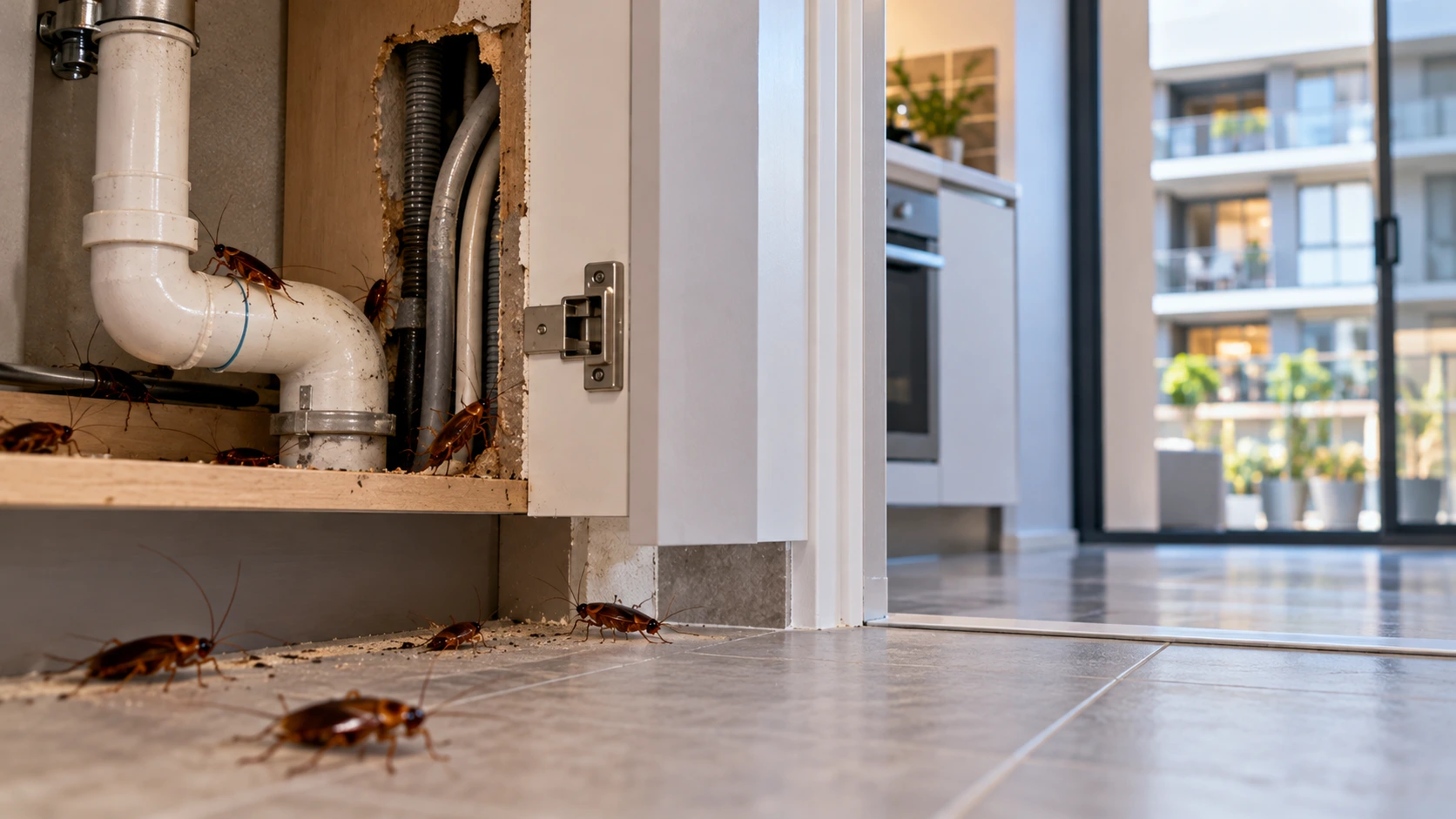
The cockroach you find in your kitchen didn’t originate there. It came through a two-millimetre gap around a water pipe, through the shared wall cavity behind your oven, or up through a drain connected to the same stack as several other units in your building.
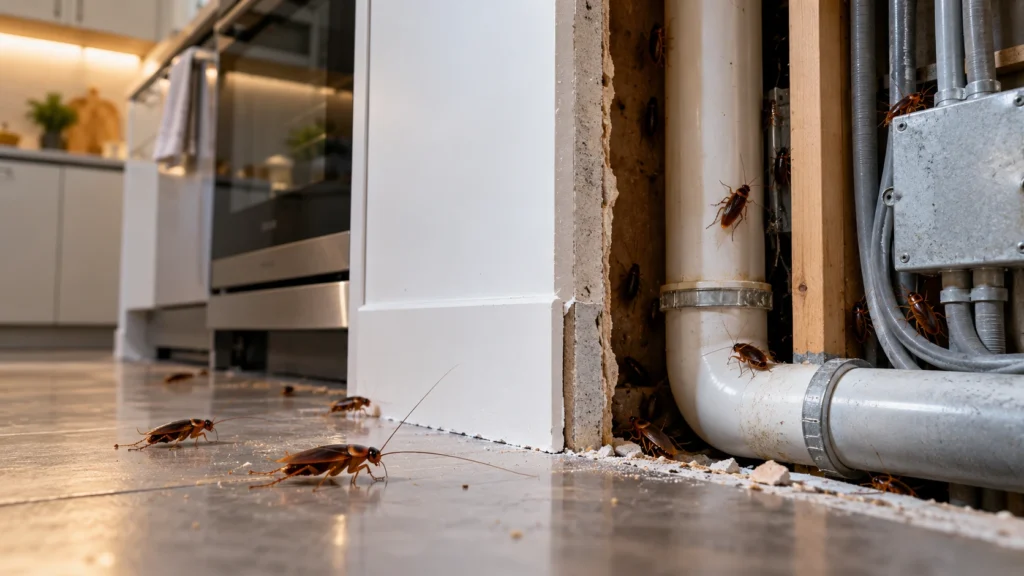
German cockroaches don’t wander in from the garden. They live and breed inside the building’s infrastructure: in wall voids, inside appliance motors, behind switchboards, and in the warm cavities around hot water pipes. A single female can produce hundreds of offspring in her lifetime, and she doesn’t need much space.
When you treat your unit, you’re eliminating the population you can access. But if the breeding colony is sitting inside the wall cavity of the unit next door, or in a shared laundry ceiling space, the survivors simply re-enter once the residual effect of the treatment fades. That’s not treatment failure. That’s treating the wrong part of the problem.
Understanding when a recurring infestation has crossed the threshold for professional intervention is the first decision that changes the outcome.
What Actually Changes When Multiple Units Are Treated Together?
Multi-unit treatment is a different category of intervention, not just a scaled-up version of single-unit treatment.
When ABC Pest Control Sydney treats multiple units in one visit, the approach targets the shared infrastructure that individual treatments can’t reach. Residual insecticide is applied at every entry point: pipe penetrations, power outlets, exhaust vents, shared wall junctions. Gel bait is placed inside the wall cavities where cockroaches actually nest rather than on the surfaces they occasionally cross.
The real advantage of treating multiple units simultaneously isn’t efficiency for its own sake. It’s that cockroaches can’t relocate to an untreated adjacent unit while the treatment is being applied. A single-unit treatment often pushes the population sideways rather than eliminating it. Coordinated treatment closes off that escape route by creating a barrier across the full affected zone.
Think of it this way: treating one unit in a row of connected apartments is like plugging one hole in a net. The fish simply move. Coordinated treatment pulls the entire net tight at once.
With over 20 years serving Sydney properties, Warren and the team carry everything needed to assess and treat multiple units in a single callout, minimising disruption to residents while targeting the infestation at its actual source.
The Entry Points Most Treatments Miss Entirely
Here’s what makes German cockroaches so persistent in apartment buildings: the spaces they travel through are almost never visible during a standard treatment.
A gap of two millimetres around a water pipe is enough for a German cockroach to pass through. The typical Sydney apartment has dozens of these gaps: where plumbing enters the kitchen cabinet base, where electrical conduit passes through the bathroom wall, where the exhaust fan connects to shared ducting, and where the hot water unit sits against a wall shared with a neighbour.
Spray applied to bench surfaces doesn’t reach inside those gaps. Gel bait placed only in the kitchen misses the void behind it where the colony is actually living.
Effective treatment at entry-point level requires a technician who knows where to look, not just what product to use. That means inspecting inside cabinet kick-boards, behind switchboards, around the hot water unit, and at every pipe penetration in the bathroom and laundry. It means applying residual product inside those gaps and sealing them afterward.
The seal is the step that separates a result that holds from one that lasts three weeks.
For a broader view of how pest prevention across a Sydney property reduces the need for reactive treatments over time, the principle is the same: block the routes, not just the current population.
When to Treat Your Unit Alone vs. When to Escalate
Not every apartment cockroach problem requires coordinated building treatment. Here’s a practical framework for deciding which situation you’re actually in.
Treating your unit alone is appropriate when:
- The infestation is genuinely isolated with no reports from neighbours
- Entry points have been identified, treated, and physically sealed during the treatment
- The cockroach species confirmed is Australian or American cockroach, which typically enters from outside rather than breeding inside shared wall cavities
Escalate to coordinated multi-unit treatment when:
- Two or more adjacent units report cockroaches within the same period
- Re-infestation occurs within four weeks of a thorough single-unit treatment
- The building has shared laundry facilities, common kitchen exhaust stacks, or older plumbing with unsealed penetrations
- The species confirmed is German cockroach, which breeds inside structures and doesn’t respond well to perimeter-only treatment
The distinction matters because the products, placement strategy, and follow-up schedule are all different depending on which scenario applies. Getting that diagnosis wrong at the start is why so many Sydney apartment residents end up treating the same problem three times without resolving it.
What Waiting Actually Costs You
It’s tempting to try one more can of spray, wait another week, or hope the problem resolves on its own. The reality of German cockroach biology makes that the most expensive option available.
German cockroaches reproduce faster than almost any other household pest. Each egg case contains between 30 and 40 eggs, and a new generation can reach breeding age within a few weeks in the warm conditions found inside Sydney apartment walls. Waiting a month doesn’t give you time to think. It gives the colony time to expand.
By the time a resident books a professional treatment three separate times for the same recurring problem, the cumulative disruption, cost, and ongoing exposure to an active infestation has almost always exceeded what a single coordinated building treatment would have required.
The math is straightforward even without specific pricing: repeating an approach that doesn’t address the source isn’t a cost-saving strategy.
Acting Now vs. Waiting It Out: What You’re Actually Comparing
| Factor | Waiting or Treating Alone Repeatedly | Coordinated Multi-Unit Treatment with ABC Pest Control Sydney |
|---|---|---|
| Addresses the visible infestation | Yes, temporarily | Yes, durably |
| Reaches shared wall cavities and entry points | No | Yes |
| Treats the breeding colony location | Rarely | Yes, with gel bait placement inside voids |
| Prevents re-entry from adjacent units | No | Yes, with residual barriers at all penetrations |
| Effective when source is in shared infrastructure | No | Yes |
| Population displacement risk during treatment | High | Low, all units treated simultaneously |
| Cumulative disruption over 12 months | High, multiple callouts | Lower, fewer repeat visits required |
| Suitable for confirmed German cockroach infestations | Partial only | Yes |
Talking to Your Strata Committee or Building Manager
This is where most Sydney apartment residents get stuck once they understand the problem.
NSW strata legislation requires lot owners and tenants to maintain their properties free of pests. When an infestation is clearly travelling through shared infrastructure, the responsibility shifts toward the owners corporation. The shared wall cavity isn’t yours to treat unilaterally, and it isn’t your neighbour’s either.
The most direct path forward is to document the re-infestation pattern, request that the building manager coordinate treatment across affected units, and have a pest controller provide a written assessment confirming the infestation source. That written assessment gives the strata committee the evidence they need to act formally.
ABC Pest Control Sydney works regularly with property managers and strata committees across Sydney to coordinate building-wide treatments. Appointments can be booked in under 60 seconds, and treating multiple units in a single visit keeps resident disruption to a minimum. All treatments comply with Australian Pest Standards.
If you manage a property across the Ryde area or anywhere across the Sydney metro, a direct conversation with the team is the fastest way to scope what coordinated treatment looks like for your building.
Frequently Asked Questions
How do I know if cockroaches are coming from a neighbouring unit rather than entering from outside?
The clearest indicator is re-infestation within two to four weeks of a thorough professional treatment. German cockroaches entering from outside are relatively easy to stop with a perimeter barrier. German cockroaches breeding inside shared wall cavities will keep returning through internal routes that a perimeter treatment doesn’t reach. A technician can identify likely internal entry points during an inspection.
Can I legally require my neighbour to treat their apartment?
You can’t compel a neighbour directly, but NSW strata legislation does require lot owners to maintain their properties free of pests. If the infestation is confirmed to be spreading through shared building infrastructure and affecting multiple units, the owners corporation has grounds to require action. A written pest assessment confirming the source gives the strata committee the documentation they need to pursue this formally.
Why are German cockroaches harder to treat than other cockroach species in apartments?
German cockroaches live and breed entirely inside the building. Australian and American cockroaches typically come in from outside and can be controlled with a perimeter barrier. German cockroaches nest inside wall voids, appliance motors, and pipe cavities, meaning they’re never exposed to a surface spray unless the spray is placed directly at their harborage sites. Their reproduction rate also means that a partial treatment leaves enough of the colony to rebuild quickly.
Does gel bait work better than spray for German cockroaches in an apartment?
Gel bait is generally more effective for German cockroaches because it’s placed inside the voids and cavities where they actually nest rather than on surfaces they occasionally cross. Spray is useful for creating residual barriers at entry points. Professional treatment typically uses both, applied to the correct locations. The placement matters far more than the product choice.
How many units need to be treated for results to actually hold?
There’s no single number that applies to every building. The goal is to treat every unit with confirmed activity plus any units directly adjacent that share plumbing or wall cavities. Treating a buffer zone around the confirmed infestation prevents the population from simply relocating during treatment. A technician can assess the minimum effective scope during an initial inspection.
How long does it take to see results after a multi-unit treatment?
Gel bait typically produces visible results within three to five days as cockroaches consume the bait and the effect moves through the colony. Residual spray barriers act on contact immediately. Full resolution of a German cockroach infestation in a multi-unit building generally takes two to four weeks. A follow-up treatment is often recommended to catch any eggs that hatch after the initial treatment.
Does ABC Pest Control Sydney service apartment buildings outside the inner suburbs?
Yes. ABC Pest Control Sydney covers the entire Sydney metropolitan area including the Eastern Suburbs, Northern Beaches, Inner West, Southern Suburbs, and Western Suburbs including Parramatta, Penrith, and Blacktown. The team works with individual residents, property managers, and strata committees and can coordinate multi-unit treatments in a single visit to keep disruption low.
If you’ve treated the same cockroach problem more than once without a lasting result, the source is almost certainly somewhere your treatment hasn’t reached yet. Get a free quote from ABC Pest Control Sydney and have a technician assess the full scope, not just the unit you can see.
About the Author
Warren Bailey is the Operations Manager at ABC Pest Control Sydney, with over 20 years of experience in residential and commercial pest management across the Sydney metropolitan area. He specialises in termite inspections, bed bug treatments, rodent control, and cockroach extermination, and has been featured in Yahoo News and the Daily Mail for his expertise in hard-to-treat pest infestations. ABC Pest Control Sydney has been serving homes and businesses across Greater Sydney for over two decades, treating up to 15 different pests with products that comply with Australian Pest Standards.