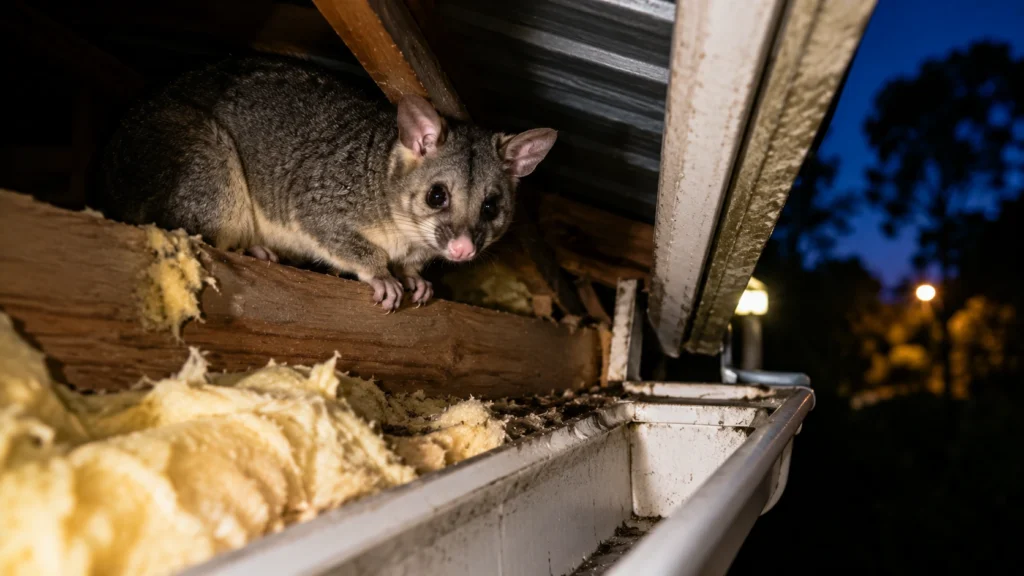
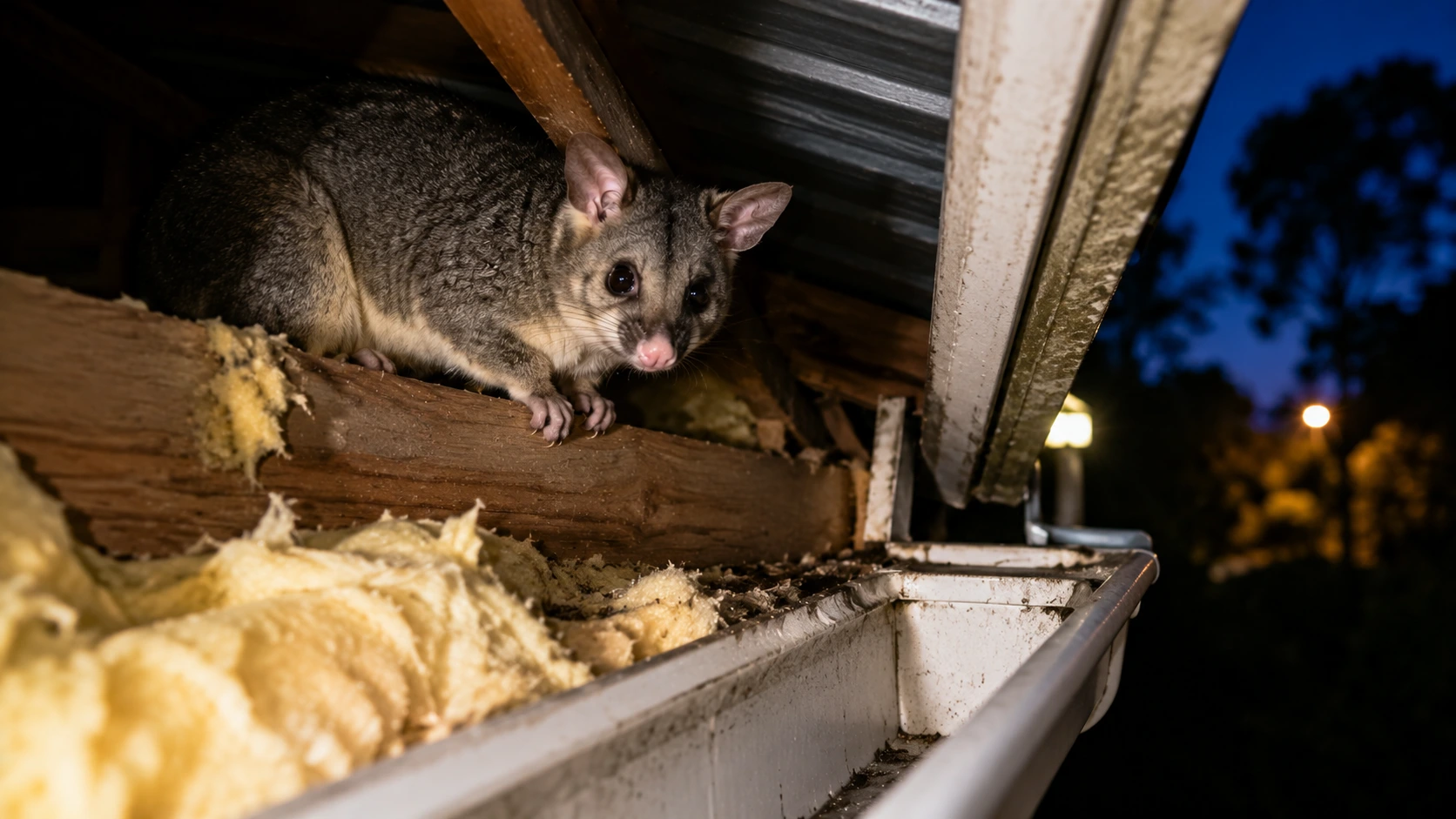
Possums in your roof cavity won’t leave on their own. Effective possum removal requires trapping the animal humanely, releasing it within 150 metres of the capture site under NSW law, and sealing the entry point before it can return. Without that seal, the scratching starts again within days.
Key Takeaways
- Possums are protected under the NSW Biodiversity Conservation Act 2016. Releasing one beyond 150 metres of its capture site is illegal and carries real penalties.
- Sealing the entry point is the only permanent fix. Trapping without sealing guarantees the problem repeats.
- Brushtail possums are territorial and will follow their own scent trail back to any opening left accessible.
- Possum urine and droppings damage insulation, stain ceilings, and create conditions that attract secondary pests.
- ABC Pest Control Sydney covers the entire Sydney metropolitan area, from the Northern Beaches to Penrith, Parramatta, and Blacktown. Booking takes under 60 seconds.
Why Do Sydney Homes Get Possum Problems?
Sydney’s mature suburban tree canopy and concentration of older housing stock create near-ideal conditions for brushtail possum activity. Older weatherboard and brick-veneer homes develop gaps in fascia boards, cracked soffits, and shifting roof tiles as the building settles with age and summer heat. A brushtail possum doesn’t need a large opening. A gap a few centimetres wide is enough to move in.
The brushtail treats a roof cavity exactly the way it would treat a hollow in a eucalyptus tree: warm, dry, sheltered, and worth defending. Once it claims a den site, it marks it with scent and returns every night. Removing the animal without closing the opening just resets the clock.
That’s the insight most DIY approaches miss entirely. The focus lands on the animal when the building itself is the actual problem.
What Does NSW Law Require for Possum Removal?
The NSW Biodiversity Conservation Act 2016 classifies possums as protected native fauna. Killing, injuring, or relocating a possum further than 150 metres from its capture site is a breach of that legislation and carries real penalties.
The 150-metre rule exists for a specific biological reason. Brushtail possums are deeply dependent on knowing their local territory. Moving one far from familiar ground places it in unfamiliar surroundings with no established food sources, no shelter it recognises, and no territory boundaries it can defend. This isn’t a rule you can work around by choosing a “nice” park a few suburbs over. It doesn’t help the possum, and it doesn’t solve your problem.
For homeowners across the Sydney metropolitan area who’ve considered buying a cage trap from the hardware store: the trapping itself isn’t always the legal problem. What you do with the animal afterward is. Professional removal handles the full sequence correctly, from trapping and timing through to lawful release and entry point sealing, without putting you at legal risk.
The Seal-First Rule: Why Trapping Alone Never Resolves It
No possum removal job is complete until the entry point is physically blocked. That’s not a preference or an optional add-on. It’s the difference between a resolved problem and a recurring one.
Here’s the mechanism. After trapping and release, the possum’s scent marking remains on the roofline. Any possum, including the same individual released nearby under the legal distance requirement, will follow that scent trail back to the opening. Sealing the entry point removes the access. Without that seal, the scent functions as a standing invitation.
Consider a typical older Sydney property where a fascia board has pulled slightly away from the roofline over years of summer expansion and contraction. A brushtail has been denning there for several weeks. If the animal is trapped but the gap is never identified and closed, the scratching resumes quickly. The trap caught one possum. It didn’t solve the structural problem that made the roof attractive in the first place.
A thorough inspection of the full roofline matters here, not just the obvious gap. Older properties often have multiple weak spots, and possums are quick to find an alternative entry if their primary one is closed while a second remains open. This is the kind of detail that only becomes visible when someone who has actually done this work inspects the whole perimeter, not just the spot where the noise was loudest.
What Damage Does a Possum Actually Cause?
Possums aren’t just a noise problem. The secondary damage accumulates in ways that cost significantly more to fix than the original removal.
Possum urine soaks into roof insulation over time and spreads into ceiling plasterboard. Left long enough, it causes structural staining, promotes mould growth, and weakens ceiling material to the point where replacement becomes unavoidable. Insulation in that condition often can’t be salvaged.
There’s also a secondary pest pathway worth understanding. Fleas living on possums drop off into the ceiling space as the animal moves through. Rodents are attracted to the same access points a possum exploits. One unresolved possum issue can become a broader infestation faster than most homeowners expect. If you’re already noticing sounds inside walls alongside ceiling activity, understanding the signs of rats in walls and what a hidden infestation looks like is worth doing before your inspection.
Acting early is cheaper. The cost of professional removal is a fraction of what ceiling repairs, insulation replacement, and secondary pest treatment adds up to when the problem is left to compound. You can get a clearer picture of what professional pest treatment costs and why timing affects that figure in the Sydney pest control pricing guide, and if you want a practical framework for protecting your property year-round, the expert pest prevention checklist for Sydney homes covers what to look for before problems take hold.
Professional Removal vs. Handling It Yourself
| Approach | Legally Compliant | Entry Point Sealed | Recurrence Risk | Full Roof Inspection |
|---|---|---|---|---|
| Professional removal with sealing | Yes | Yes, same service | Low | Yes |
| DIY trapping with distant release | No, 150m breach | No | Very high | No |
| DIY proofing without removing the animal first | Partial | Sometimes | Moderate to high | No |
| Doing nothing | N/A | No | Certain | No |
The tradeoffs are concrete. DIY trapping followed by releasing the possum in a park two suburbs away isn’t just ineffective. It breaches the NSW Biodiversity Conservation Act 2016. DIY proofing without removing the animal first carries a real risk of sealing the possum inside the cavity, which creates both a welfare problem and an odour issue that’s considerably harder to fix after the fact. Professional removal handles both sides correctly, with a full roofline check built in.
With over 20 years handling pest problems across Sydney, the team at ABC Pest Control Sydney is familiar with the structural characteristics older properties present across the metro area. Where multiple pests are active alongside a possum issue, comprehensive packages treating up to 15 different pest types can address everything in a single service visit.
Apartments, Strata Buildings, and Shared Roof Spaces
For apartment buildings and strata complexes, possum activity in a shared roof space creates a different kind of pressure. A single entry point affects multiple tenants, and the responsibility for noise complaints, hygiene concerns, and structural deterioration sits with the property manager or the owners corporation.
Waiting for tenants to escalate is the expensive option. ABC Pest Control Sydney handles apartment buildings efficiently, often assessing and treating multiple units in a single visit. That approach consolidates cost and keeps disruption minimal across the whole building. The same logic applies to German cockroach infestations, which spread rapidly between units through shared wall cavities and plumbing chases. Addressing the roof space and shared pest pressures in one coordinated visit is far more effective than treating one unit at a time.
Property managers with broader compliance responsibilities can get a clear picture of what’s involved in the pest control guide for Sydney property managers. If possum activity is part of wider seasonal pest pressure across the building, folding it into a year-round quarterly pest management plan makes ongoing maintenance costs predictable and keeps the building protected across up to three treatments annually.
Frequently Asked Questions
How does professional possum removal in Sydney actually work?
A licensed technician inspects the property to identify the possum’s entry point and assess the full roofline, then sets a humane trap. Once the animal is caught, it’s released at dusk within the legally required distance from the capture site, and the entry point is sealed. Contact ABC Pest Control Sydney directly for details about your specific property, as the process and number of visits can vary depending on access, roof layout, and whether multiple entry points are involved.
Is the 150-metre relocation limit actually enforced?
Yes. Possums are protected under the NSW Biodiversity Conservation Act 2016, and releasing one beyond 150 metres of its capture site is a breach of that law. Beyond the legal exposure, moving a possum far from its known territory makes survival significantly harder for the animal and doesn’t prevent another possum from claiming the same den site if the entry point stays open.
What’s the difference between a brushtail and a ringtail possum, and does it matter?
It affects the approach. Brushtail possums are larger, strongly territorial, and commonly den inside roof cavities. Ringtails tend to build external nests in dense shrubs and rarely enter buildings. In Sydney suburbs, the brushtail is the more frequent roof intruder. Entry point sizing, trap selection, and sealing methods differ between species, which is part of why a proper inspection before any sealing work starts matters.
Can a possum cause serious structural damage?
Yes, over time. Urine saturation weakens insulation and ceiling plasterboard. Possum movement can also dislodge roof tiles and widen existing gaps, which worsens weatherproofing and creates additional entry points for rodents and other pests. The longer the animal occupies the space, the more expensive the secondary repairs become.
My neighbour has the same problem. Should we coordinate?
If you’re in a terrace row or a strata block, coordinating makes practical sense. A possum removed from one roof cavity will often move directly into an adjacent one if that entry point is also accessible. Treating multiple properties at the same time prevents that lateral shift and is more cost-effective for everyone involved.
Will the possum return after it’s been removed?
Not if the entry point is properly sealed. The seal removes access, and without access, the scent trail left behind becomes irrelevant. If the seal is incomplete, or if a secondary entry point was missed during the inspection, the same animal or a different possum will return. A full roofline check rather than a patch on the obvious gap is what makes the fix last.
How do I know the possum has left before the entry point is sealed?
A professional confirms the cavity is clear before sealing. The standard approach is either releasing the trapped possum at dusk and sealing immediately afterward, or installing a one-way exclusion flap that allows the animal to exit but blocks re-entry. Sealing while the possum is still inside creates both a welfare problem and a regulatory issue. Confirmation that the space is vacant is a non-negotiable part of doing the job correctly.
The scratching in your ceiling won’t stop on its own. And the longer it continues, the more damage builds behind the plasterboard. Possum removal done properly is a one-time fix. Done incorrectly or left unaddressed, it becomes a recurring cost.
Contact ABC Pest Control Sydney for a free quote. Booking takes under 60 seconds, and the team covers the entire Sydney metropolitan area, including the Northern Beaches, Eastern Suburbs, Inner West, Southern Suburbs, Western Suburbs, Parramatta, Penrith, and Blacktown.
Warren Bailey is the Operations Manager at ABC Pest Control Sydney, with over 20 years of experience in residential and commercial pest management across the Sydney metropolitan area. He specialises in termite inspections, bed bug treatments, rodent control, and integrated pest management, and has been featured in Yahoo News and the Daily Mail for his expertise. ABC Pest Control Sydney’s treatments comply with Australian Pest Standards.