

What if the buzzing you hear near your eaves isn’t just a passing insect, but the sound of a thousand aggressive European wasps building a colony inches from your family’s favorite outdoor space? It’s a common source of anxiety for Sydney homeowners. You want your kids and pets to play safely in the backyard without the constant fear of a painful sting. Identifying the signs of a wasp nest nearby early is the only way to prevent a minor nuisance from turning into a dangerous safety hazard.
We understand that you need to know if a threat exists right now. This guide helps you confirm if a nest is hidden on your property and teaches you to distinguish between common Sydney species like the aggressive European wasp and the native paper wasp. You’ll learn how to track flight patterns and identify specific sounds to locate a nest safely. By the end of this article, you will have the expert knowledge needed to protect your home and ensure your peace of mind before wasp populations peak this autumn.
Key Takeaways
- Identify “beelines” to track consistent, straight flight paths that lead directly to a hidden colony.
- Discover why Sydney sandstone retaining walls and roof voids are prime real estate for dangerous nests.
- Recognize the early signs of a wasp nest nearby before populations peak and aggression increases during autumn.
- Learn the specific dangers of the European Wasp and why their ability to sting repeatedly requires immediate action.
- Understand the benefits of professional removal methods to ensure your family’s safety and long-term peace of mind.
Spotting the Early Warning Signs of a Wasp Nest
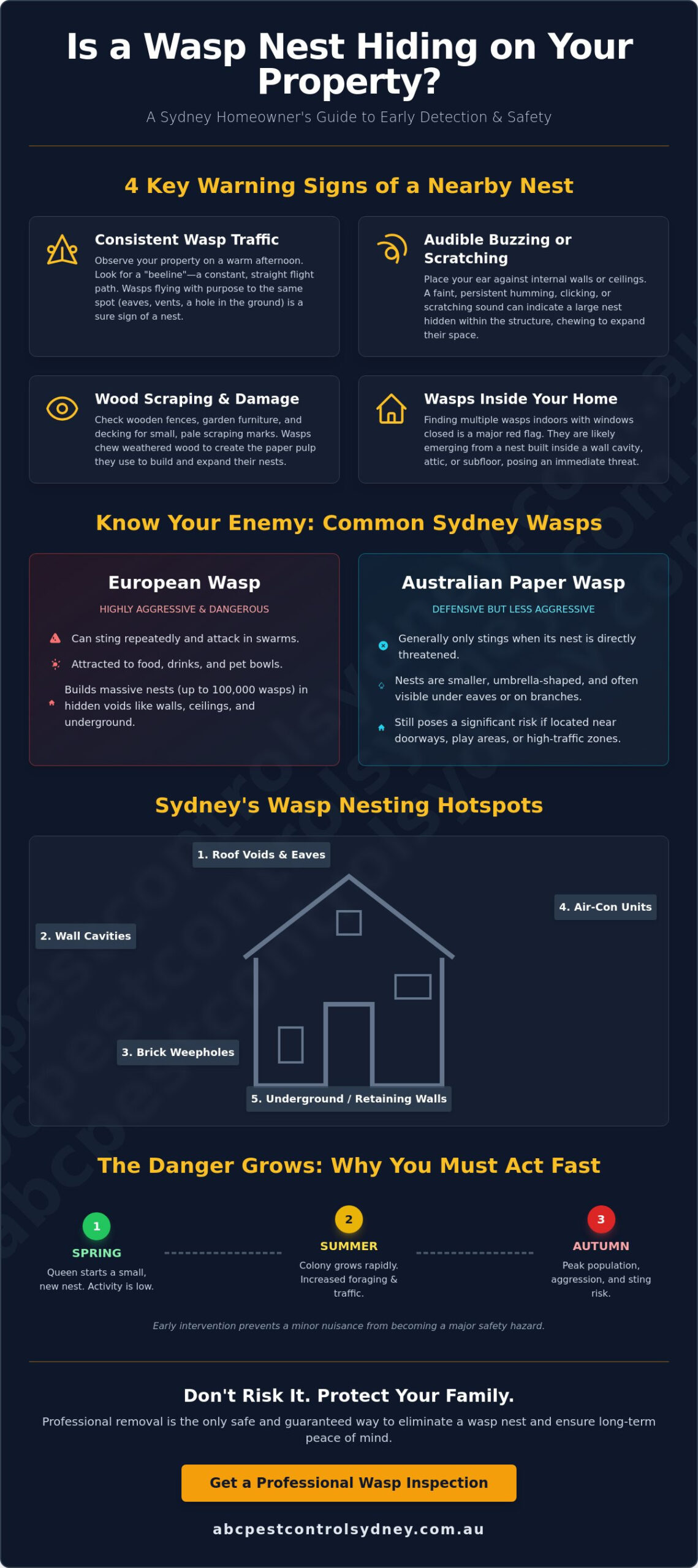
Identifying the signs of a wasp nest nearby starts with distinguishing a casual visitor from a resident. A single Wasp might just be hunting for food or water in your garden. However, if you notice multiple insects returning to the exact same spot every few seconds, you’ve likely found a colony. Look for physical evidence on your property, such as strange wood scraping marks on your garden furniture or timber fences. Wasps chew weathered wood to create the paper pulp required to build their intricate nests. These marks look like tiny, pale parallel lines where the top layer of wood has been stripped away.
Finding wasps inside your home when windows are closed is another major red flag. They haven’t just wandered in through an open door; they’re likely emerging from a nest built inside your wall cavity or attic. This situation is urgent because trapped wasps become highly defensive and unpredictable. Check your light fixtures, floorboards, and vents for any localized activity. Seeing multiple wasps indoors almost always points to a significant infestation that requires professional intervention to keep your family safe.
Increased Wasp Traffic and Flight Paths
Stop and watch the air around your property during the warmest part of a Sydney afternoon. This is when colony activity peaks. You’re looking for a “beeline,” which is a consistent, straight-line flight path. Unlike foragers that meander through flowers, nesting wasps fly with extreme purpose and speed. Trace these streams of traffic back to their source. They often lead to roof eaves, brick vents, or hidden holes in the ground. If you see a constant “stream” of insects entering a specific crevice, do not investigate closely. This high-speed entry confirms a mature nest is active and potentially dangerous.
Audible Buzzing and Scratching Sounds
Sometimes your ears find the problem before your eyes do. If a nest is hidden inside a wall cavity or ceiling, you’ll hear a distinct, low-frequency hum. Listen for a persistent clicking or vibrating sound behind the plasterboard. This is the collective sound of thousands of larvae and workers moving within the paper structure. You might even hear a faint scratching or chewing noise. Wasps often chew on the back of the plasterboard or timber beams to expand their living space. If the buzzing is louder near window frames or ceiling vents, the colony is likely established deep within the structural void of your home. Treat these sounds as an immediate warning of a hidden hazard.
Observing Wasp Behavior: Beelines and Activity Patterns
Understanding wasp behavior is the most effective way to confirm a growing problem. A “beeline” is a biological necessity for a social colony. It’s a direct, straight flight path that worker wasps use to ferry food and water back to the queen. Unlike the erratic, zig-zagging motion of a fly or a beetle, a wasp on a mission moves like an arrow. If you see this purposeful pattern, you are looking at one of the most reliable signs of a wasp nest nearby. These insects don’t wander aimlessly when they have a hungry colony to support.
In Sydney, you’ll likely encounter either the introduced European Wasp or the native Australian Paper Wasp. European Wasps are notorious for their aggression and tendency to build massive colonies in wall cavities or underground. For help identifying these local species, you can consult the Australian Museum’s guide to paper wasps. While native species are generally less defensive, any nest located near a doorway or a child’s play area is a significant safety risk. As temperatures rise during Sydney’s spring and summer, the metabolism of these insects increases, making them faster and far more visible around your property.
Tracking the Return Flight
Stand back at least five meters from your home and scan the roofline. Use the afternoon sun to your advantage. When insects fly between you and the light, their wings glint, making them much easier to track against dark gutters or brickwork. Look for “gateways” where multiple insects enter and exit. In Sydney homes, common entry points include weepholes in brickwork, gaps under roof tiles, or even the external casings of air conditioning vents. If you notice a high-frequency “stream” of traffic, the nest is already well-established. If the flight path is confusing, a professional Sydney wasp inspection can provide the clarity you need to stay safe.
Feeding and Foraging Indicators
Early spring brings “scout” wasps. These are queens or early workers looking for a permanent site to build. They’ll hover around eaves and vents, testing for entry points. Later in the season, foraging behavior becomes more obvious near food sources. Are wasps swarming your pet’s bowl or hovering over your outdoor dining table? This suggests a colony is close enough that your home has become part of their regular foraging territory. You might also notice damage to fruit trees or garden plants, as wasps hunt for caterpillars or sugary nectar to sustain their larvae.
Common Hiding Spots for Wasp Nests in Sydney Properties
Sydney’s unique landscape offers more than just harbor views; it provides ideal real estate for stinging pests. Finding the signs of a wasp nest nearby often requires looking beyond eye level. Sydney sandstone retaining walls are a prime example. The natural gaps and crevices in these structures provide the perfect thermal insulation for a growing colony. Similarly, household machinery like pool pump housings and electricity boxes are high-risk areas. These units generate consistent warmth. This attracts queens looking to establish a nest during the cooler start of the season. Don’t overlook these functional areas when scanning your property.
When managing your property, whether it is your family home or a rental investment, keeping it free from such hazards is essential for maintaining its value and appeal. To see how professional property services can assist you, find out more about Across Town Real Estate.
Internal wall cavities are another favorite for opportunistic species. If you notice wasps consistently entering a small gap in your brickwork or a weep hole, they’ve likely found a path into your home’s structure. These hidden colonies are difficult to treat without professional equipment. They can grow undisturbed for months until the population reaches a critical mass. Identifying these entry points early is essential to prevent the nest from expanding into your living spaces or ceiling voids.
Aerial Nests: Eaves, Vents, and Gutters
Aerial nests are the most frequent sightings for NSW homeowners. Paper wasps typically build exposed, umbrella-shaped structures under guttering or window ledges. These nests are made from chewed wood fibers. However, more dangerous colonies often hide within your home’s infrastructure. Check your roof vents and garage rafters for papery debris or mud tubes. Blocked gutters are another major concern. The trapped moisture and leaf litter create a humid environment that supports rapid nest expansion. If you see wasps disappear behind a fascia board or into a soffit vent, they’ve likely accessed the roof void. Treat these high-traffic areas with extreme caution.
Ground and Subterranean Nests
While aerial nests are visible, the most dangerous threats often lie beneath your feet. The European wasp is a master of concealment. According to Agriculture Victoria’s information on European wasps, roughly 80% of their nests are hidden underground or in wall cavities. In a typical Sydney backyard, this might look like a small, unassuming hole in a garden bed or a patch of dead grass. These colonies can house thousands of insects. The risk of accidentally disturbing them is high. A vibration from a lawnmower can trigger a mass attack from a hidden ground nest in seconds. Always scan for signs of a wasp nest nearby before starting heavy garden work or letting pets roam in dense shrubbery.
The Dangers of a Hidden Nest: Why You Shouldn’t Wait
Ignoring the signs of a wasp nest nearby is a gamble with your family’s safety. Unlike many other insects, wasps are highly territorial and possess a sophisticated defense mechanism called an “alarm pheromone.” When a single wasp feels threatened or is crushed, it releases this chemical signal into the air. This triggers an immediate, synchronized attack from the rest of the colony. You aren’t just dealing with one angry insect; you’re inviting a swarm of hundreds or thousands to defend their home. This biological response makes even a “small” nest a significant liability.
The European wasp is particularly dangerous because it doesn’t die after stinging. It can inject venom repeatedly without losing its stinger. For most people, this causes intense pain and swelling. However, for those with undiagnosed allergies, multiple stings can lead to anaphylaxis. This is a life-threatening medical emergency that requires immediate intervention. Beyond the physical risk, these pests cause tangible structural damage. They’ll chew through your home’s insulation and even gyprock wall linings to create space for their expanding paper structures. Delaying treatment only allows the colony to grow and the potential repair bill to climb.
The Risks of DIY Wasp Removal
Taking a “spray and pray” approach with hardware store products is often ineffective and dangerous. Most retail aerosols lack the pressure or residual strength to reach the queen at the heart of a mature nest. If you only kill the workers on the exterior, the colony will quickly rebuild and become even more aggressive. Using a ladder to reach a nest under your eaves is also a major safety hazard. If the wasps swarm while you’re several meters off the ground, a fall is almost inevitable. Professional intervention ensures the entire colony is neutralized safely without putting you in the line of fire. For expert help, book a professional wasp removal service today.
Protecting Pets and Children
Children and pets are the most vulnerable members of your household. They often lack the awareness to stay away from high-traffic areas or ground-dwelling nests. A curious dog sniffing at a hole in the garden bed can be swarmed in seconds. If you suspect a colony is present, establish a strict “no-go” zone immediately. Keep pets indoors and ensure children play away from the suspected site until a professional can confirm the nest’s location. Rapid intervention is the only way to restore safety to your backyard and eliminate the constant anxiety of a hidden sting hazard.
Professional Wasp Nest Removal in Sydney
Once you have identified the signs of a wasp nest nearby, the priority shifts from observation to elimination. ABC Pest Control Sydney brings over 20 years of specialized experience to every residential and commercial property we service. We understand that a wasp infestation isn’t just a nuisance; it’s a significant safety liability for your family or staff. Our team uses professional-grade, eco-friendly treatment methods designed to neutralize the colony while minimizing the impact on your local environment. We don’t just manage the problem. We provide a total resolution that ensures these aggressive pests don’t return next season.
Relying on expert intervention is the only way to guarantee the total eradication of a mature colony. Many homeowners attempt to use retail sprays, only to find the wasps returning days later. This happens because the queen remains protected deep within the nest structure. Our technicians are trained to locate the heart of the infestation, even when it’s hidden behind sandstone walls or inside complex roof voids. By choosing a professional solution, you avoid the high risk of multiple stings and ensure the job is done right the first time.
Our Proven Wasp Removal Process
We follow a rigorous, step-by-step methodology to clear your property safely. Our process begins with the expert identification of the specific wasp species. Determining whether you have a native Paper Wasp or an invasive European Wasp dictates our tactical approach. Once identified, we apply specialized insecticidal dusts or high-pressure sprays directly into the nest entrance. These professional-grade products are far more effective than standard retail options. Finally, where the structure is accessible, we perform a complete removal of the physical nest to prevent secondary pest issues or the attraction of future colonies.
Secure Your Sydney Home Today
Don’t wait for an emergency to address a growing pest problem. Early intervention is always the most cost-effective strategy. Our General Pest Control Packages offer an integrated defense system for your home. These bundles cover wasps alongside other common Sydney pests like cockroaches and spiders, providing comprehensive protection in a single visit. This proactive management prevents the signs of a wasp nest nearby from ever appearing on your property again. Take the first step toward a safer backyard and professional peace of mind.
Protect your family and restore your outdoor living spaces today. Our booking process is streamlined for modern convenience, ensuring you get the help you need without delay. Book Your Wasp Inspection with ABC Pest Control Sydney and let our experienced team handle the danger for you.
Take Control of Your Property’s Safety
Identifying the signs of a wasp nest nearby is the first step toward reclaiming your backyard and ensuring your family’s peace of mind. You now know how to track purposeful beelines and exactly where to look for hidden colonies within Sydney sandstone walls or roof voids. Don’t let the fear of a defensive swarm keep you from enjoying your outdoor spaces. Because a single disturbance can trigger a dangerous colony-wide response, acting quickly is essential for your protection. Waiting only allows the population to grow more aggressive as autumn approaches.
Trust our 20 years of local expertise to handle the risk for you safely and efficiently. We use eco-friendly and family-safe methods to ensure total eradication without compromising your home’s environment. We also offer same-day service for urgent emergencies when you need immediate intervention. Stop the buzzing before it becomes a serious safety hazard. Get a Professional Wasp Nest Inspection Today and enjoy the security you deserve. Your pest-free home is just one quick booking away.
Frequently Asked Questions
How do I tell the difference between a bee and a wasp?
Bees are generally fuzzy with rounder bodies, while wasps have smooth, shiny skin and a distinctively narrow “waist.” You can also identify them by their behavior; bees are usually focused on flowers, whereas wasps are attracted to proteins and sugars at your outdoor table. Most importantly, a bee can only sting once, but a wasp can sting multiple times without dying.
Is it safe to leave a wasp nest alone if it is far from the house?
Leaving a nest alone is risky even if it’s located at the back of your property. Foraging workers will still travel to your home in search of food, increasing the chance of accidental encounters. If you ignore the signs of a wasp nest nearby, the colony can grow to house thousands of insects by late summer, making the entire backyard a “no-go” zone for your family.
What should I do if a wasp nest is inside my wall cavity?
Do not seal the entry hole with expanding foam or caulking. If you block their only exit, the wasps will often chew through the internal plasterboard to find a new way out, leading them directly into your living room. This is a high-danger situation. You need a professional to apply specialized insecticidal dusts that penetrate the cavity and neutralize the queen safely.
Can I use a garden hose to knock down a wasp nest?
Never use water to attack a nest. Wasps are not killed by water; they are only provoked into a defensive frenzy. Using a hose will trigger an immediate swarm, and you will likely be stung multiple times before you can retreat. High-pressure water also fails to reach the interior of the nest, leaving the colony active and even more aggressive than before.
How much does professional wasp nest removal cost in Sydney?
The cost of professional removal depends on several factors, including the nest’s size, its height from the ground, and its accessibility. A nest hidden deep within a wall cavity or a high roof void requires more time and specialized equipment than a visible paper wasp nest. For an accurate assessment, it is best to contact a licensed technician who can evaluate your specific property needs.
Will wasps return to the same spot next year if the nest is removed?
Wasps rarely reuse an old nest, but they are highly attracted to the same environmental conditions. If a spot was perfect for a colony once, a new queen might find it just as appealing next season. Total physical removal of the old structure and a residual pest spray are the most effective ways to discourage new colonies from established in the same location.
What is the most aggressive type of wasp in Sydney?
The European Wasp is the most aggressive species found in the Sydney region. They are an introduced pest with a hair-trigger defensive response. Unlike native species, they will often attack in large numbers if you simply walk too close to their nest. Their ability to sting repeatedly makes them a primary concern for homeowners with young children or curious pets.
How quickly can ABC Pest Control Sydney respond to a wasp emergency?
We prioritize emergency calls where a nest poses an immediate threat to people or animals. Our team offers same-day service availability for urgent wasp removals across the Sydney metropolitan area. We use a streamlined digital booking process to ensure a technician can be dispatched to your property without delay, restoring your safety and peace of mind as quickly as possible.