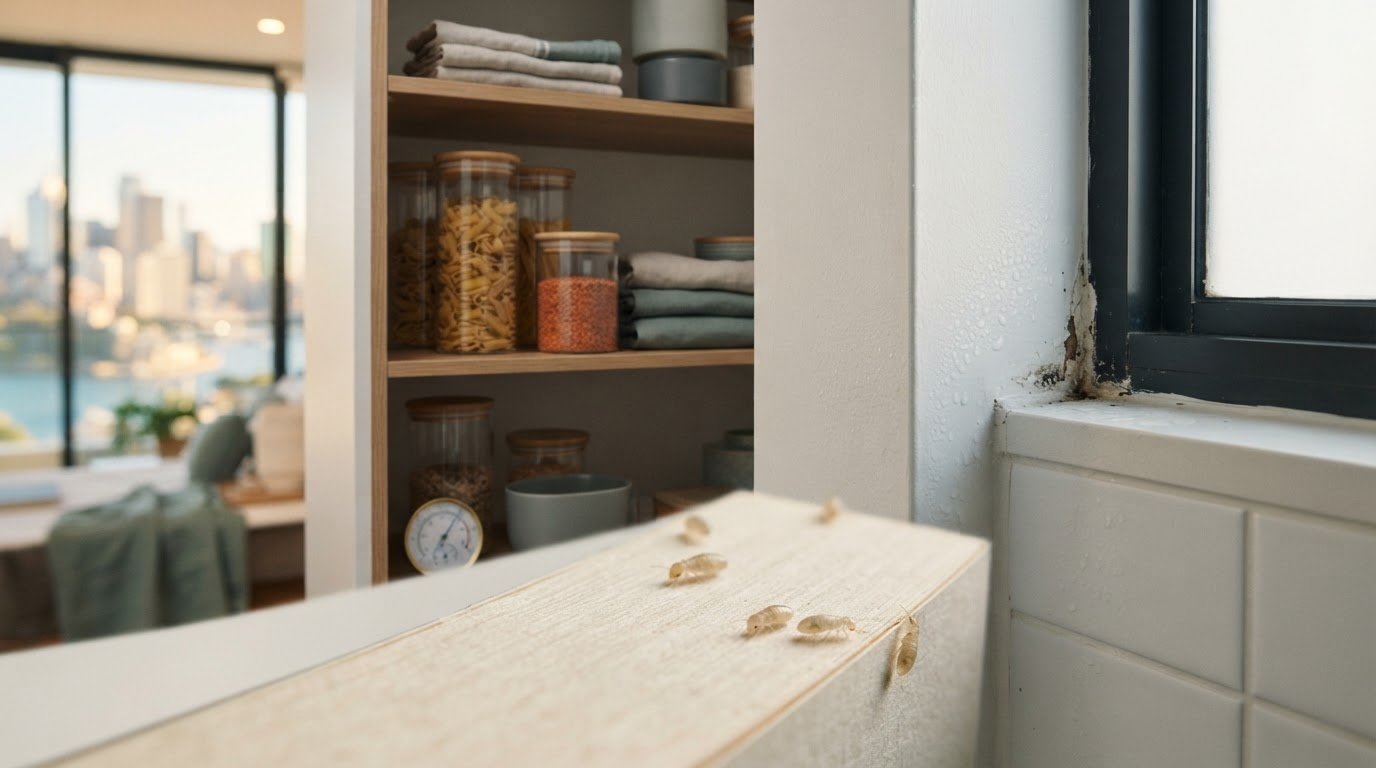
What is the best first step for a psocid bug infestation in apartment living? It may not be spraying the insects. Finding tiny bugs in a cupboard, pantry or on a wall can be unsettling, especially when you’re unsure whether they’re booklice, termites or another pest. Psocids are commonly called booklice, but they aren’t true lice. Their presence can point to damp conditions and mould, so investigate the surrounding environment as well as the insects.
This guide explains how to recognise likely psocids, where to look for moisture and mould, and what practical steps can make an apartment less favourable to them. You’ll also learn how to consider whether activity may involve another part of the building, and when professional pest control can help with a recurring or difficult-to-identify pest issue.
Key Takeaways
- Track recurring sightings and where they appear. One small insect alone can’t confirm an infestation or reveal its source.
- Compare an insect’s size, appearance and location with clues linked to common lookalikes before deciding what to do.
- Record sightings and investigate damp areas. Reducing visible insects alone may not address the conditions supporting them.
- Dry affected belongings where appropriate, reduce dampness and monitor the area. If activity continues, consider whether the source could be elsewhere in the building.
- When identification or recurring activity is difficult, ABC Pest Control Sydney provides residential pest control across metropolitan Sydney, backed by more than 20 years of local experience.
Psocid Bug Infestation in an Apartment: What Residents Should Look For
Psocids, commonly called booklice, are tiny, soft-bodied insects that may turn up indoors. Despite the name, they aren’t true lice. Many indoor booklice are wingless and around 1-2 mm long, so they can look like moving specks unless you inspect them closely. Their small size makes identification difficult, particularly if you’ve spotted only one or two. The broader insect group is described in this Psocoptera overview, but a general description can’t confirm which insect is in your apartment.
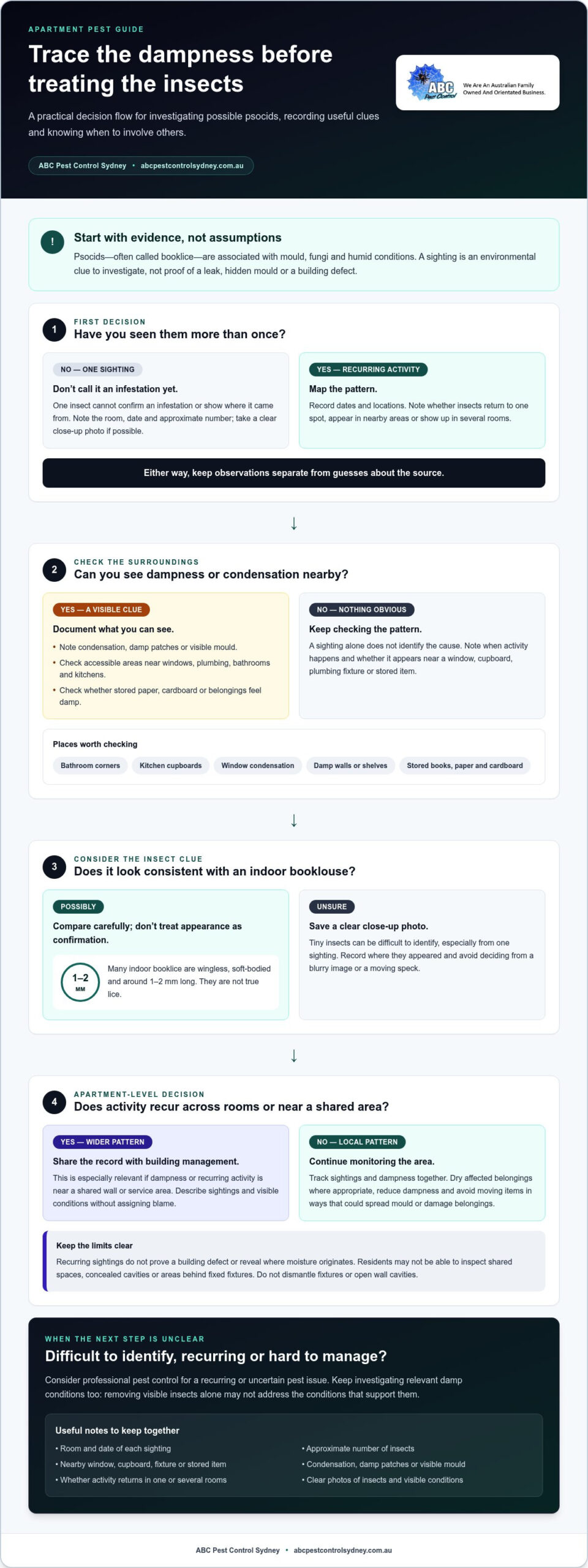
A single sighting doesn’t establish an infestation, show how long insects have been present, or reveal where they came from. Look for repeated sightings in the same area, insects in several nearby spots, or activity around items that have been stored undisturbed. A clear close-up photo can help with later identification.
Where psocids may appear inside an apartment
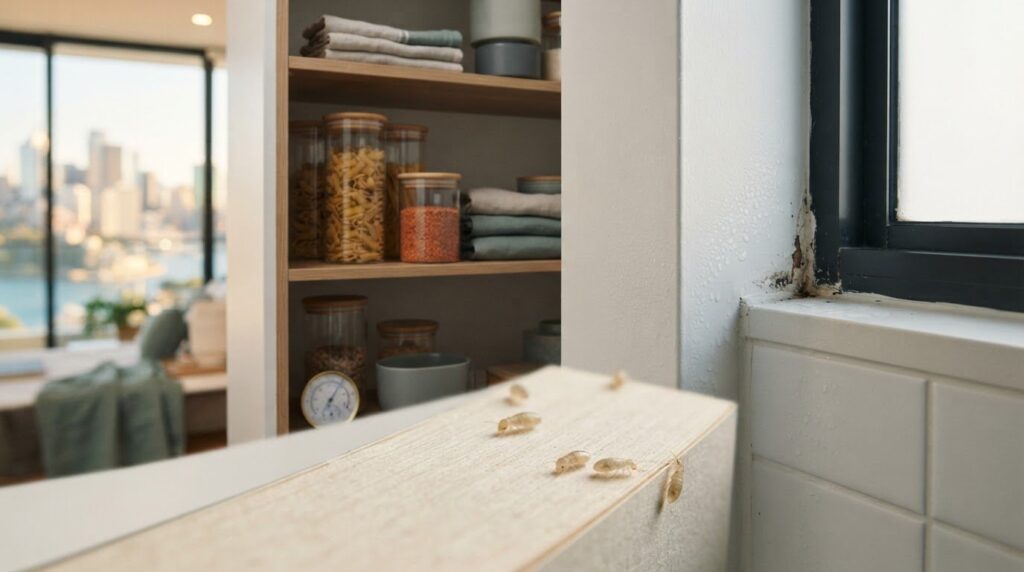
Start with places where moisture may linger: bathroom corners, kitchen cupboards, areas around condensation, and walls or shelves that feel damp. Check nearby books, stored paper, cardboard and other undisturbed items. Psocids are associated with mould and fungi, so note visible mould or persistent dampness, but don’t assume every sighting has the same cause.
- Write down the room, date and approximate number of insects.
- Note whether they appeared near a window, cupboard, plumbing fixture or stored item.
- Record visible condensation or damp patches. Avoid moving items in a way that could spread mould or damage belongings.
These notes can show whether activity is recurring in one location or appearing across different parts of the apartment. That pattern is more useful than guessing from one insect.
What a psocid sighting can, and cannot, tell you
Psocids are linked with mould, fungi and humid conditions. Their presence can be an environmental clue worth investigating, especially if sightings recur beside damp materials. It isn’t proof of a plumbing leak, hidden mould or a building defect. Condensation, localised dampness and other indoor conditions may also be relevant, so look for evidence before drawing conclusions.
A few tiny insects don’t, by themselves, show that books or apartment surfaces are being damaged. Nor does one sighting confirm that every insect is a psocid. If you’re uncertain, save a clear photo and record where the insects appeared. Repeated activity alongside dampness deserves attention. Identify the insect and check the surrounding conditions before deciding what action to take.
Why Psocids Appear in Apartments: Moisture, Mould and Indoor Conditions
Psocids are associated with mould and fungi, which can develop where materials remain damp or indoor humidity stays high. Simply removing the insects you can see may not address the conditions that support them. If suitable damp, mouldy conditions remain, activity may recur. Investigate the environment while tracking the insects.
A sighting doesn’t diagnose the cause. Condensation on a window, a damp item in a cupboard or visible mould may be useful clues, but none proves that a pipe is leaking or that the building has a defect. Moisture can have different sources in an apartment, and some areas may be outside a resident’s access. Keep observations separate from assumptions.
Checking for moisture is a practical first step, not a guaranteed cure. It can help narrow down what may be supporting psocids, but you’ll need to understand and address the relevant conditions before judging whether the environment has changed.
Apartment conditions worth checking
Look for everyday sources of persistent dampness before concluding there’s a hidden problem. Check windows for regular condensation, bathrooms and kitchens for poor airflow, and stored belongings for dampness. Look at accessible areas near plumbing and window frames for visible moisture or mould. Don’t dismantle fixtures or open wall cavities.
- Note whether condensation appears after cooking, showering or overnight.
- Check whether stored paper, cardboard or other belongings feel damp.
- Record sightings by room and date, including whether they cluster in one area or return in several locations.
A repeated pattern can help distinguish a local issue from activity appearing in multiple rooms. It won’t identify the moisture source on its own, but it gives you clearer information for deciding what to do next.
When the source may involve shared building areas
Apartment residents can’t always inspect shared spaces, concealed cavities or areas behind fixed fixtures. If insects keep appearing in more than one room, or you notice dampness near a shared wall or service area, record the location and dates. Photos of visible condensation or mould can help document what you’ve observed.
Share your observations with building management if dampness or recurring activity may involve a common area. Describe what you’ve seen rather than assigning blame: sightings alone don’t prove a building defect or establish where the moisture originates. A clear record can help the relevant people decide whether further inspection is needed.
If recurring insect activity is difficult to identify or manage, Sydney apartment pest control from ABC Pest Control Sydney can help address the pest concern. Investigating and addressing damp conditions remains an important part of managing the environment.
Psocids or Another Apartment Pest? Compare the Clues Before Acting
Tiny insects can be hard to identify by sight, especially if they’re moving or your photo is blurry. Booklice may be mistaken for bed bugs, but size and location offer useful clues. These are not a complete diagnostic test: insects can wander, and a single sighting doesn’t confirm what’s present. Compare several details before deciding how to respond to a possible psocid bug infestation in apartment living.
Clues that may help distinguish booklice from bed bugs
The comparison below describes booklice as smaller than bed bugs and associated with different locations. Use it to guide your observations, not to make a definite identification from one clue.
| Clue | Psocids (booklice) | Bed bugs |
|---|---|---|
| Visible size | Very small, commonly described as around 1-2 mm. | Larger than booklice. |
| Appearance | Small, soft-bodied and often wingless indoors. Colour alone isn’t enough to confirm identity. | Don’t rely on colour or shape from a distant or unclear image. Look for a closer view of the insect. |
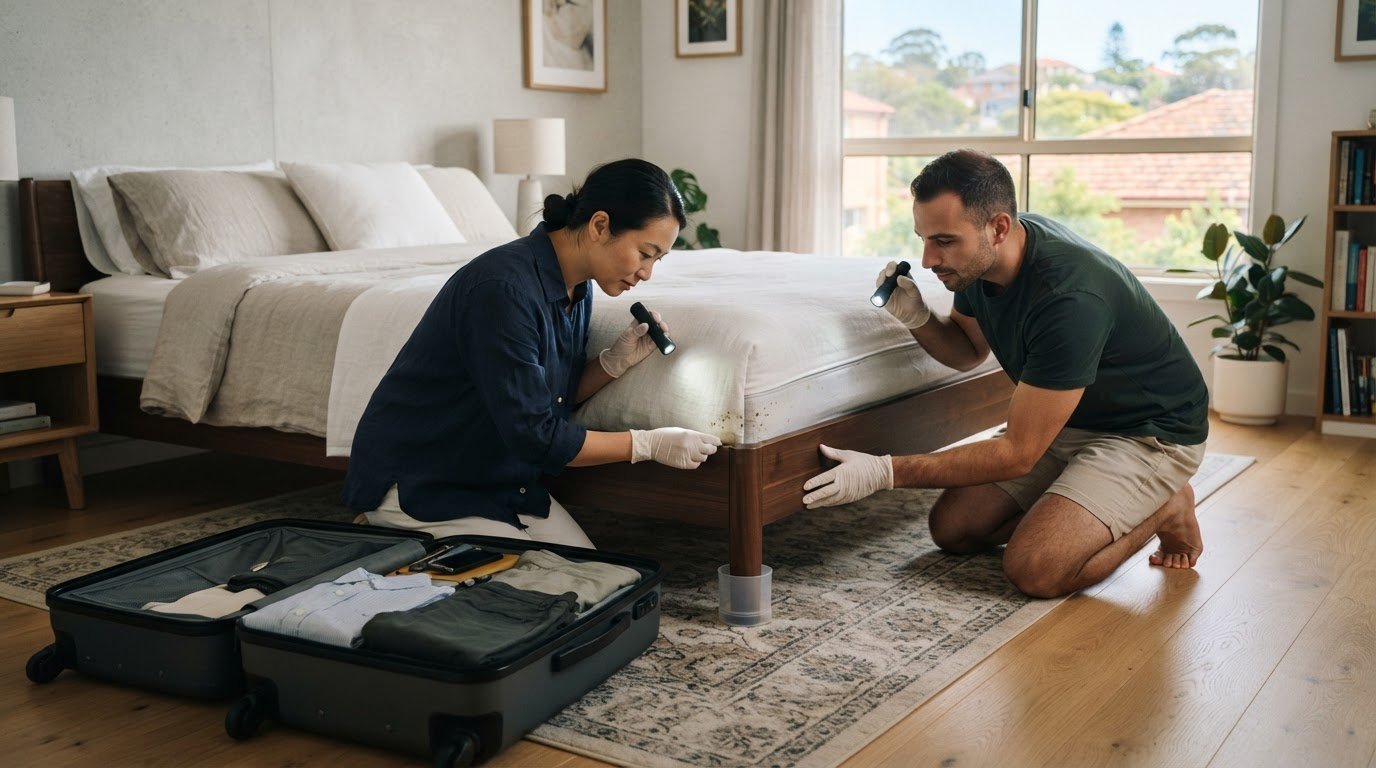
| Where to look | May be found near damp areas, mould, or stored paper and other undisturbed materials. | Check sleeping areas, including mattress seams and bed frames, for insects or other signs. |
Location adds context, but it doesn’t settle the question. An insect found in a bedroom isn’t automatically a bed bug, and a tiny insect near a damp cupboard isn’t automatically a psocid. If bed bugs are a concern, use the bed bug identification and control guide to understand what signs to look for.
How to document an uncertain insect sighting
Build a useful record without handling insects unnecessarily. Take a close-up photo in good light and place a familiar object, such as a ruler, beside it for scale. Keep the camera steady and take more than one image if the insect is moving. A poor-quality photo may not show enough detail for reliable identification.
- Record the room, date and exact spot where you noticed the insect.
- Note nearby materials, such as bedding, books, cardboard or stored belongings.
- Write down any visible dampness, condensation or mould in the area.
If you can safely capture a specimen in a sealed container, it may help an expert inspect it. Don’t crush or handle an unknown insect just to get a sample. If evidence remains inconclusive, sightings recur, or you’re concerned about bed bugs, seek professional identification before choosing a treatment. Correct identification helps avoid treating the wrong pest while the actual issue continues.
Psocids in an Apartment: A Practical Action Plan
A calm, step-by-step response helps you separate a one-off sighting from a recurring problem. For a psocid bug infestation in apartment living, keep a record, investigate damp conditions and reassess before deciding what further help is needed. Cleaning and drying can help manage affected belongings, but they don’t guarantee control if the conditions supporting insect activity remain.
- Document sightings. Note the date, room and location, and take a clear photo if possible. Record whether you see insects again in the same spot or in different areas.
- Investigate moisture. Look for condensation, visible mould, damp stored items or other signs of persistent moisture. Check accessible areas near windows and plumbing, but don’t dismantle fixtures or assume a sighting proves a leak.
- Reduce damp conditions. Ventilate rooms where practical and dry damp belongings. Clean affected items and storage areas appropriately, then let them dry fully before putting them away. Addressing moisture may help make conditions less favourable, but it isn’t a guaranteed cure.
- Reassess the pattern. Continue noting where and when insects appear. If activity persists, identification remains uncertain or the suspected source is inaccessible, seek professional advice.
In an apartment, some areas may be shared or concealed. Your observations can help clarify what’s happening without prematurely assigning a cause. For broader context on residential pest management, consult this Sydney pest control guide.
Resident steps to take before requesting treatment
Before treatment, remove clothing items, newspapers, children’s toys and food from ground surfaces, and provide access to skirtings. Share your sighting record and observations about dampness or mould. This information gives the pest-control professional a clearer picture of where activity has occurred.
What to expect during and after treatment
Residents must vacate while wet chemicals are applied. Allow approximately 1-2 hours, or approximately 1 hour on a hot day. ABC Pest Control Sydney uses a water-based residual spray that does not affect surface colouring or finishes. Once the spray has dried, surfaces don’t need washing. If a sprayed area is still wet and you come into contact with it, wash immediately with soap and plenty of water. Children with asthma should not be present during application and can return after 2-3 hours.
Treatment should be considered alongside the conditions you’ve observed, not as a substitute for investigating persistent dampness. If the source may be in a shared area or behind a fixed fixture, pass your dated notes to building management as well as discussing the pest activity with a professional. Monitor the area after taking practical steps, and seek further advice if sightings continue or the insect’s identity remains unclear.
For professional help with a recurring or difficult-to-identify apartment pest issue, arrange pest control with ABC Pest Control Sydney.
Professional Psocid Pest Control in a Sydney Apartment: What Happens Next
If you’re unsure what insect you’ve found, activity keeps returning, or sightings come from areas you can’t inspect, professional advice can help you decide what to do next. ABC Pest Control Sydney provides residential pest control across the Sydney metropolitan area, with more than 20 years of local experience. Share your photos, sighting notes and moisture observations so the pest concern can be considered alongside conditions in your apartment.
A professional pest-control visit can form part of a moisture-first plan. Treatment can address pest activity, while residents investigate damp conditions separately. Pest control does not repair leaks, remove mould or correct building ventilation. If moisture may involve a shared or concealed area, keep building management informed as well.
How professional help fits into a moisture-first plan
ABC Pest Control Sydney uses eco-friendly, water-based treatments, including a water-based residual spray that does not affect surface colouring or finishes. This is not a promise of instant elimination or a psocid-specific result. The right response depends on the pest concern and observed conditions. For optimal prevention, the company recommends three treatments per year, or as needed based on environmental conditions.
Professional guidance is useful when an insect’s identity remains unclear, sightings recur despite practical steps, or suspected activity is in an inaccessible area. Bring a concise record: where you saw insects, when they appeared, whether sightings repeat, and any visible dampness or mould. These details provide context without treating a moisture clue as proof of a leak or building defect.
Book Sydney pest control with clear preparation guidance
Before treatment, prepare the apartment so the technician can access the areas that need attention. Remove clothing items, newspapers, children’s toys and food from ground surfaces, and provide clear access to skirtings. Mention rooms or areas that are difficult to access, along with locations where sightings recur.
Residents must vacate while wet chemicals are applied. Plan to be away for approximately 1-2 hours, or approximately 1 hour on a hot day. Once the spray has dried, surfaces do not need washing. Children with asthma should not be present during application and can return after 2-3 hours. If a sprayed area is still wet and contacted, wash immediately with soap and plenty of water.
For broader information about residential services in the area, explore this Sydney pest control guide. If recurring pest activity needs attention, book trusted local pest control online in under 60 seconds, or call 0404 130 944.
Take the Next Step Towards a More Comfortable Apartment
Uncertainty can make a few tiny insects feel like a much larger problem. Keep your observations together, note whether activity continues, and share relevant details with building management if dampness may involve a shared area. A practical record can help turn concern into a focused conversation.
If you’re still unsure what you’ve found, or sightings keep returning, professional advice can help you decide how to proceed. For a psocid bug infestation in apartment setting, make sure the discussion considers both the pest activity and any moisture clues you’ve noticed. Addressing the right questions early can help you avoid guesswork and feel more confident about what to do next.
Book trusted local pest control in Sydney and take a practical step towards resolving the issue. ABC Pest Control Sydney provides residential pest control across Sydney, helping you move forward with a clear plan.
Frequently Asked Questions
Are psocids harmful to people or pets?
Psocids aren’t known to bite people or pets or transmit disease to them. Their presence is usually more useful as a clue to check indoor dampness than as a reason to fear direct harm. If you’re unsure whether an insect is a psocid, don’t assume this applies to another pest. Take a clear photo and seek identification if sightings continue or the insects look different from the descriptions in this guide.
Can psocids come from another apartment?
They could be associated with conditions or materials beyond your own unit, but sightings alone can’t show where they came from. In a shared building, note whether activity appears near a common wall, corridor, window or service area, then record dates and locations. Share recurring observations with building management so relevant areas can be considered. Avoid concluding that a neighbour or building defect is responsible without an inspection.
Do psocids damage books, documents, or stored items?
Psocids are associated with the mould and fungi that may grow on items in damp conditions; they don’t feed on paper itself. If books or documents are stored in a humid cupboard, check for dampness or visible mould and dry the items carefully in a suitable place. Protect valuable papers from further moisture, and don’t treat insect sightings alone as proof that contents have been damaged.
Can psocids disappear when an apartment becomes drier?
Reducing dampness can make an apartment less favourable to psocids, so activity may decline as conditions change. It doesn’t guarantee that all insects will disappear: damp materials may remain, or sightings may have another source. Keep monitoring the original area after improving ventilation or drying belongings. If insects keep appearing, review whether moisture persists or seek help identifying the pest and the surrounding conditions.
How long does it take to get rid of psocids in an apartment?
There isn’t a reliable fixed timeframe. It depends on whether the insect has been identified correctly, whether damp conditions continue, and whether activity is coming from an area you can access. For a psocid bug infestation in apartment living, track sightings after taking practical moisture-control steps rather than expecting an instant result. If activity recurs, share your notes with a pest professional to help guide what happens next.
Do I need to leave my apartment during pest treatment?
Yes. Residents must vacate while wet chemicals are applied. Plan to be away for approximately 1-2 hours, or approximately 1 hour on a hot day. Before treatment, remove clothing items, newspapers, children’s toys and food from ground surfaces, and make skirtings accessible. Children with asthma should not be present during application and can return after 2-3 hours. Follow the technician’s instructions for your visit so everyone in the household knows what to expect.
Do I need to wash surfaces after pest treatment?
No. Once the water-based spray has dried, surfaces don’t need washing. The spray does not affect surface colouring or finishes. If a sprayed area is still wet and you come into contact with it, wash immediately with soap and plenty of water. Follow the technician’s instructions for your visit.