What if the faint clicking sound behind your skirting boards isn’t just the house settling, but the sound of two million termites eating through your home’s equity? In a high-risk climate like ours, identifying the early signs of termites Sydney homeowners often overlook is the only way to prevent repair bills that can easily soar toward A$100,000. These pests cause over A$1.5 billion in damage across Australia every year. Because standard home insurance rarely covers termite destruction, the entire financial burden falls on your shoulders.
It is completely normal to feel a sense of urgency or even anxiety when you suspect hidden damage within your walls. You shouldn’t have to guess whether you’re looking at a harmless ant or a colony of Coptotermes acinaciformis. We understand that your home is your most significant investment, and protecting it requires more than just luck. With over 20 years of experience across the Sydney metropolitan area, we know exactly where these silent destroyers hide.
This 2026 guide will help you identify the subtle, hidden indicators of an infestation before structural costs spiral out of control. You will gain a definitive understanding of termite behavior and a clear action plan for professional intervention. We’ll preview the latest detection technologies, from thermal imaging to moisture meters, ensuring you have the peace of mind that comes with expert-led protection.
Key Takeaways
- Understand why Sydney’s humid coastal climate makes one in three local homes vulnerable to infestation and why standard insurance policies offer no protection.
- Identify the specific signs of termites Sydney homeowners must watch for, such as mud shelter tubes on sub-floors and “frass” near timber joints.
- Learn why 90% of termite damage is invisible to the naked eye and how professional thermal imaging detects active colonies hidden behind your walls.
- Distinguish between common ants and destructive termites by checking for straight antennae and thick waistlines to avoid confusing the two species.
- Master the golden rule of detection: never disturb mud tubes or infested wood, as sudden movement can drive the colony deeper into your home’s structure.
Why Sydney Homes Face a High Termite Risk in 2026
Sydney’s iconic harbor and coastal lifestyle come with a hidden cost. Our city’s warm, humid climate creates the perfect environment for colony expansion. In 2026, shifting weather patterns have increased moisture levels across the metropolitan area, providing ideal conditions for subterranean species like Coptotermes acinaciformis. Statistics show that one in three Australian homes will face a termite attack at some point. For residents in the “Termite Belt,” which includes high-density suburbs in the Inner West and the lush Northern Beaches, the risk is even more pronounced. Understanding the early signs of termites Sydney homeowners should look for is no longer optional; it’s a financial necessity.
Modern 2026 building materials often incorporate composite timbers and complex insulation layers. While these improve energy efficiency, they can also mask the presence of pests for longer periods. Termites can chew through internal structures while leaving the outer aesthetic untouched, meaning the damage is often catastrophic by the time it becomes visible to an untrained eye. You shouldn’t wait for a floorboard to give way before taking action. To see how structural engineering experts approach building damage and inspections, you can visit Schippers Bouwconsult BV.
Sydney’s Climate and Termite Biology
Warm, wet summers in New South Wales act as a biological trigger for subterranean termite swarms. Termites are eusocial insects that rely on high humidity to survive outside their nests. When the ground saturates after heavy Sydney rainfall, scouts move rapidly toward residential structures. Common garden habits often invite trouble. Thick layers of mulch and poor drainage against the house foundation create a “moisture highway” for these pests. Don’t assume the risk vanishes when the temperature drops. Sydney’s temperate winters aren’t cold enough to stop termite activity; they simply move deeper into the warm timber of your home’s frame.
High-Risk Property Features in the Metro Area
Your property’s age and design significantly influence its vulnerability. We see distinct patterns across different Sydney regions that require constant vigilance:
- Heritage Cottages: Suburbs like Balmain, Paddington, and Glebe feature older timber-framed homes that often lack modern physical barriers.
- Western Sydney Slabs: Newer developments often rely on concrete slabs. However, ground movement can cause cracks that allow termites to bypass chemical barriers.
- Garden Bridging: This occurs when garden beds or decking are built up against external walls, covering weep holes and providing a direct, hidden entry point. Following the design principles of experts like Landscape By Design Of Palmetto can help you create beautiful hardscapes and retaining walls that don’t compromise your home’s termite protection.
If your property matches these descriptions, stay alert for the signs of termites Sydney professionals look for during annual inspections. Early detection is the difference between a simple treatment and a structural rebuild that can cost tens of thousands of dollars.
5 Critical Visual Signs of Termites in Your Home
Detecting the early signs of termites Sydney properties exhibit requires a keen eye and a systematic approach. While these insects are masters of concealment, they leave behind specific biological and structural markers. Identifying these five visual cues can save you from a complete structural failure. It’s about looking for anomalies that don’t belong in a healthy home environment.
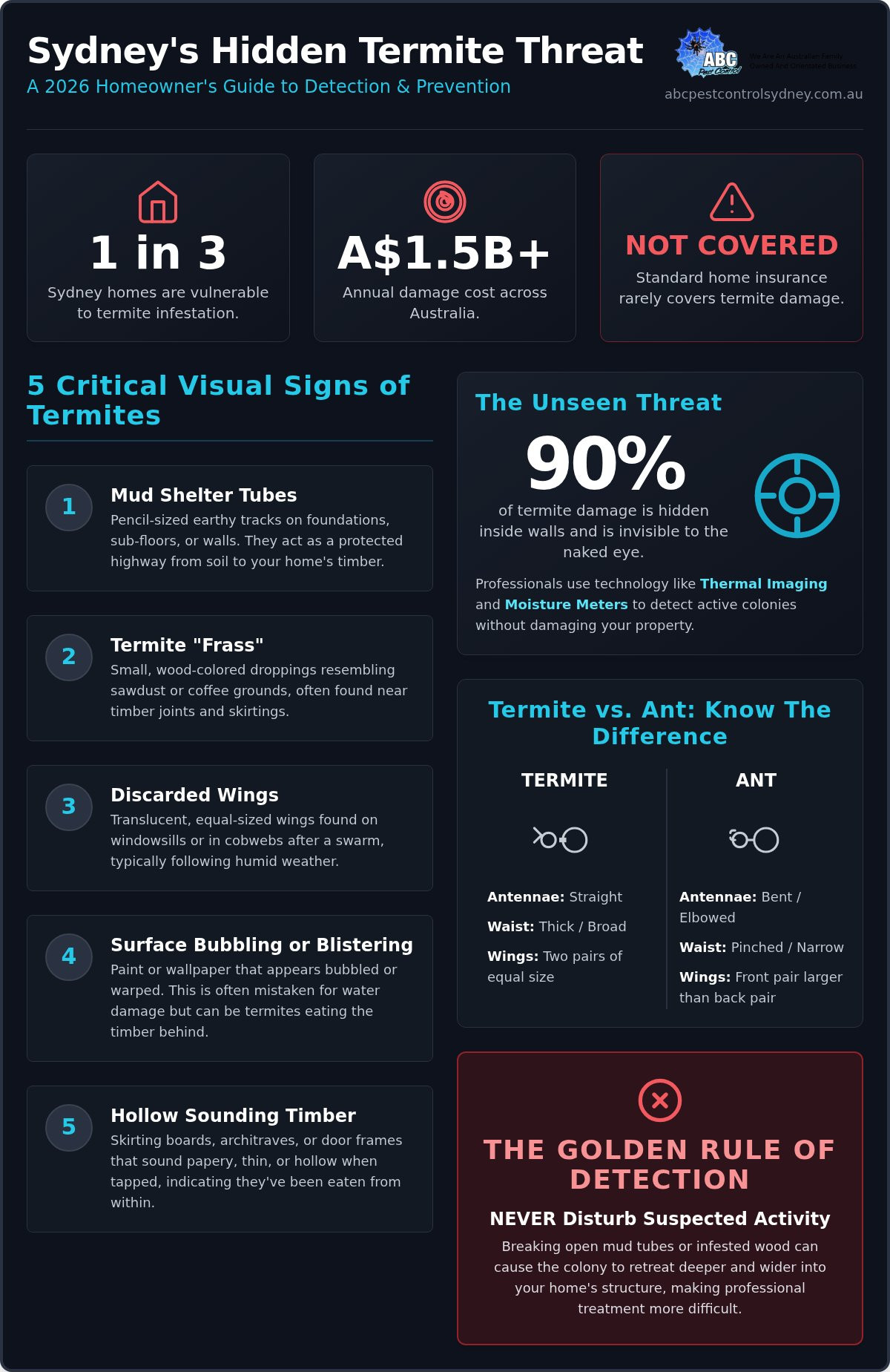
- Mud Shelter Tubes: Look for pencil-sized earthy tracks on sub-floor walls, foundations, or piers.
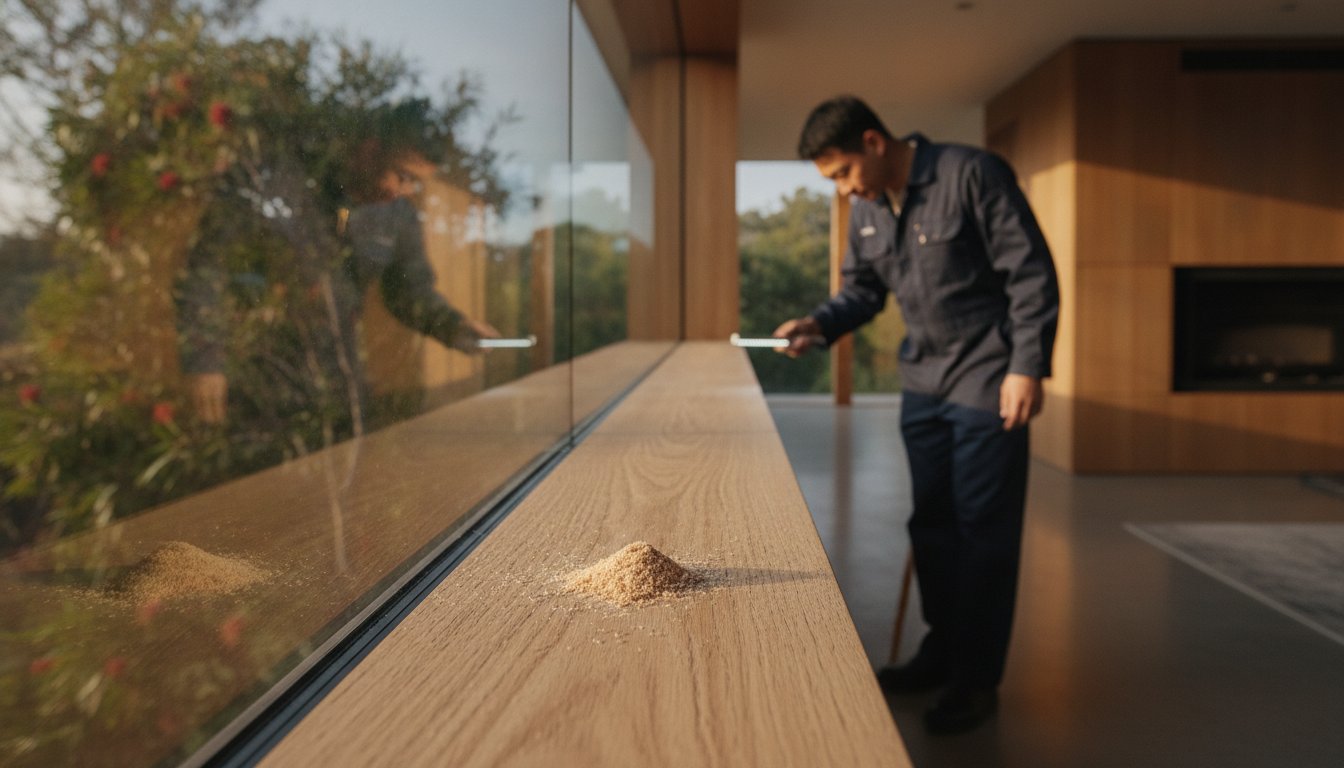
- Termite Frass: Check for small, wood-colored droppings that resemble sawdust or coffee grounds near timber joints.
- Discarded Wings: Find translucent, equal-sized wings on windowsills or in cobwebs after a humid Sydney swarming event.
- Surface Bubbling: Spot paint or wallpaper that appears blistered or “bubbled,” which is often mistaken for water damage.
- Hollow Timber: Identify skirting boards or door frames that sound papery, thin, or hollow when tapped.
Mud Tubes: The Termite Highway
Mud tubes are one of the most definitive signs of termites Sydney residents will encounter. These earthy tracks protect subterranean termites from light and dry air as they travel from the soil to your home’s timber. You will typically find them along foundations, crawl spaces, or near weep holes in brickwork. If you discover a tube, do not break it. Disrupting their path alerts the colony to danger. This causes them to abandon that specific area and relocate deeper into your house structure, making it significantly harder for experts to implement effective termite control methods later. Leave the tube intact so a professional can identify the species and the lead’s activity level.
Timber Damage and Surface Distortions
Termites eat timber from the inside out, often leaving only a thin veneer of paint or wood. Perform a simple “tapping test” on your skirting boards and door frames using the back of a screwdriver. If the wood sounds hollow or crushes easily under light pressure, the structural integrity is likely compromised. You should also pay attention to doors or windows that suddenly become difficult to open or close. While often blamed on Sydney’s humidity, this swelling is frequently caused by termite activity within the frames. Recognizing these distortions early allows you to book a comprehensive termite inspection before the damage becomes irreversible. It’s much easier to treat a localized issue than a full-scale infestation that has reached your roof trusses. Don’t ignore these subtle changes in your home’s “feel,” as they are often the first indicators of a hidden colony.
Hidden Indicators: DIY vs. Professional Detection
Homeowners often believe they can spot an infestation with a quick walkaround. This is a gamble. Approximately 90% of termite damage is hidden deep within the structure, far beyond the reach of a standard flashlight. The “screwdriver test” only works once the wood is already hollowed out. By that stage, you’re looking at a massive repair bill rather than a prevention plan. Professional detection focuses on identifying the signs of termites Sydney experts look for before the timber fails. We use specialized equipment to map activity through solid walls, floors, and ceilings.
The Power of Thermal Imaging Technology
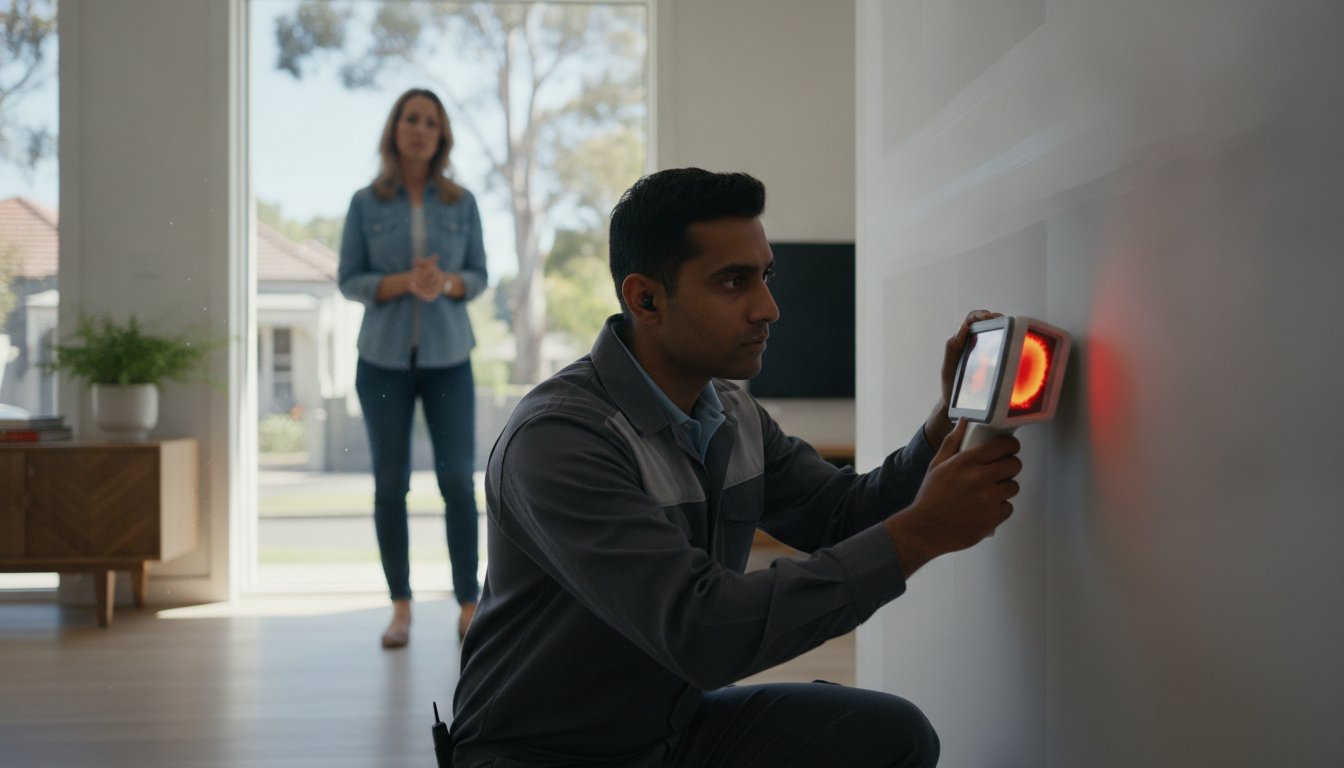
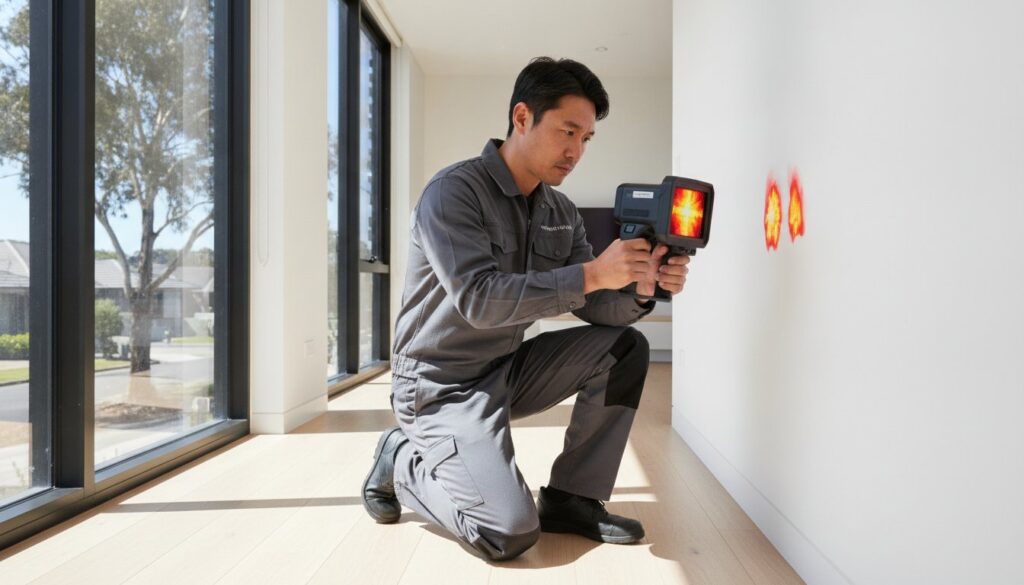
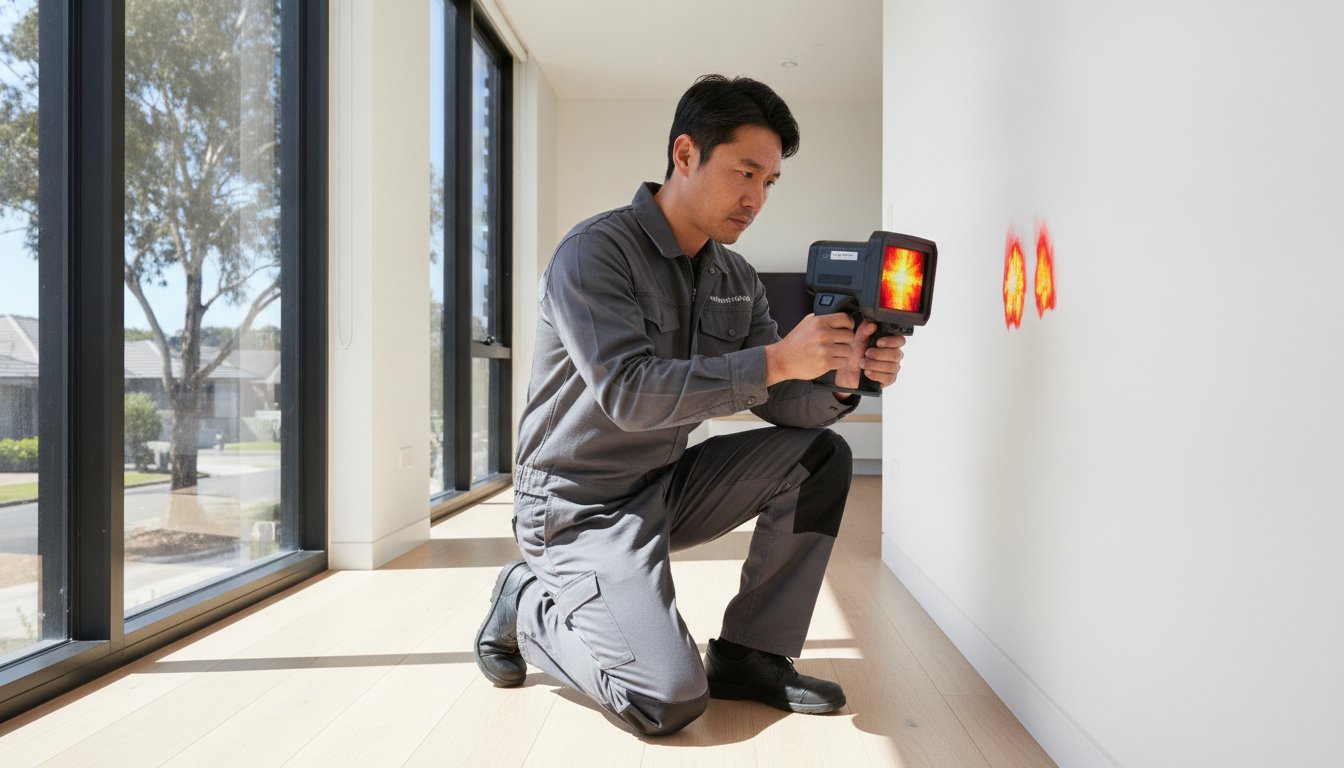
Thermal imaging allows us to see through the “skin” of your home. Large colonies generate significant metabolic heat, which creates a distinct thermal signature on our cameras. This technology is vital for historic Sydney homes in suburbs like Surry Hills or The Rocks. We can identify active hotspots without drilling into heritage-listed timbers or decorative cornices. In one recent case, a homeowner saw no external issues, but our thermal scan revealed a massive nest hidden deep inside a chimney breast. Without this technology, the colony would have continued eating into the roof trusses undetected. There are many termite species in Australia, and each behaves differently, making visual-only checks unreliable.
Moisture Meters and Acoustic Sensors
Termites are biologically programmed to seek out moisture. They require nearly 100% humidity to survive within their galleries. We use high-precision moisture meters to find unusual dampness behind your drywall, which often indicates a concealed nesting site. If a moisture reading is high, we follow up with acoustic sensors. These devices amplify the high-frequency clicking sounds made by soldier termites as they bang their heads against the wood to warn the colony of danger. This multi-layered approach ensures we don’t miss a single threat. Don’t leave your property’s safety to chance when the signs of termites Sydney homes exhibit are so difficult to see. If you’re ready to move beyond DIY guesswork, you can learn more about our Termite Inspection Sydney: What to Expect during a professional visit.
Termites vs. Ants: Identifying the ‘White Ant’ Myth
Many homeowners across the metropolitan area call us in a panic about “white ants” in their garden or sub-floor. Biologically, there’s no such thing as a white ant. This common misnomer often leads to dangerous complacency. If you assume you’re dealing with a standard garden ant, you might ignore the early signs of termites Sydney homes frequently exhibit. While both insects are small and live in colonies, they belong to entirely different orders. Mistaking one for the other can be the difference between a minor pest spray and a total structural failure. Understanding these anatomical differences is your first line of defense.
Anatomical Comparison Guide
The term ‘White Ant’ is simply a colloquialism for the subterranean termite. To protect your property, you must look closer at the physical characteristics of the insects you find. Termites have straight, beaded antennae, whereas ants have distinctively elbowed ones. Their waistlines are also a major giveaway. Termites have a thick, straight waist that blends into their abdomen; ants have a constricted, “pinched” waist that is easy to spot. If you find winged insects, check the wing size. Termites possess four wings of equal length, while ants have two pairs of unequal size. Coloration is often misleading. While many termites are pale or translucent, some species are darker, so don’t rely on color alone to make an identification.
- Antennae: Straight and beaded (Termites) vs. Elbowed (Ants).
- Waist: Thick and broad (Termites) vs. Thin and constricted (Ants).
- Wings: Four equal-sized wings (Termites) vs. Two unequal pairs (Ants).
- Behavior: Termites are photophobic and run from light; ants are often found foraging in the open.
Common Sydney Ant Species Often Mistaken for Termites
Carpenter ants are the most frequent source of confusion in New South Wales. These ants nest in wood, creating smooth galleries that look remarkably similar to termite damage. However, carpenter ants don’t eat the timber; they simply excavate it to build their homes. You will often see them foraging for food in your kitchen or along garden paths, which is a behavior termites never exhibit. Identifying these differences helps you determine if you’re reading the signs of termites Sydney experts worry about or a more manageable pest issue. For a broader look at local threats, see our article on What is a Pest? A Guide to Common Pests in Sydney. If you’ve found insects in your timber and can’t confirm their identity, don’t wait. Schedule your Sydney termite assessment today to prevent hidden damage from accelerating.
Action Plan: What to Do if You Find Signs of Termites
The moment you discover potential signs of termites Sydney homeowners often panic. Your first instinct might be to reach for a can of surface spray or to break open a mud tube to see what’s inside. Stop. This is the most critical mistake you can make. Termites are hyper-sensitive to light, vibrations, and foreign chemical scents. If you disturb their galleries or spray the few workers you see, the colony will immediately retreat. They don’t leave your house; they simply relocate to a different, more inaccessible part of the structure. This makes professional detection and baiting significantly harder and more expensive in the long run.
Instead of taking DIY action, follow the Golden Rule: leave everything exactly as you found it. Tape over any holes you’ve accidentally made with dark masking tape to restore the colony’s sense of security. This keeps the termites active in that specific location, which is vital for the success of professional treatment systems. Once the area is secure, your next step is to secure a professional assessment. A comprehensive inspection is the only way to determine the extent of the activity and the specific species involved.
Why Professional Intervention is Urgent
Time is your greatest enemy when dealing with subterranean pests. A mature colony can contain over two million individuals. In peak conditions, they can consume a meter of timber in as little as three to six months. This rapid rate of destruction is why you must act within 24 to 48 hours of finding evidence. Professional intervention provides more than just a quick fix; it offers a detailed written report compliant with Australian Standard AS 3660. This documentation is essential for your peace of mind, future insurance claims, and the eventual resale value of your property. We typically recommend one of two primary protection methods:
- Chemical Barriers: A treated zone in the soil around your home’s perimeter that prevents entry.
- Baiting Systems: Strategic stations that intercept scouts and eliminate the colony at the source.
The ABC Pest Control Sydney Approach
We’ve spent over 20 years protecting families across the Sydney metropolitan area from the devastating impact of timber pests. Every property is different. A terrace in Balmain requires a vastly different strategy than a modern slab-on-ground home in Western Sydney. Our team develops customized treatment plans that respect your family’s safety and the local environment. We use eco-friendly methods and advanced thermal technology to ensure the job is done right the first time. Don’t let a small issue turn into a structural catastrophe. Book your urgent termite inspection today and let our experienced technicians provide the definitive resolution you need.
Protect Your Sydney Investment Today
Your property is likely your most significant investment. In our high-risk coastal climate, ignoring the subtle indicators of pest activity isn’t a risk you can afford to take. We’ve explored how identifying mud tubes or hollow timber early can prevent devastating structural loss. You now understand that the vast majority of activity remains invisible to the naked eye; it requires the specialized thermal imaging and moisture meters that only experts provide.
Recognizing the signs of termites Sydney homeowners must watch for is only the beginning. True peace of mind comes from a definitive, professional assessment. Don’t wait for visible damage to appear before you take action. With over 20 years of local experience, we deliver AS 3660 compliant inspections that safeguard your property’s long-term resale value. Take the proactive step to secure your home’s future right now.
Secure your home with a professional Termite Inspection from ABC Pest Control Sydney. We provide free quotes for termite barriers and the reliable intervention you need. You can rest easy knowing your home is in the hands of seasoned Sydney specialists who prioritize your safety.
Frequently Asked Questions
What do the first signs of termites look like in a Sydney house?
The first indicators usually include pencil thin mud shelter tubes on your foundation or sub-floor piers. You might also notice translucent wings on windowsills or small piles of wood colored droppings called frass. These subtle changes often signal a massive colony is already active. Because termites eat timber from the inside out, the exterior usually looks normal until the damage is advanced. Stay alert for any bubbling paint that resembles water damage.
Can I see termites with the naked eye or are they always hidden?
You can see termites during a swarming event when winged “alates” leave the nest to start new colonies. Outside of these events, termites remain hidden within their mud tubes or deep inside timber galleries to maintain 100% humidity. If you break into a piece of infested wood, you will see small, pale, cream colored insects. However, their survival depends on avoiding light, so they spend 99% of their lives completely concealed from view.
How long does it take for termites to cause structural damage?
Significant structural damage can occur in as little as three to six months under peak conditions. A large colony of subterranean termites can consume a meter of timber in this short timeframe. While they don’t destroy a house overnight, their constant feeding means a delay of just a few weeks can result in thousands of dollars in extra repair costs. Factors like Sydney’s humidity and the presence of moisture accelerate this destructive process.
Are termite inspections covered by standard home insurance in NSW?
Standard home insurance policies in New South Wales don’t cover termite damage or the cost of inspections. Insurers classify termite activity as a preventable maintenance issue rather than a sudden, accidental event. This means you are personally responsible for all costs associated with structural repairs and professional treatments. Regular annual inspections are the only way to mitigate this financial risk and protect your investment from a total loss.
What is the difference between termites and white ants?
There is no biological difference; “white ant” is simply an outdated colloquial term for termites. While they share a similar colonial social structure, termites are more closely related to cockroaches than ants. You can distinguish them by their straight antennae and thick, broad waists. True ants have elbowed antennae and a constricted, pinched waist. Understanding this distinction ensures you don’t dismiss dangerous signs of termites Sydney as a harmless ant trail.
How often should I have a termite inspection in Sydney?
Australian Standard AS 3660 recommends a professional termite inspection at least once every 12 months. In high risk areas like Sydney’s Inner West or Northern Beaches, some properties may require more frequent checks every six months. Regular inspections using thermal imaging and moisture meters ensure that any new activity is caught before it compromises the structural integrity of your home. Consistent monitoring is the foundation of a reliable defense strategy.
What should I do immediately if I find a mud tube?
Do not touch, break, or spray the mud tube with household chemicals. If you disturb the lead, the colony will retreat and hide deeper in your walls; this makes professional treatment far more difficult. Tape over any accidental openings with dark tape to keep the termites active in that spot. Immediately contact a professional to conduct a full inspection. Keeping the termites undisturbed allows us to use effective baiting systems to eliminate the entire colony.
Are termite treatments safe for my pets and children?
Modern professional termite treatments are designed with family and pet safety as a priority. We use eco friendly methods and targeted baiting systems that focus specifically on termite biology without impacting humans or domestic animals. Our chemical barriers are applied according to strict Australian safety standards to ensure no harmful residues enter your living spaces. Always inform your technician about any specific health concerns or pets so we can tailor the application for maximum safety.