
Last Tuesday, a homeowner in Surry Hills discovered that a tiny 2cm gap behind her dishwasher had allowed a family of mice to turn her kitchen into their personal pantry. It’s a stressful reality for many Sydney residents who find themselves lying awake at 2:00 AM listening to scratching inside their walls. You shouldn’t have to worry about pests chewing through your expensive electrical wiring or spreading diseases in your home. Learning how to block rodent entry points is the most effective way to reclaim your peace of mind and protect your property from long-term damage.
We agree that your home should be a sanctuary, not a playground for pests. You need a permanent solution that actually works, rather than a temporary fix that fails after a few weeks. This guide promises to reveal the exact methods and chew-proof materials our professional exterminators use to seal every possible access point. We will walk you through a step-by-step process to identify hidden vulnerabilities and apply expert-level mouse-proofing techniques to keep your family safe and your home secure.
Key Takeaways
- Master the “Pencil vs. Thumb” rule to identify gaps as small as 6mm that allow mice and rats to breach your home’s defenses.
- Learn how to block rodent entry points using professional mechanical barriers instead of standard expanding foams that rodents can easily chew through.
- Discover the “Stuff and Seal” technique and why removing pheromone trails is a critical step for a permanently pest-free environment.
- Identify and eliminate “bridge” entries in your garden to reduce the physical pressure rodents place on your home’s exterior structure.
- Understand when to call in the experts for thermal imaging inspections to locate hidden colonies and heat signatures deep within wall cavities.
Identifying Rodent Entry Points: Where the Invasion Begins
Rodent exclusion is the professional process of physically sealing your home to stop pests before they ever step foot inside. It’s the most effective way to protect your family and property. While traps and baits manage existing problems, Exclusion techniques provide a permanent solution by removing the welcome mat entirely. At ABC Pest Control, we’ve spent over 20 years perfecting these methods across Sydney to ensure your home remains a sanctuary, not a nesting ground.
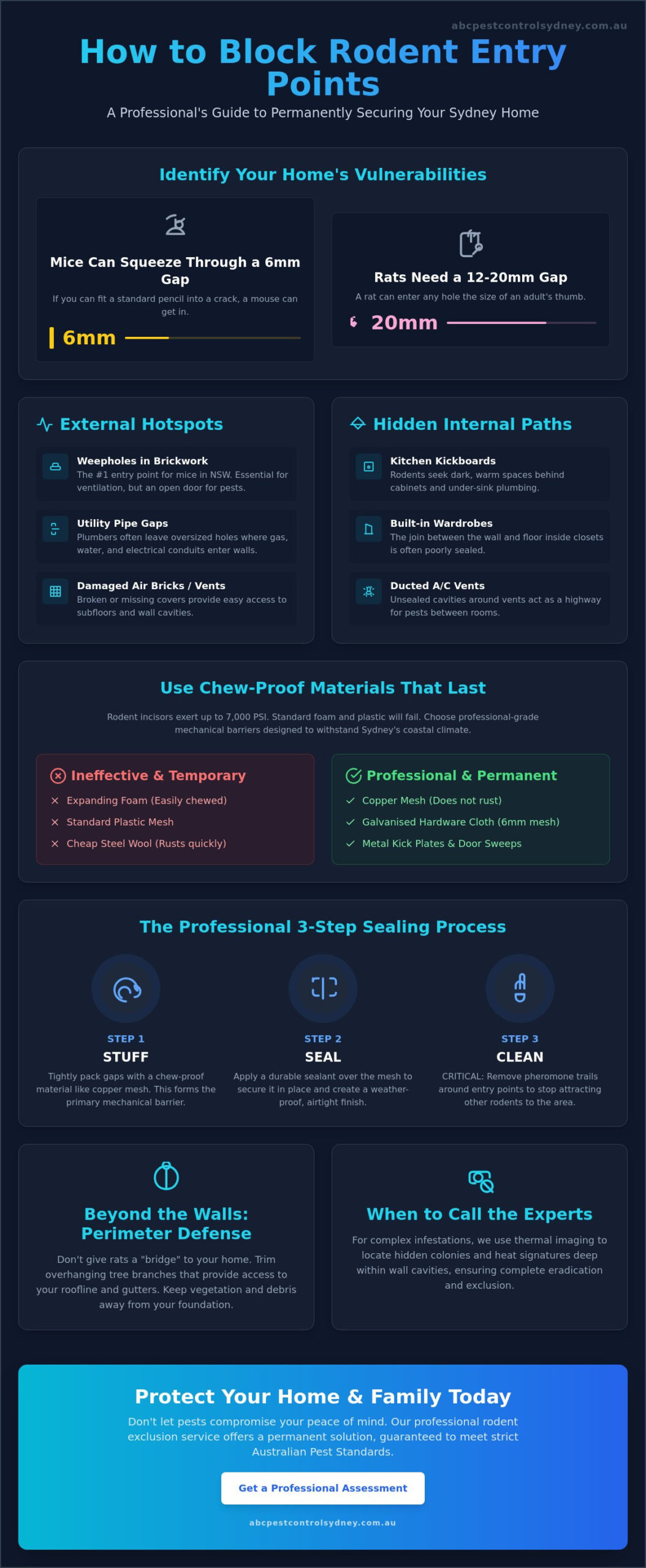
Mice and rats are master contortionists with flexible skeletons. To understand how to block rodent entry points, you must apply the “Pencil vs. Thumb” rule. A mouse only needs a 6mm gap to enter, which is roughly the width of a standard pencil. A rat requires slightly more space, about 12 to 20mm, or the width of an adult thumb. If you can fit a pencil into a crack, a mouse can get in. It’s that simple and that urgent.
Sydney’s unique climate plays a massive role in pest vulnerability. Our shifting clay soils and high humidity levels cause building materials to expand and contract throughout the year. This movement creates fresh gaps in foundations and walls that weren’t there six months ago. We recommend a 360-degree inspection that covers everything from the lowest foundation vent to the highest roofline. Rats are excellent climbers and often use overhanging branches to access your roof tiles or guttering.
Common External Access Points in Sydney Homes
- Weepholes in brickwork: These are the #1 entry point for mice in New South Wales. They’re essential for ventilation but provide an open door for small rodents.
- Utility pipe gaps: Check where gas, water, and electrical conduits enter your walls. Plumbers often leave holes larger than the pipe itself.
- Damaged air bricks: Broken or missing vent covers allow easy access to the subfloor or wall cavities.
Hidden Internal Entryways You Might Miss
Once a rodent is in your walls, it looks for ways into your living space. You must know how to block rodent entry points inside the home to stop them from reaching your food and wires. Our expert technicians frequently find activity in these hidden spots:
- Kitchen kickboards: Rodents love the dark, warm spaces behind cabinets and under-sink plumbing.
- Built-in wardrobes: The interface where the wall meets the floor inside a closet is often poorly sealed.
- Ducted air conditioning: Unsealed cavities around AC vents act as a highway for pests to travel between rooms undetected.
Don’t wait until you hear scratching in the walls to take action. Identifying these vulnerabilities is the first step toward a pest-free home. You’re in expert hands with our highly trained team, and we guarantee results that follow strict Australian Pest Standards.
The Best Materials for Blocking Rats and Mice
Standard expanding foam and plastic mesh won’t stop a determined rat. These pests possess incisors that exert pressure up to 7,000 pounds per square inch. They’ll chew through soft plastic or wood in seconds. Effective exclusion requires mechanical barriers that cause physical discomfort or are simply too hard to penetrate. When you are learning how to block rodent entry points, you must choose materials that withstand Sydney’s unique climate. Our coastal salt air and high humidity will corrode cheap steel wool in less than 30 days, leaving ugly rust stains on your masonry. Professional-grade materials ensure your home remains a fortress for years rather than weeks.
For homeowners, permanent solutions like masonry and heavy-gauge metal are the standard. Renters can use high-quality removable barriers that don’t damage the property but still provide high-level protection. Rodent-proofing your home is a detailed process that relies on the durability of your chosen “fill” and “seal” components.
Chew-Proof Hardware Essentials
Stainless steel wool is a reliable choice for dry areas, but copper mesh is the superior option for Sydney’s wet zones and external walls. Copper does not rust, meaning it won’t leave orange streaks on your brickwork after a storm. For larger openings like subfloor vents or crawl spaces, use galvanised hardware cloth. Ensure the mesh size is no larger than 6mm; anything bigger allows juvenile mice to squeeze through. External doors often have gaps at the base. Install metal kick plates or heavy-duty door sweeps to eliminate these common how to block rodent entry points vulnerabilities. These metal barriers are impossible for rodents to gnaw through and provide a clean, professional finish.
Specialised Sealants and Fillers
Don’t reach for standard DIY store sealants. We use professional rodent-proof expanding foams that contain stainless steel fibers or intense bittering agents. These additives stop chewing immediately by causing physical discomfort. For gaps in masonry foundations or brickwork, quick-set mortar or concrete is the only permanent answer. These materials provide a rock-hard barrier that rodents cannot bypass. If you’re dealing with small cracks less than 5mm wide, use a heavy-duty silicone-based caulking. This remains flexible but tough enough to deter pests. If you’re unsure which material fits your specific gap, you can book a professional inspection to get an expert recommendation for your property.
- Copper Mesh: Best for coastal areas to prevent rust.
- Galvanised Cloth: Essential for vents and large voids.
- Rodent-Proof Foam: Contains fibers that hurt rodent teeth.
- Mortar: The gold standard for permanent foundation repairs.
Step-by-Step Guide: How to Block Rodent Entry Points
Taking action now prevents a small intrusion from becoming a full-blown infestation. You’re in expert hands when you follow these professional steps to secure your Sydney property. Before you begin, put on your personal protective equipment. This includes a P2 respirator mask and heavy-duty gloves. Rodent waste contains bacteria and pathogens that become airborne when disturbed. Don’t take risks with your health while you work.
- Clean the area: Use a disinfectant or a 10% bleach solution to scrub the entry point. This removes pheromone trails that act as a digital map for other rodents.
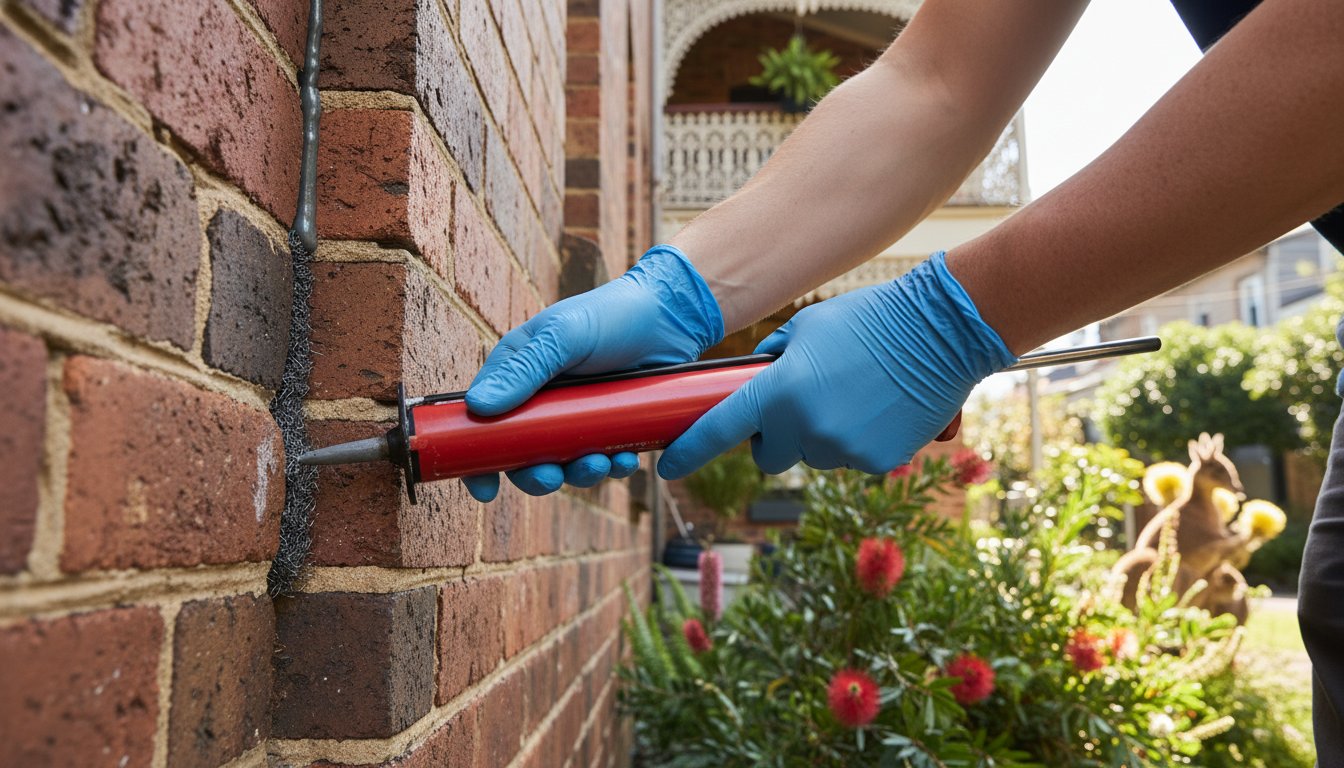
- The “Stuff and Seal” method: Use stainless steel wool or copper mesh to fill gaps. Mice can’t chew through these metals. Apply a high-quality, weather-resistant sealant over the mesh to create a permanent, airtight barrier.
- Verify the seal: Use a high-lumen torch and an inspection mirror. If you see light passing through a gap from the opposite side, the seal isn’t complete.
Learning how to block rodent entry points requires extreme attention to detail. A mouse can squeeze through a gap as small as 6mm, which is roughly the width of a standard ballpoint pen. If a pencil fits in the hole, a mouse fits too. Focus your efforts on the foundation level first and work your way up to the roofline.
Sealing Weepholes and Vents
Sydney brick homes rely on weepholes for essential cavity ventilation. Never block these with mortar or expanding foam, as this causes dampness and structural rot. Instead, install specialised stainless steel weephole guards that allow airflow but stop pests. For irregular subfloor vents, measure the opening and cut 6mm galvanised hardware cloth to size. Secure the mesh using masonry screws or heavy-duty adhesive to ensure it stays in place during heavy rain.
Proofing Pipe Penetrations and Roof Gaps
Gaps around air conditioning lines and plumbing are common highways for rats. Create a custom “collar” using metal flashing or heavy-duty mesh around every pipe entering your walls. For rooflines, inspect the junction where the fascia meets the guttering. Older Sydney properties often have warped timber or gaps in the eaves that provide easy access to the ceiling void. Exclusion is the process of physically barring pests from entering a structure, and it remains the most cost-effective long-term pest strategy.
Beyond the Walls: Perimeter and Garden Proofing
You’ve sealed the gaps at ground level. That’s a great start. But rodents are agile climbers. They use “bridge” entries to bypass your hard work. If a branch touches your roof, it’s a highway for pests. Learning how to block rodent entry points means looking up, not just down. High-level access is a major risk for Sydney properties with established gardens. Our team sees this daily. Mice and rats use overhead lines and foliage to enter through eaves or roof vents.
Vegetation management is essential to reduce rodent pressure. When plants grow against your home, they provide cover and easy access. This creates a “safe zone” where rodents can gnaw on your structure undisturbed. Reducing this pressure is just as vital as sealing the holes themselves. For more comprehensive outdoor strategies and professional advice, view our Rodent Control Sydney guide.
Rubbish is the #1 outdoor attractant. Improperly stored waste or pet food left in bowls will draw rodents from blocks away. Once they’re in your yard for the food, they’ll start looking for a way into your warm home. Use heavy-duty bins with tight-fitting lids. Stop feeding pets outside after dark. These simple changes make your property much less appealing to local colonies.
Eliminating Natural Bridges
Trim tree branches so they’re at least 2 metres away from your roofline. Roof rats are common in Sydney and can leap significant distances. Remove climbing vines like ivy immediately. They’re essentially ladders for mice. Keep garden beds tidy and clear of thick ground cover. Move woodpiles at least 5 metres away from the house foundation. This removes “harbourage” sites where rodents hide before trying to enter. Don’t let your garden become a staging ground for an invasion.
Securing Outdoor Structures
Garden sheds and detached garages often lack the tight seals of a main home. Check these buildings for gaps larger than 5mm. Install a gravel border 150mm wide and 100mm deep around the perimeter of concrete slabs. Rodents hate digging through loose gravel because the tunnels collapse. Secure compost bins with heavy-duty wire mesh at the base. If you keep chickens in suburban Sydney, use rodent-proof feeders. Spilled grain is a primary reason for localized rat outbreaks.
Stop rodents before they reach your door. Book a professional perimeter inspection with ABC Pest Control today and protect your home.
When to Call ABC Pest Control for Professional Exclusion
Learning how to block rodent entry points is a vital skill for every Sydney homeowner, but DIY efforts have clear limits. If you already hear scratching inside your wall cavities or ceiling voids, the infestation has likely moved beyond simple gaps. Established colonies are stubborn. A single pair of mice can produce up to 10 litters a year, meaning a small entry point you missed can quickly lead to hundreds of rodents living out of reach. When pests are nesting deep within your home’s structure, standard hardware store solutions won’t be enough to stop the cycle.
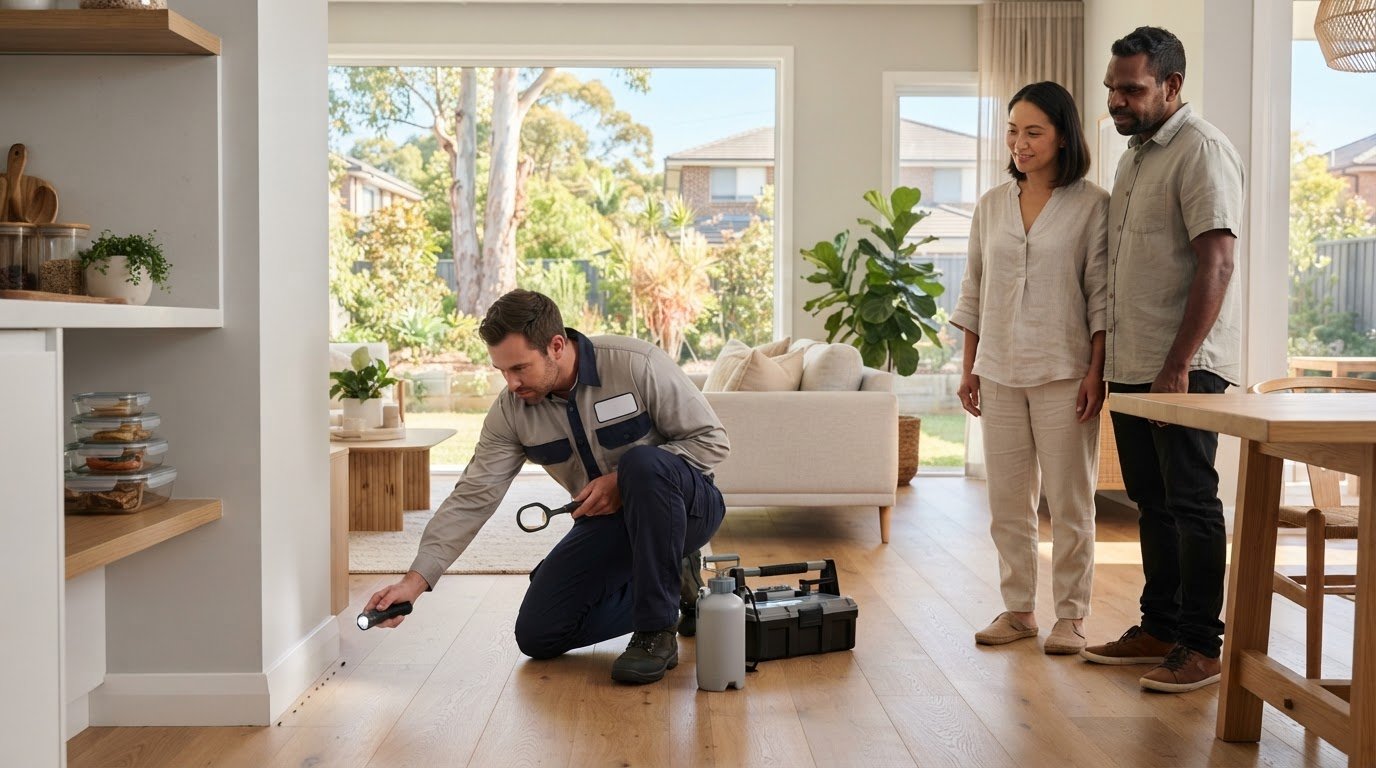
Our team uses professional thermal imaging technology to find what the naked eye misses. These cameras detect hidden heat signatures behind plasterboard and under floorboards. Instead of guessing where the nests are, we pinpoint the exact locations of rodent activity. This high-tech approach ensures we address the root of the problem without unnecessary damage to your property. It’s the most efficient way to handle complex infestations in Sydney’s diverse housing stock.
Sydney architecture presents unique challenges for exclusion. Whether you live in a historic Victorian terrace with crumbling mortar or a modern apartment with complex utility penetrations, rodents find a way in. We specialise in “Tough Pests” that other companies struggle to manage. Our “Safety First” approach means we prioritise eco-friendly and non-toxic methods. You don’t have to worry about harsh chemicals affecting your family or pets while we secure your home’s perimeter.
The ABC Advantage: 20 Years of Sydney Expertise
Our technicians bring over 20 years of local experience to every property. We follow strict Australian Pest Standards to ensure every exclusion job is durable and effective. We don’t just patch holes; we provide long-term structural security. Many of our clients choose our “Deluxe Package,” which is our most popular service. This comprehensive plan combines total elimination of the current population with professional-grade structural proofing to prevent future break-ins.
You can trust our authority in the industry. Our Operations Manager is a recognised pest expert whose insights have been featured in the Daily Mail and Yahoo News. This media-backed expertise ensures that the strategies we use on your home are the same ones trusted by national news outlets. We understand the specific behaviours of Sydney rats and mice, allowing us to outsmart them every time.
Book Your Professional Rodent Inspection Today
Speed is essential when dealing with rodents. Our digital platform allows you to book an inspection in under 60 seconds, providing the urgent response you need. We provide a clear guarantee for our customers: we don’t just kill the rats; we keep them out. Our team focuses on permanent results so you can stop worrying about uninvited guests in your kitchen.
Don’t wait for rodents to chew through your electrical wiring or contaminate your food. Take the professional route to a pest-free home today. Get a Free Rodent Control Quote Today and let our experts handle the hard work of mouse-proofing your property.
Secure Your Sydney Home Against Unwanted Intruders
Mastering how to block rodent entry points is the most effective way to protect your property from structural damage and health risks. You now have the knowledge to identify hidden gaps and use professional-grade materials like steel mesh to seal your home tight. Remember that consistent garden maintenance and perimeter checks are just as vital as fixing internal walls. Even a tiny crack can invite a colony of mice into your living space, so staying vigilant is key.
If the task feels overwhelming, you’re in expert hands with ABC Pest Control. We bring over 20 years of Sydney pest control experience to your doorstep. Our technicians follow all Australian Pest Standards, ensuring every treatment is safe and non-toxic for your family and pets. As recognised industry leaders featured in Yahoo News and Daily Mail, we specialize in permanent exclusion strategies that actually work. Don’t wait until rats cause expensive electrical damage or contaminate your kitchen pantry.
Get Rid of Rodents Today – Book Your Sydney Inspection in Under 60 Seconds
Take the first step toward a pest-free life today and enjoy the peace of mind you deserve.
Frequently Asked Questions
What is the best material to block mouse holes?
The most effective materials to block mouse holes are 6mm galvanised steel mesh and stainless steel wool. These materials are too hard for rodents to gnaw through and provide a permanent barrier. You should avoid using plastic, wood, or rubber because mice can chew through these soft surfaces in less than 24 hours. For a professional finish, we recommend securing the mesh with a strong adhesive or screws to ensure it stays in place.
Can mice chew through expanding foam?
Yes, mice can easily chew through standard expanding foam because the soft, airy texture offers no resistance to their teeth. Most rodents will shred foam in minutes to create a nest or gain entry. If you use foam, you must pack the hole with copper mesh or steel wool first. This creates a physical barrier that stops them. Learning how to block rodent entry points correctly requires using these reinforced materials rather than relying on foam alone.
How small of a hole can a rat fit through?
A rat can fit through a hole as small as 12 millimetres, which is roughly the size of an adult human thumb. Mice are even more agile and can squeeze through a 6 millimetre gap, which is about the width of a standard pencil. Their ribs are flexible and their bodies are highly compressible. This is why our technicians inspect every millimetre of your property to ensure no tiny cracks remain open for pests to exploit.
Should I use steel wool or copper mesh for rodent proofing?
Copper mesh is the superior choice for rodent proofing because it does not rust or degrade over time. Standard steel wool can rust and leave permanent orange stains on your walls when exposed to Sydney’s humidity. Copper mesh stays tightly packed in gaps and provides a sharp, unpleasant texture that stops rodents from gnawing. It’s a reliable, long-term solution for homeowners who want to protect their property without causing unsightly damage to the exterior.
How do I find where rodents are entering my house?
You can find entry points by looking for dark “rub marks” caused by oils in rodent fur against your walls. Check around pipe penetrations, vents, and roof lines using a high-powered torch. Look for droppings or chewed insulation near corners and skirting boards. Our experts use over 20 years of experience to identify these hidden gaps. If you’re struggling to find the source, book an inspection in under 60 seconds for a professional assessment.
Is it better to trap rodents before or after sealing the holes?
You should seal the entry points at the same time you begin your trapping program. If you trap before sealing, new rodents will simply replace the ones you catch. Sealing the exterior ensures no more pests enter your living space. Once the perimeter is secure, you must place traps inside immediately to catch any rodents already stuck within your wall cavities. This two-step process is the most effective way to manage a tough infestation.
Do ultrasonic rodent repellers actually work for entry points?
Ultrasonic rodent repellers are generally ineffective for protecting entry points or eliminating an infestation. Research from the University of Arizona indicates that rodents quickly become used to the sound and eventually ignore it. These devices don’t provide a physical barrier to stop pests. For real results, you need a professional solution that focuses on structural exclusion. Understanding how to block rodent entry points with physical materials is always more reliable than using electronic gadgets.
How much does professional rodent proofing cost in Sydney?
Professional rodent proofing costs in Sydney typically range from A$250 to A$650 for a standard residential property. The final price depends on the size of your home and the number of entry points that require sealing. This investment covers high-quality materials and expert labour to ensure your home meets Australian Pest Standards. For a specific price tailored to your needs, our team provides transparent quotes after a thorough on-site inspection of your property’s perimeter.