What if the tiny moth you just saw fluttering in your hallway isn’t the real enemy, but merely a distraction from the invisible larvae currently harvesting your favourite A$400 merino jumper? If you have discovered holes in wool clothing, identifying what pest is responsible is likely the only thing on your mind as you tally up the cost of the damage. You’ve likely felt that sudden jolt of panic after pulling a beloved winter coat from the wardrobe only to find it riddled with holes. It’s heartbreaking to see quality investments destroyed, and the anxiety about an infestation spreading through your home is completely valid.
You don’t have to guess which creature is responsible or watch your wardrobe disappear piece by piece. We understand the urgency of protecting your property and offer the peace of mind that comes with twenty years of Sydney expertise. This guide will help you identify exactly which fabric pest is causing the destruction. You’ll learn immediate, actionable steps to rescue your clothes and discover how our General Pest Control Packages provide a permanent solution to keep your wardrobe safe. Stop the damage now before your most expensive items become nothing more than expensive snacks.
Key Takeaways
- Identify the specific larvae eating your clothes by distinguishing between the irregular damage of moths and the clean cuts of carpet beetles.
- Pinpoint the exact cause of holes in wool clothing what pest is responsible, and why standard repellents like cedar and lavender often fail to stop an active infestation.
- Understand the keratin connection to see why your expensive wool, silk, and cashmere items are targeted while synthetic fabrics remain untouched.
- Recognise how Sydney’s humid climate accelerates breeding cycles, making seasonal wardrobe transitions the highest-risk period for your clothing.
- Secure your luxury investments with professional General Pest Control Packages that provide a permanent, eco-friendly solution to eliminate deep-seated infestations.
Why Pests Target Your Woollens: The Keratin Connection
You open your wardrobe and see it: a jagged hole in your favourite jumper. When investigating holes in wool clothing what pest is the culprit, the answer lies in biology. These pests aren’t just looking for a place to hide. They are looking for a buffet. In Sydney homes, these larvae thrive in the dark, quiet corners of your closet where they can feed undisturbed.
What is Keratin and Why Do Pests Want It?
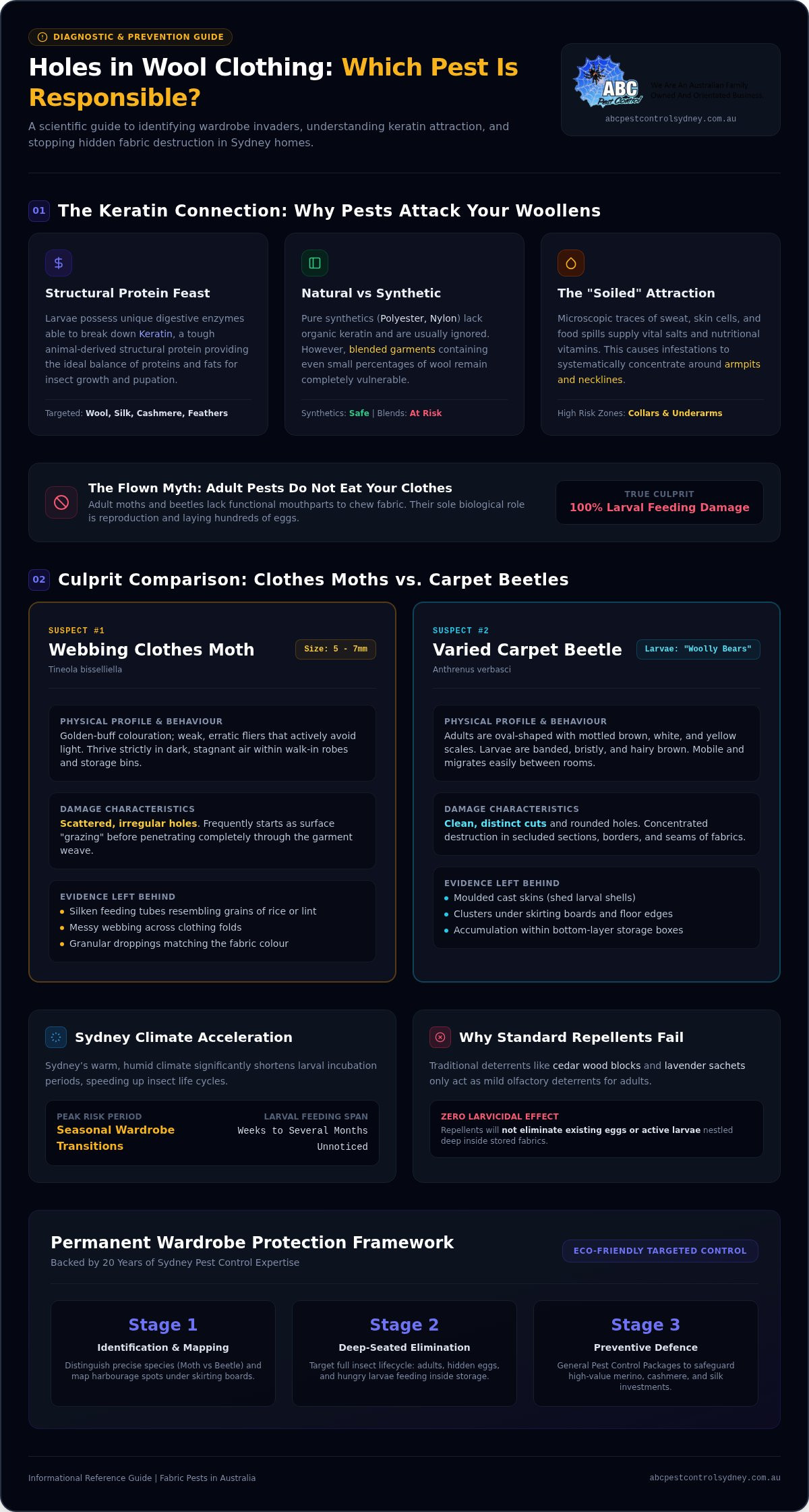
Keratin is a structural protein found in animal-derived materials like wool, silk, feathers, and human hair. While humans can’t digest it, the larvae of certain clothes moths and beetles possess unique digestive enzymes that break down these tough fibres. This biological advantage allows them to turn your clothing into a high-protein food source. Wool provides the perfect nutritional balance of proteins and fats required for these insects to grow and pupate.
Synthetic fibres like polyester or nylon are usually ignored because they lack this organic protein. However, if your synthetic blend contains even a small amount of wool, it’s still at risk. Pests are even more attracted to “soiled” clothing. Microscopic traces of sweat, skin cells, or food spills provide essential vitamins and salts that help larvae thrive. This is why you often find damage concentrated around the armpits or necklines of your jumpers.
The Invisible Danger: Adult Pests vs. Hungry Larvae
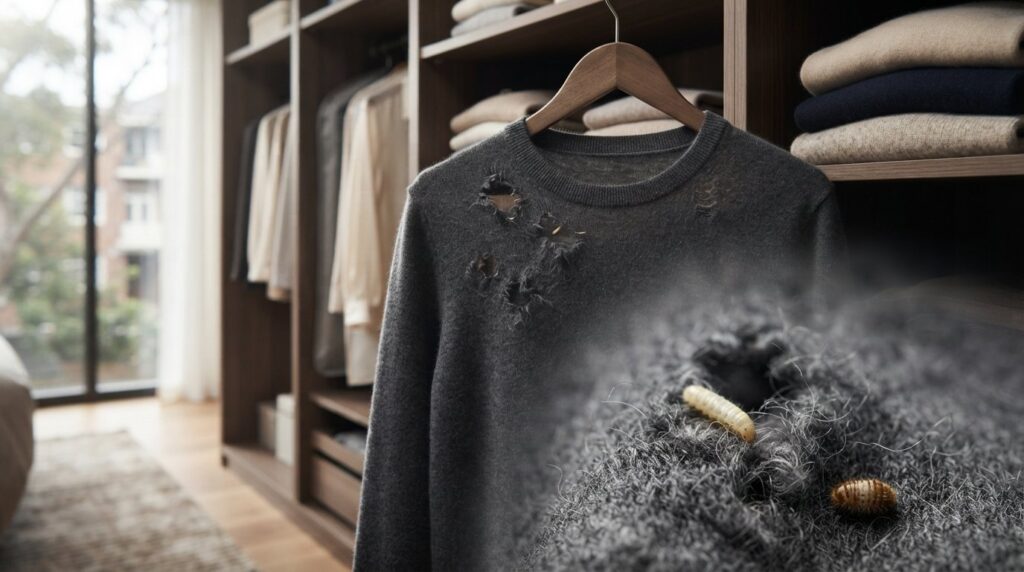
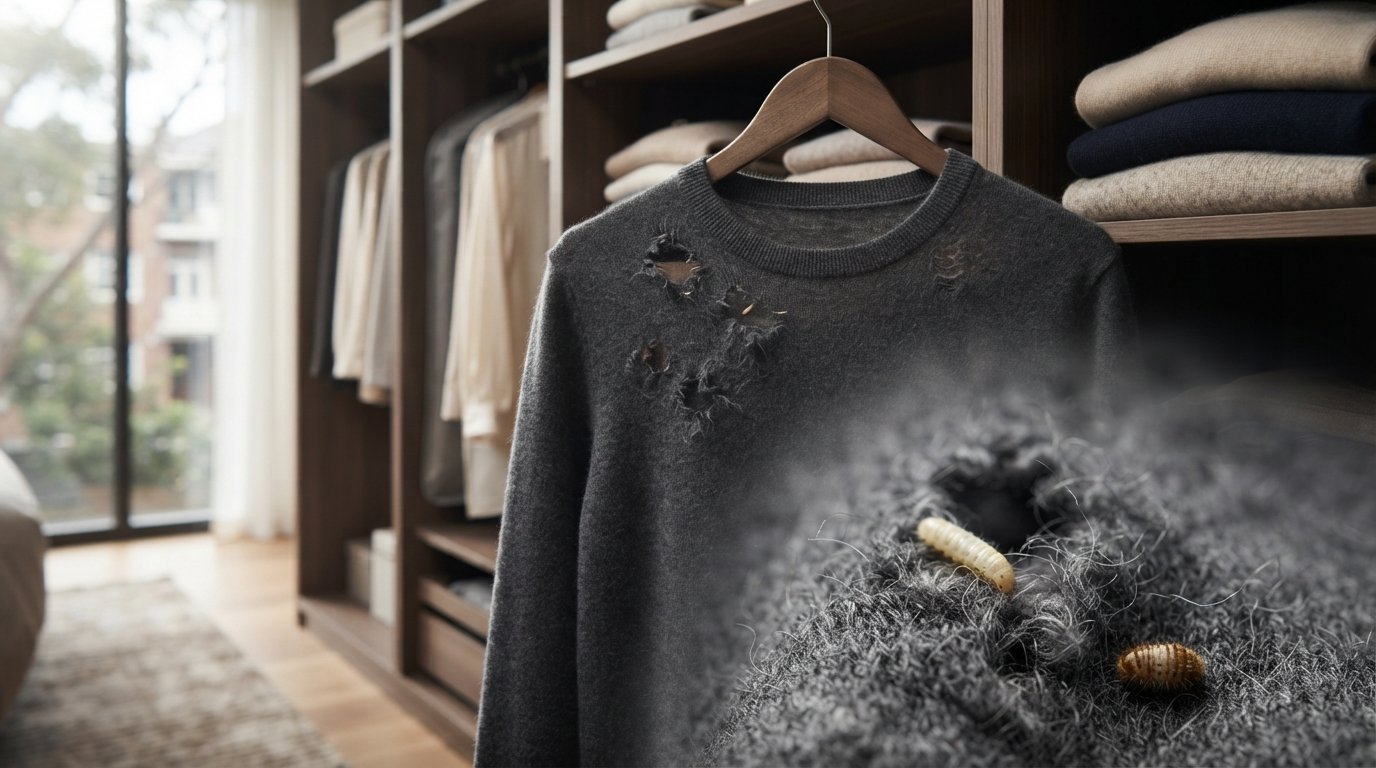
Don’t be fooled by the fluttering moth in your bedroom. Adult moths and beetles actually lack the mouthparts to eat fabric. Their only job is to find a safe spot to lay hundreds of eggs. The real destruction comes from the larvae. These tiny, worm-like grubs are the ones systematically chewing through your wardrobe. They prefer dark, undisturbed environments, which makes your stored winter woollens an ideal target.
Seeing an adult moth is a major warning sign. It means there are likely eggs or active larvae already nestled deep within your stacks of clothing. Finding a hole means the damage is already advanced. Larvae can feed for weeks or even months before you notice the first sign of trouble. By the time you wonder about holes in wool clothing what pest is responsible, the infestation has likely been active for quite some time. You need to act quickly to stop the cycle before more items are lost.
The Usual Suspects: Clothes Moths vs. Carpet Beetles
Identifying the specific intruder is the first step toward saving your wardrobe. In Sydney, the question of holes in wool clothing what pest is responsible usually narrows down to two main offenders: the Webbing Clothes Moth and the Varied Carpet Beetle. While both consume keratin, they leave behind very different calling cards. Understanding these differences is essential for effective treatment and peace of mind.
Identifying the Webbing Clothes Moth
These pests are small, golden-buff coloured insects measuring roughly 5 to 7mm. They are weak fliers and prefer the dark, stagnant air of a walk-in robe. Because they avoid light, you’ll rarely see them flying in the middle of a room. For more technical details on their life cycle and habits, you can refer to expert guides on clothes moth identification and control. They are notorious for their stealth and ability to hide in the tightest crevices.
Look for silken tubes or “cases” attached to the fabric. These often look like small grains of rice or clumps of lint. Moth damage is typically scattered and irregular. It often starts as “grazed” patches on the surface before a full hole develops. If you find messy webbing or granular droppings that match the colour of the fabric, you’re almost certainly dealing with moths.
Spotting the Varied Carpet Beetle
The adult Varied Carpet Beetle looks quite different. It is oval-shaped with a mottled pattern of brown, white, and yellow scales. However, the adult beetle doesn’t eat your clothes. The damage is caused by its larvae, known as “woolly bears” due to their hairy, brown appearance. These larvae are highly resilient and can migrate between rooms, often hiding under skirting boards or inside storage bins. You can find more detail on the Carpet Beetle in Australia to better understand their specific behaviour in local climates.
If you’ve discovered holes in wool clothing what pest you are facing depends on the shape of the damage. Beetle damage is often concentrated in one specific area, resulting in large, clean-cut holes rather than the messy webbing associated with moths. They often leave behind translucent, brown shed skins as they grow. If you notice these signs, don’t wait for the infestation to spread. Our General Pest Control Packages provide a professional shield for your luxury items, ensuring these pests are eliminated before more damage occurs.
Beyond the Holes: Hidden Signs of an Infestation in Sydney
Sydney’s humid, subtropical climate provides the perfect breeding ground for fabric pests. While many homeowners only react after finding holes in wool clothing what pest is responsible often leaves a trail of breadcrumbs long before the first fibre is severed. High humidity levels in coastal New South Wales accelerate the metabolic rates of larvae. This means they eat more, grow faster, and reproduce more frequently than they would in drier environments. An infestation that might take a year to establish in a cooler climate can explode in just a few months here.
Seasonal transitions are particularly high-risk periods. When you pack away your winter woollens in spring, you might be sealing a few eggs into an ideal, dark environment. Without the regular movement of air or light, these eggs hatch and the larvae feast undisturbed for months. By the time you pull your jumpers out for the next winter, the damage is already done.
Check these hidden hotspots regularly to catch an issue early:
- Under heavy furniture that hasn’t been moved in months.
- Along the crevices of skirting boards near carpeted areas.
- Inside the dark corners of drawers and at the bottom of laundry baskets.
- Behind hanging clothes in walk-in wardrobes where air circulation is poor.
Larval Skins and Frass: The Evidence They Leave Behind
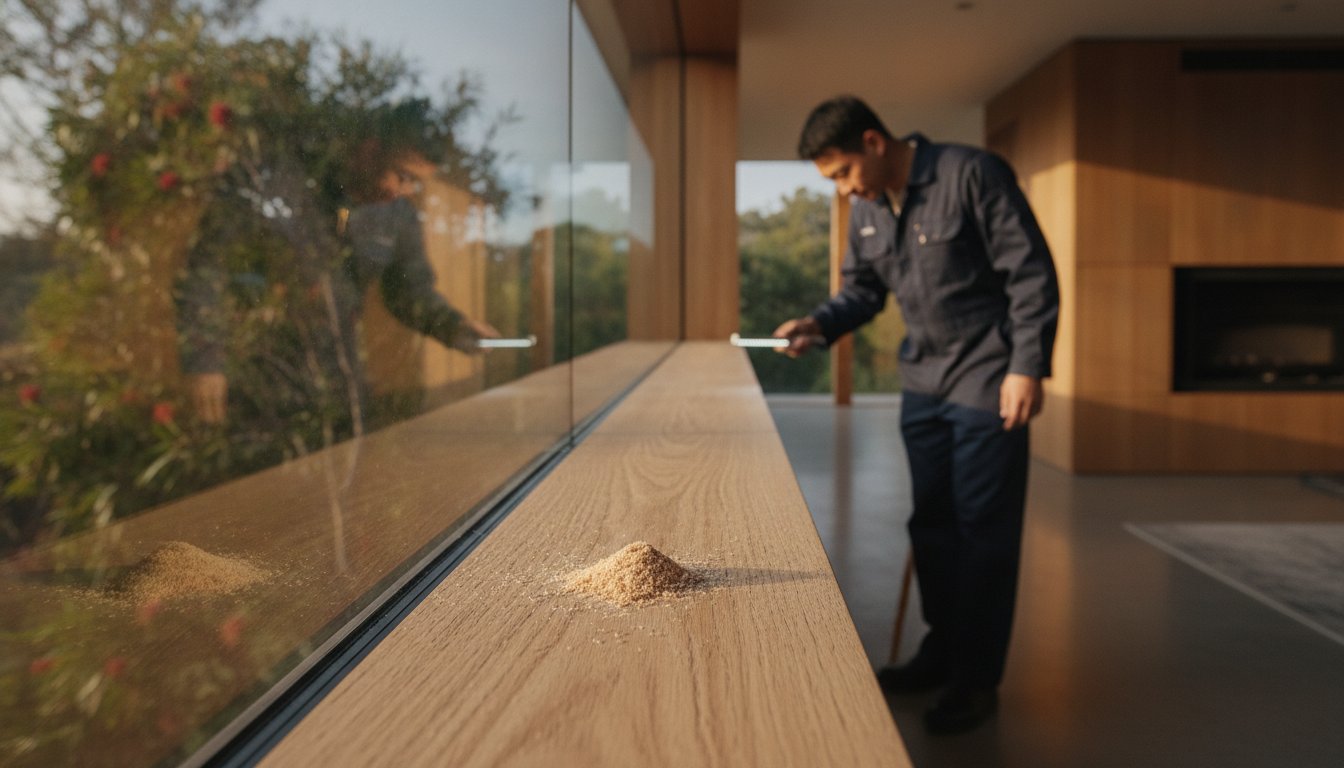
Before you see a hole, you might notice “frass.” This is essentially pest excrement. It often looks like fine, granular sand or colourful pepper that matches the shade of the fabric being consumed. If you see these tiny particles at the bottom of a drawer or on a shelf, it’s a clear sign of an active colony. Larvae shed their skin as they grow, leaving behind these papery husks as evidence of their development. Finding translucent, hollow “skins” in your drawers means the larvae are maturing and the infestation is expanding rapidly.
Nesting Grounds: Where Pests Hide in Your Home
Suitcases and plastic storage bins are common trap zones. If these containers aren’t 100% airtight, pests will find a way in. Once inside, they have a protected environment with a concentrated food supply. This is why you should never store clothes that haven’t been professionally cleaned, as even tiny amounts of organic matter can sustain a population for a long time.
Don’t overlook your floors. Wall-to-wall wool carpets often act as a massive reservoir for wardrobe pests. Larvae can live happily in the edges of the carpet under your bed and then migrate into your wardrobe. Professional pest control Sydney services use specialised equipment to identify these hidden reservoirs. We look beyond the wardrobe to ensure the entire population is eradicated, preventing a cycle of re-infestation that DIY methods often miss.
Why Standard Repellents Often Fail to Protect Your Clothing
When you discover holes in wool clothing what pest is the culprit, your first instinct might be to rush to the supermarket for cedar blocks or lavender sachets. While these smell pleasant, they are often a waste of money when dealing with an active infestation. These natural solutions are repellents, not eradicators. They might discourage a new moth from landing, but they won’t stop the hungry larvae already nestled in your cashmere. Cedar oils lose their potency quickly, and lavender simply isn’t strong enough to kill deep-seated larvae.
Traditional mothballs are even more problematic for Sydney homeowners. They rely on toxic chemicals like naphthalene that leave a pungent, lingering odour. This scent can be nearly impossible to remove from delicate fibres. They also pose health risks to pets and children in confined spaces. Simply “cleaning the hole” by washing one garment won’t solve the problem either. Eggs are microscopic and often hide in the seams of surrounding clothes or the cracks of your wardrobe. You need a comprehensive approach to ensure your entire collection is safe.
Off-the-shelf sprays often contain harsh solvents that can permanently stain or degrade high-value wool and silk. Using these products without expert guidance is a gamble with your luxury investments. Professional intervention is the only way to guarantee that the treatment is both safe for your family and lethal to the pests.
Repellents vs. Insecticides: Understanding the Difference
Repellents act like a “Keep Out” sign, while insecticides are designed to eliminate the population. If you already have damage, you need to break the life cycle immediately. Most larvae are surprisingly resistant to the mild scents used in natural deterrents. Professional treatment ensures that every stage, from egg to adult, is neutralised safely. This prevents the next generation from hatching and continuing the destruction.
The Danger of Misidentifying the Pest
Using the wrong product is a costly mistake. If you treat for moths but the actual culprit is a rodent chewing through your storage bins, the damage will continue. A professional diagnosis is far more cost-effective than a trial-and-error approach with hardware store products. One-size-fits-all solutions often lead to recurring issues because they don’t address the specific nesting habits of the pest in your home.
Don’t let a small issue turn into a total wardrobe loss. Secure your investment today by booking our General Pest Control Packages for expert intervention and total peace of mind.
Professional Wardrobe Protection: The ABC Pest Control Solution
Finding holes in wool clothing what pest is responsible is only half the battle. The real challenge is ensuring the infestation doesn’t return to finish off your remaining items. Many people rely on online forums that suggest washing clothes at high heat. While this might kill some larvae, it fails to address the microscopic eggs tucked into wardrobe hinges, skirting boards, and carpet joins. You need a solution that treats the environment, not just the garment.
Our General Pest Control Packages are designed to provide this total protection. We leverage over 20 years of experience in the Sydney metropolitan area to identify the specific nesting habits of fabric pests in your home. We use eco-friendly, safe extermination methods that are specifically chosen for residential wardrobes. You don’t have to worry about harsh chemical residues on your luxury woollens or silk ties. Our professional intervention is the ultimate insurance for a high-value wardrobe.
To prepare for your treatment, we recommend clearing the floor of your wardrobe and identifying any items with visible damage. This allows our technicians to focus on the most vulnerable areas immediately. By taking swift action, you prevent a manageable issue from turning into a total loss of your favourite winter staples.
Our Comprehensive Treatment Process
We begin with a meticulous inspection of your wardrobes, under-bed storage, and wool carpets. We look for the hidden signs discussed earlier, such as frass and shed skins. Our team then performs a targeted application of safe, non-staining treatments. These are formulated to kill both active larvae and dormant eggs in the cracks and crevices where they hide. We also provide tailored advice on long-term storage habits, such as using airtight containers and ensuring all items are cleaned before seasonal storage. This multi-layered approach ensures the life cycle is broken permanently.
Why Sydney Homeowners Trust ABC Pest Control Sydney
Our reputation is built on reliability and technical expertise. We handle the most difficult cases, from resilient carpet beetles to complex bed bugs infestations. We understand that your wardrobe represents a significant financial investment. Our goal is to provide peace of mind through a service that is both effective and respectful of your home environment. We mitigate your anxiety by delivering a professional solution that DIY products simply cannot match.
Don’t let pests ruin your wardrobe. Take the first step toward total peace of mind and protect your home today. Book your inspection with ABC Pest Control Sydney today and save your favourite woollens from further damage.
Secure Your Wardrobe Against Fabric Pests Today
Your luxury woollens are more than just clothes; they’re a significant investment that deserves expert protection. Keratin attracts these silent destroyers, while Sydney’s unique humidity makes your home a high-risk zone for rapid breeding. If you’ve discovered holes in wool clothing what pest is responsible matters less than how quickly you act to stop the cycle. DIY repellents might mask the scent, but they won’t save your favourite cashmere jumper from a deep-seated infestation.
With over 20 years of expertise in the Sydney metropolitan area, we know exactly where these larvae hide. Our General Pest Control Packages offer a comprehensive, eco-friendly, and family-safe solution to eliminate the threat at its source. Don’t wait until your entire wardrobe is riddled with damage. Professional intervention provides the peace of mind you need to pull your winter coats out of storage with absolute confidence.
Protect your wardrobe with our General Pest Control Packages today! You can reclaim your home and keep your investments safe for many seasons to come.
Frequently Asked Questions
What is the most common pest that eats wool clothing?
The Webbing Clothes Moth and the Varied Carpet Beetle are the most frequent culprits in Sydney. When homeowners ask about holes in wool clothing what pest is the cause, these two are usually responsible. They thrive in the dark, humid corners of your wardrobe. While moths are more famous, carpet beetles are equally destructive and often more resilient. Identifying them correctly is the first step toward saving your luxury investments from total destruction.
Do adult moths actually eat my clothes?
Adult moths don’t have mouthparts, so they cannot eat your clothing. Their primary purpose is to mate and lay eggs in keratin-rich fabrics. The real damage is caused by the hungry larvae that hatch from these eggs. Seeing a flying moth is a major warning sign that an infestation is already active nearby. You must target the larvae and eggs to stop the holes from appearing in your favourite woollen garments.
Can I get rid of wool-eating pests by just washing my clothes?
Washing your clothes might kill the larvae on a specific garment, but it won’t eliminate the infestation. Eggs are often hidden in the cracks of your wardrobe, behind skirting boards, or in the carpet pile. These survivors will quickly re-infest your clean clothes once you hang them back up. Professional treatment is necessary to reach these hidden reservoirs and break the breeding cycle permanently across your entire home.
How do I know if the holes are from moths or carpet beetles?
Look for visual clues left behind by the larvae. Moths leave irregular, scattered holes often accompanied by silken tubes or messy webbing that looks like lint. Carpet beetles tend to create larger, cleaner holes in a single area of the fabric. You might also find translucent, brown shed skins near the damage. Identifying these signs helps our team choose the most effective method within our General Pest Control Packages.
Are mothballs safe to use in my Sydney home?
Mothballs are generally not recommended for modern Sydney homes due to their chemical composition. They rely on naphthalene or paradichlorobenzene, which release toxic vapours that can be harmful to children and pets. The pungent odour also clings to wool fibres and is notoriously difficult to remove. Our eco-friendly methods provide a much safer alternative. We focus on protecting your health while ensuring the total eradication of fabric-destroying pests.
Will a standard pest control spray kill fabric pests?
Off-the-shelf sprays from hardware stores often fail because they don’t reach the eggs or the deep-seated nesting grounds. Some DIY sprays can also cause permanent staining or chemical damage to delicate wool and silk fibres. Our General Pest Control Packages use professional-grade, non-staining treatments that are far more effective. These methods are specifically designed to kill larvae on contact and prevent the next generation from hatching in your wardrobe.
How can I prevent pests from returning to my wardrobe?
Prevention starts with hygiene and proper storage. Always wash or dry-clean your clothes before packing them away for the season, as sweat and skin cells attract pests; premium services like thawbwateeb.com emphasize that professional cleaning is essential to remove the organic matter larvae feed on. Use high-quality, airtight plastic bins rather than cardboard boxes for long-term storage. When you’re investigating holes in wool clothing what pest prevention works best, a yearly professional inspection is the most reliable way to catch an infestation before it destroys your luxury items.
It’s absolutely worth it because a few holes are just the visible tip of the iceberg. Those holes prove that larvae are active and likely breeding in other parts of your wardrobe or carpet. With over 20 years of Sydney experience, we know that early intervention is much cheaper than replacing a luxury wardrobe. Our General Pest Control Packages provide the expert diagnosis and treatment needed to stop the spread immediately.