

A cockroach spends nearly twenty percent of its life grooming, making it one of the most fastidious creatures in your Sydney kitchen. It is a dangerous misconception to think that if I cockroaches clean, they are somehow less of a threat to your family’s safety. In reality, this obsessive behavior is a vital survival mechanism that helps them spread pathogens more effectively across your food preparation surfaces. You are right to feel anxious about a hidden infestation. Sydney’s current high humidity is accelerating breeding cycles across the Inner West and Eastern Suburbs, making professional intervention more critical than ever.
We understand the confusion caused by conflicting information regarding pest hygiene. This article will explain the biological reasons behind roach grooming and why it makes them such efficient carriers for 33 different types of bacteria. You will learn to identify the specific health risks these pests pose and discover when it is time to stop using ineffective DIY sprays and call for expert help. Discover how to properly sanitize your home and regain your peace of mind today.
Key Takeaways
- Understand the “Pathogen Passenger” effect and why a roach’s obsessive grooming helps it spread Salmonella and E. coli across your food preparation surfaces.
- Discover why the common belief that “I cockroaches clean” is a dangerous misconception that hides the true bacterial risk to your family.
- Learn how cockroaches groom to maintain their sensory antennae, allowing them to navigate high-density Sydney units and detect pheromones with precision.
- Identify the hygiene differences between German and American cockroaches to better target the specific health threats found in Sydney kitchens.
- Find out how professional pest control packages exploit the cockroach’s natural grooming instinct to deliver lethal gel baits to the entire nest.
Are Cockroaches Clean? The Surprising Truth About Roach Hygiene
You might be surprised to see a cockroach meticulously scrubbing its antennae in your Sydney kitchen. It looks almost like a cat’s grooming ritual. This behavior leads some homeowners to wonder about the actual risks. It is a dangerous myth to believe that because I cockroaches clean themselves so frequently, they are somehow less of a threat to your health. In reality, this obsessive grooming is a survival tactic that makes them even better at surviving in your home. They aren’t trying to be polite guests; they are maintaining their equipment for continued survival.
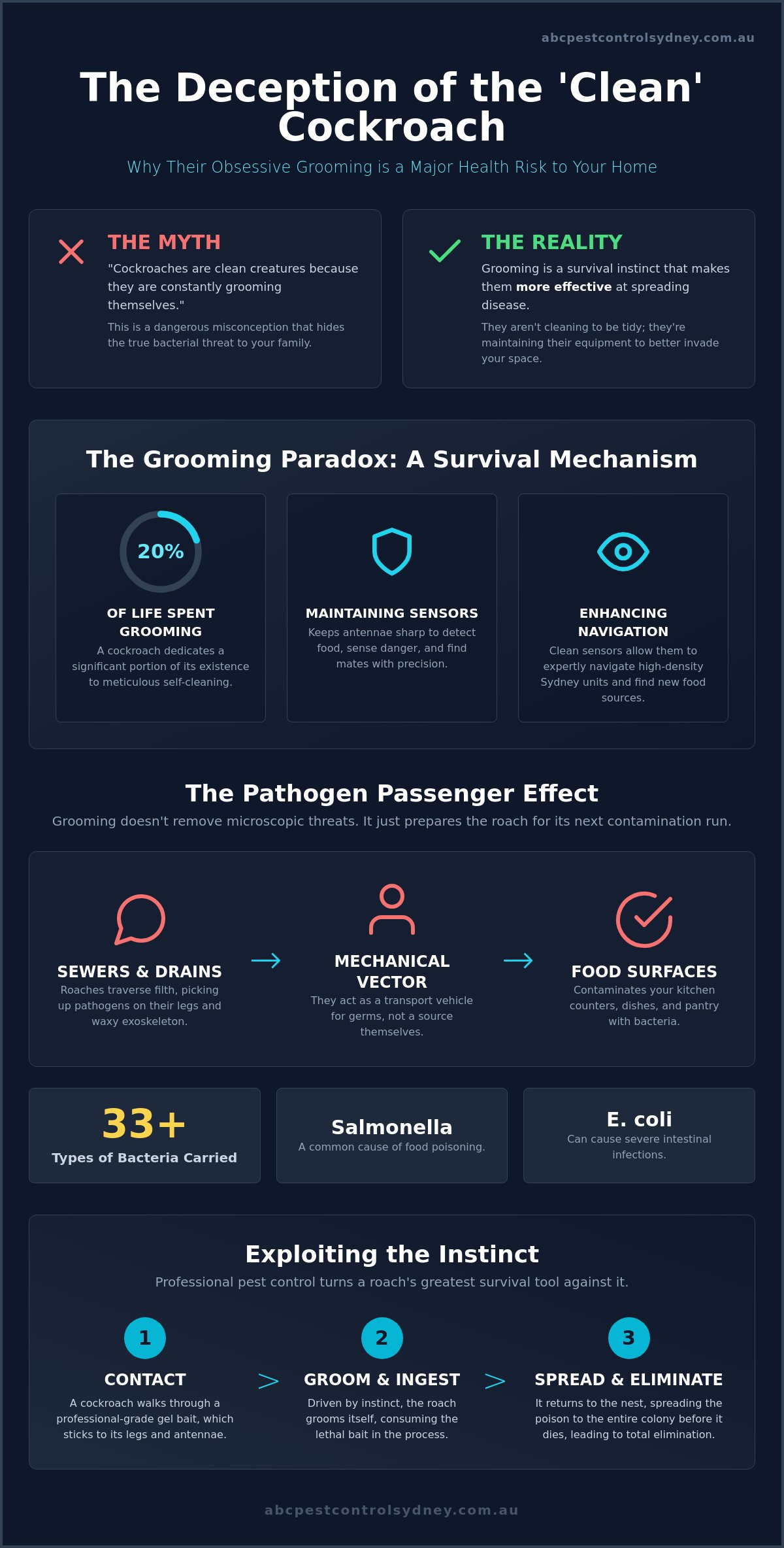
The paradox of roach hygiene is simple. While they are physically removing dust and environmental debris, they are biologically saturated with filth. Cockroaches are mechanical vectors. They don’t just carry germs; they transport them. Their grooming doesn’t kill bacteria; it simply keeps their sensory organs sharp so they can continue to navigate your pantry and avoid your traps. If you’ve spotted one grooming, don’t be fooled by the appearance of cleanliness. It’s a signal of a highly functional survivor that is actively spreading pathogens across your home.
Physical Cleanliness vs. Biological Safety
Physical grooming focuses on the exterior, but it does nothing to remove the internal pathogens a roach carries. These pests spend their time in Sydney’s sewers, grease traps, and drains. They pick up microscopic filth on their legs and exoskeletons. Even if they wipe away visible dirt, they are still crawling with Salmonella and E. coli. Their waxy exoskeleton is designed to repel water. This actually helps keep bacteria trapped against their bodies until they brush against your clean dishes or food prep surfaces. You cannot clean away the biological threat a roach represents just because it looks “tidy” on the surface.
The Grooming Ritual Explained
A cockroach’s grooming ritual is a systematic, ritualistic process. They use their front legs to pull an antenna down to their mouthparts. Then, they slowly draw the entire length of the antenna through their mandibles to scrape off any buildup. They repeat this for their legs and wings dozens of times a day. Why is this so urgent for them? Their antennae are their primary sensors. If these become coated in dust or oils, the roach loses its ability to “smell” food, detect predators, or find a mate. They aren’t cleaning for vanity; they are cleaning to stay lethal and efficient. This is why when I cockroaches clean their sensors, they are actually preparing to further invade your living space and find new food sources.
Why Do Cockroaches Groom Themselves So Obsessively?
A cockroach isn’t grooming because it cares about aesthetics. It’s a calculated survival move. When people observe this behavior, they might think, “I cockroaches clean,” but this is a biological necessity rather than a hygiene preference. For a roach, being dirty is a death sentence. Their entire existence depends on their ability to sense the environment through microscopic receptors. If these sensors get blocked, the insect becomes vulnerable, disoriented, and unable to find food or mates.
Grooming serves as a vital defense against the health risks of cockroaches that ironically affects the insect itself. Environmental “noise” like dust, grease, and even fungal spores can accumulate on their bodies. These spores can lead to fatal infections if not removed immediately. By cleaning themselves dozens of times a day, they ensure they remain the ultimate survivors in your Sydney home. They are cleaning to stay dangerous, not to stay safe for you.
The Antennae: A Roach’s High-Tech Sensors
Think of a roach’s antennae as high-tech sensory arrays. They are covered in thousands of chemoreceptors that detect pheromones and food sources from meters away. Sydney’s high humidity, which reached record levels in the summer of 2026, creates a sticky environment. This moisture causes dust and airborne particles to cling more aggressively to a roach’s body. Even a tiny film of oil can effectively “blind” a German cockroach. They must scrape this buildup away to maintain their razor-sharp navigation skills in your kitchen and bathroom.
Survival of the Cleanest
Grooming is also a primary defense against environmental toxins. When a roach walks through a treated area, it instinctively tries to clean the foreign substance off its legs and antennae. This survival instinct allows them to navigate the tightest cracks and crevices of older Sydney homes without getting stuck or losing their way. The energy cost of this constant cleaning is massive. Roaches will often prioritize grooming over feeding because they know that without functioning sensors, they won’t live long enough to eat anyway. If you are struggling with a persistent infestation, it might be time to look into professional pest sprays in Sydney to handle these resilient survivors.
Grooming vs. Germs: Why a ‘Clean’ Roach is Still a Health Risk
The sight of a cockroach cleaning itself might lead you to believe it is a sanitary insect. This is a dangerous assumption. While you might observe the behavior and think “I cockroaches clean,” you are actually witnessing a biological transport vehicle maintaining its efficiency. These pests are mechanical vectors. They don’t just carry pathogens; they actively distribute them. As they move from the damp sewers of the Eastern Suburbs into your clean kitchen, they bring a payload of 33 different types of bacteria. This “Pathogen Passenger” effect means the insect is never truly clean, regardless of its grooming habits.
A roach’s body is a breeding ground for dangerous microorganisms. They carry Salmonella, E. coli, and Staphylococcus on their legs and within their digestive tracts. When they groom, they aren’t disinfecting themselves. They are simply moving these germs around. This process ensures that every surface they touch—from your toaster to your children’s lunchboxes—becomes a potential site for infection. For effective Cockroach Elimination, you must look past the surface behavior and address the biological reality of the infestation.
How They Spread Disease While Cleaning
Cross-contamination happens in seconds. A cockroach can travel from a garbage bin to your food preparation area with ease. Because they use their mouthparts to clean their legs and antennae, their mouths become one of the most contaminated parts of their bodies. They leave behind “smear marks” in Sydney kitchens, which are dark, oily trails of waste and bacteria. These marks are often found in cupboards or along skirting boards. Every time a roach grooms, it deposits contaminated saliva and fecal matter onto these surfaces, creating a hidden map of disease in your home.
The Hidden Danger: Allergens and Asthma
The threat isn’t limited to stomach bugs. Cockroach saliva, waste, and shedding skin contain potent proteins that act as major triggers for respiratory issues. In high-density Sydney apartments, these allergens accumulate in dust and air vents. They are a leading cause of asthma attacks in children. Even if you don’t see a “dirty” roach, the invisible proteins they leave behind remain active for weeks. Protecting your family requires more than just surface wiping. You need a comprehensive approach to health-focused pest control Sydney to remove these triggers from your living environment permanently. Don’t let the myth that I cockroaches clean lead to a health crisis in your home.
Sydney Cockroach Species and Their Hygiene Habits
Sydney’s unique climate makes it a primary breeding ground for various cockroach species. The record-breaking heat and high humidity during the 2026 summer have significantly accelerated pest breeding cycles across the City and Inner South. While you might observe a pest in your kitchen and think, “I cockroaches clean,” the reality is that their hygiene is purely functional. Different species exhibit different levels of grooming intensity, but all remain significant health risks to your family. Understanding which species has invaded your home is the first step toward total resolution.
American cockroaches are the larger, reddish-brown pests often seen in Sydney gardens and subfloors. They frequently travel through sewer pipes and stormwater drains. While they do groom themselves after these trips, they remain biologically hazardous carriers of disease. Oriental cockroaches are even more concerning. These “water bugs” are the least hygienic of the group. They prefer the damp, decaying matter found in aging Sydney housing stock. Because they groom less frequently, they carry a higher load of external filth on their exoskeletons. Demand for pest control in Sydney is currently 96.9% higher than the national average, largely due to the resilience of these specific species.
The German Cockroach Challenge in Sydney Units
High-density living in the Inner West and Eastern Suburbs leads to a faster spread of infestations. German cockroaches are the primary culprits in these environments. They are obsessive groomers that thrive in tight kitchen cabinetry and behind warm appliances. Their small size and constant cleaning allow them to slip into the tiniest crevices without getting stuck. This behavior makes them incredibly difficult to eradicate with standard store-bought sprays. When I cockroaches clean in these environments, they are maintaining the sensory precision needed to avoid your traps and find new food sources. It is vital to understand how to get rid of cockroaches using professional-grade gel baits that exploit this grooming instinct for a total nest kill.
Outdoor vs. Indoor Roaches
It is important to distinguish between native species and household pests. Australian native cockroaches usually stay in the garden and do not seek out human food. They are far cleaner than the invasive species found in your pantry. However, the extreme weather of 2026 is driving more outdoor roaches inside seeking moisture. An outdoor roach becomes an indoor health hazard the moment it touches your food preparation surfaces. Unlike “filth flies” that are easily spotted, these roaches hide in the shadows and move between units with ease. Identifying the species correctly ensures you aren’t wasting time on the wrong treatment. If you see large roaches entering from your garden, take action before they establish a permanent nest inside your walls.
Stop the spread in your home and protect your family from hidden bacteria. Schedule our unit and apartment pest control experts to secure your living space today.
How Professional Pest Control Targets Cockroach Hygiene
Professional pest management doesn’t just aim to kill the insects you see. It turns their biological instincts into a weapon for total colony elimination. While a homeowner might observe a roach and think, “I cockroaches clean,” we view that grooming behavior as a fatal flaw. By understanding that a cockroach must keep its sensory organs free of debris to survive, we can introduce targeted treatments that the insect will inevitably ingest. This method is far more effective than the repellent sprays found on supermarket shelves, which often just drive pests deeper into your wall cavities.
Our approach focuses on non-repellent technology. When a cockroach encounters a professional-grade treatment, it doesn’t immediately die or flee. Instead, it carries the active agent back to the heart of the infestation. Because cockroaches are social creatures that frequently groom one another and themselves, the treatment spreads rapidly through the population. This is a level of precision that DIY products simply cannot match, especially given the massive spike in cockroach activity across Sydney following the record humidity of 2026.
The Science of Gel Baits
Gel baits are the gold standard for treating German cockroaches in high-density Sydney apartments. Experts place these baits in strategic “hot spots” where roaches travel, such as behind fridge motors and inside cupboard hinges. When a roach walks across the bait, the substance clings to its legs and antennae. Because I cockroaches clean these appendages dozens of times a day to maintain their sensory receptors, they ingest the bait during their ritual. This turns their survival instinct into a delivery system for the treatment. It is a highly controlled method that ensures the poison reaches the nest without contaminating your food preparation surfaces.
Long-Term Prevention and Maintenance
A single application of a store-bought spray is rarely enough to handle a resilient Sydney roach population. These pests breed too quickly, and their grooming habits often help them survive surface-level toxins. For lasting peace of mind, we recommend our General Pest Control Packages. These plans provide year-round protection and use eco-friendly treatments that are safe for your children and pets. We prioritize environmental responsibility while ensuring your home remains a fortress against invasive species. Don’t wait for a small sighting to become a full-blown health crisis in your kitchen.
Take control of your home’s hygiene today. Contact our team to book a professional inspection and clear your “clean” roaches once and for all. Our experienced technicians are ready to provide the expert intervention your Sydney home deserves.
While professional pest control secures your home’s interior, maintaining your property’s exterior and glass surfaces is another essential step for a truly clean environment. For those looking for expert services in other regions, Cassidys Window Cleaning Services Adelaide & Newcastle region offers specialized window cleaning for both residential and commercial properties.
Secure Your Sydney Home Against Hidden Pathogens
Understanding the biological reality of cockroach behavior is the first step toward reclaiming your kitchen. We have explored how their obsessive grooming is actually a vital survival mechanism designed to keep their sensory receptors sharp for navigation and breeding. While it is fascinating to observe how I cockroaches clean their sensors, don’t let this ritual lull you into a false sense of security. These pests remain dangerous mechanical vectors for Salmonella, E. coli, and triggers for childhood asthma.
Professional intervention is the only way to exploit these instincts and achieve a total nest kill. With over 20 years of Sydney experience, we provide eco-friendly and pet-safe methods that protect your family’s health without compromise. Our expertise has been recognized and featured on major Australian media outlets, ensuring you receive a standard of service you can trust. Act now to stop the spread of allergens and bacteria in your living space. Don’t let ‘clean’ roaches compromise your home—Book your Sydney Pest Control Package now!
Regain your peace of mind and enjoy a truly sanitary environment today. Your family’s safety is our priority.
Frequently Asked Questions
Are cockroaches cleaner than humans?
No, this is a dangerous misconception. While cockroaches spend up to 20% of their time grooming, they do not use soap or disinfectants. Humans clean to remove harmful germs, but roaches only groom to clear their sensory organs of dust and oils. They remain biological vectors that live and breed in Sydney’s sewer systems and grease traps.
Why do cockroaches clean themselves after a human touches them?
Cockroaches groom after human contact because our skin produces natural oils and salts that are “dirty” to them. These substances clog the microscopic chemoreceptors on their antennae and legs. They must scrub themselves immediately to restore their ability to detect food, pheromones, and potential predators in your home.
Do cockroaches carry diseases even if they look clean?
Yes, they are highly effective mechanical vectors for disease. A roach might look physically tidy, but it carries 33 different types of bacteria, including Salmonella and E. coli. Their grooming ritual only removes visible debris; it does nothing to eliminate the microscopic pathogens and allergens they transport from drains to your kitchen surfaces.
What is the cleanest type of cockroach?
Native Australian wood cockroaches are generally the cleanest because they live in bushland rather than urban waste. Among household pests, the German cockroach is the most obsessive groomer. However, because they thrive in kitchens and bathrooms, their grooming behavior actually helps them spread bacteria more efficiently across your food preparation areas.
How do roaches clean their antennae?
They use a ritualistic, step-by-step process. The roach uses its front legs to pull an antenna down to its mouthparts. It then slowly draws the entire length through its mandibles to scrape off environmental “noise” like dust and grease. This ensures their high-tech sensors remain sharp for navigation through tight cracks and crevices.
Can a cockroach make you sick just by crawling on you?
Yes, a roach can transfer harmful pathogens and allergens to your skin in seconds. As they move, they deposit contaminated saliva and waste. These proteins are major triggers for asthma and respiratory issues, especially in high-density Sydney units. Even a brief encounter can leave behind invisible bacteria that cause significant health risks.
Why is professional pest control better than DIY for ‘clean’ roaches?
Professional treatments are superior because they turn the roach’s biology against it. Supermarket sprays are often repellent and only drive the infestation deeper into your walls. When I cockroaches clean their legs after walking through professional gel baits, they ingest the active agent. This exploits their grooming instinct to deliver a lethal dose back to the entire nest.
How often should I get a cockroach inspection in Sydney?
You should schedule a professional inspection at least once every 12 months. Sydney is a high-risk zone, with pest demand 96.9% higher than the national average. If you live in high-density areas like the Inner West or Eastern Suburbs, bi-annual checks are safer. Regular maintenance prevents small sightings from turning into established, dangerous infestations.