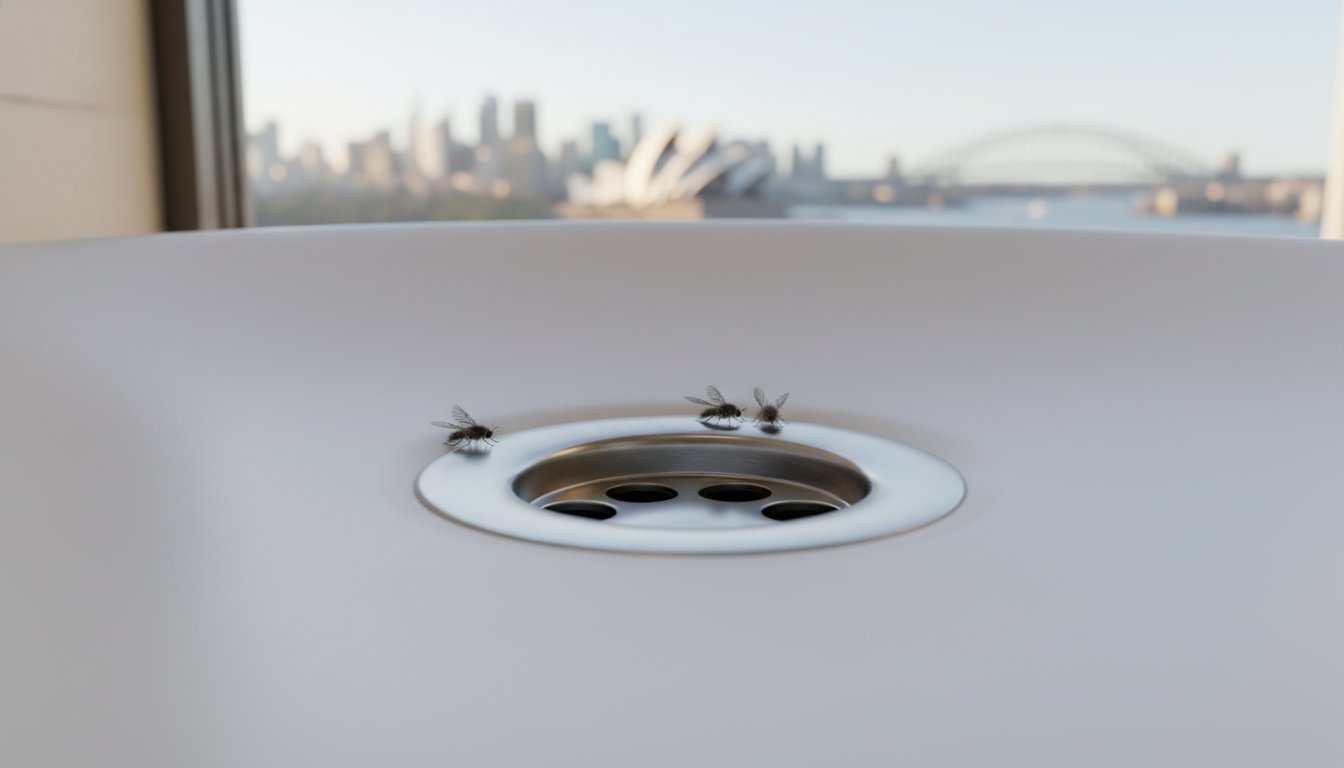
Pouring boiling water down your sink is likely making your pest problem worse. If you have spotted tiny, fuzzy, moth-like insects hovering around your bathroom mirror, you are dealing with a resilient invader that thrives on the sludge inside your pipes. Most people don’t actually know the term “drain fly” when the problem starts. They search based on what the bug looks like or where it’s hanging out. These pests are a serious hygiene risk. A single female can lay up to 100 eggs in the organic biofilm of your drains, creating a cycle that repeats every one to three weeks in Sydney’s humid climate.
It is embarrassing when guests see flies in your bathroom, and it’s even more frustrating when your cleaning efforts don’t stop them. You deserve a home that is safe, clean, and free from the bacteria these insects carry from the sewers. This article will show you how to identify these intruders and eliminate their breeding grounds forever. You will learn the science behind the biofilm they inhabit and discover a professional, eco-friendly approach to keep your kitchen and bathroom fly-free.
Key Takeaways
- Most people don’t actually know the term “drain fly” when the problem starts. They search based on what the bug looks like or where it’s hanging out. Learn to identify these fuzzy, moth-like pests by their unique resting habits near drains.
- Understand why standard cleaning fails against the gelatinous biofilm inside your pipes. This protective slime is the secret to their survival and must be neutralized to stop the breeding cycle.
- Perform the simple “Duct Tape Test” to accurately locate the source of the infestation. Distinguish drain flies from fruit flies by looking for fuzzy wings instead of red eyes.
- Avoid damaging your plumbing with ineffective DIY myths like boiling water or bleach. These methods rarely reach the larvae and fail to provide a permanent solution.
- Discover how professional-grade Insect Growth Regulators (IGRs) break the biological cycle for good. Expert intervention ensures total elimination while prioritizing your family’s safety and peace of mind.
What Are These Small, Fuzzy Flies in My Bathroom?
You’ve likely noticed them resting on your bathroom tiles or hovering near the sink. They look like tiny, hairy moths, but they aren’t interested in your wardrobe. These insects are actually members of the Psychodidae family of flies, commonly known as drain flies. Most people don’t actually know the term “drain fly” when the problem starts. They search based on what the bug looks like or where it’s hanging out. Because they are small, fuzzy, and grey, it’s easy to mistake them for a harmless moth until the population explodes.
Unlike houseflies that constantly buzz around your kitchen, these pests prefer the damp sanctuary of your plumbing. They are incredibly weak fliers. You’ll usually find them sitting perfectly still on the walls near your shower or floor wastes. Don’t let their slow movement fool you. Their reproductive rate is a serious concern for any homeowner. A single female can lay up to 300 eggs every 48 hours. In Sydney’s warm, humid climate, these eggs hatch into larvae that thrive inside the gelatinous slime of your pipes. You can’t just “clean more” to fix this. If the breeding site is hidden deep within the P-trap or overflow, surface scrubbing will never reach the source of the infestation.
Identifying the ‘Fuzzy’ Intruder
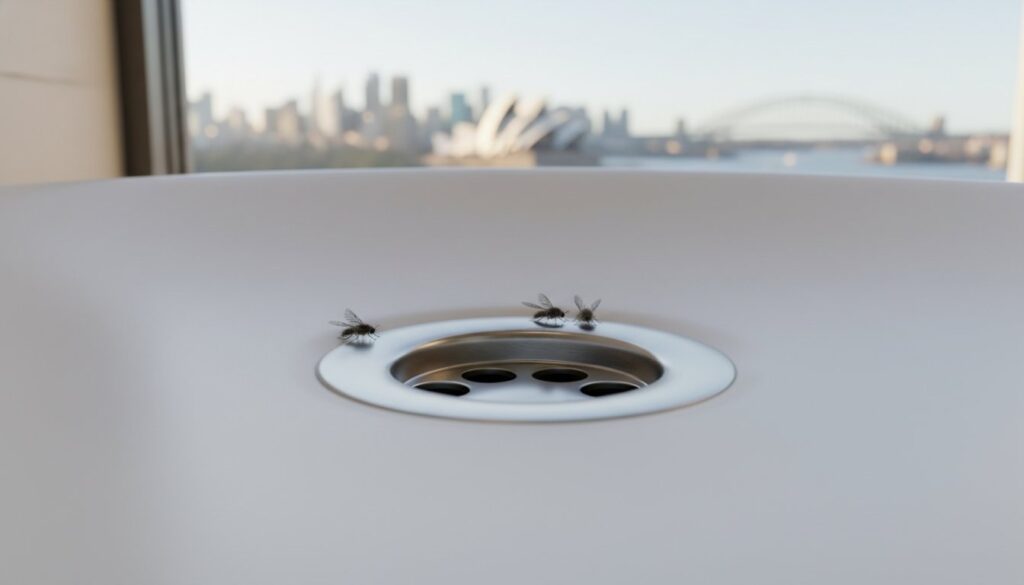
Check for these specific physical traits to confirm you have an infestation. Look for broad, heart-shaped wings covered in fine hairs and long, beaded antennae. Their flight pattern is a major giveaway; they move in short, jerky hops rather than sustained flight. In Sydney homes, you’ll find them in these high-risk areas:
- Shower drains: The most common breeding ground due to the accumulation of hair and soap scum.
- Floor wastes: Often overlooked in laundry rooms or guest bathrooms where water sits stagnant.
- Kitchen overflows: Where food particles and moisture create a perfect nursery for larvae.
Are Drain Flies Dangerous to Your Family?
They don’t bite, but they are a genuine health risk. These flies breed in sewage and decaying organic matter. They act as mechanical vectors, physically carrying harmful bacteria from your pipes onto your vanity, towels, or kitchen surfaces. For sensitive individuals, the decaying bodies of dead flies can even act as asthma triggers. Beyond the physical risks, there’s the embarrassment of guests seeing flies in your bathroom. It’s a sign of a hidden hygiene issue that requires immediate professional attention to resolve permanently. Ignoring the problem only allows the biofilm to thicken, making the flies even harder to eradicate later.
The Breeding Ground: Why Your Drains Are Attracting ‘Moth Flies’
Most people don’t actually know the term “drain fly” when the problem starts. They search based on what the bug looks like or where it’s hanging out. When you see those fuzzy wings on your bathroom mirror, you’re only seeing the tip of the iceberg. The real problem is hidden deep inside your pipes. A thick, gelatinous layer of biofilm, often called “slime,” builds up in P-traps and floor wastes. This substance isn’t just dirt. It’s a complex biological community that provides food and a protective shield for fly larvae. It prevents them from being flushed away by normal water flow or killed by surface-level cleaning.
Sydney’s unique environment makes this problem even more persistent. Our humid NSW summers create a greenhouse effect within plumbing systems, accelerating the fly’s lifecycle. In older Sydney suburbs like Surry Hills, Paddington, or Balmain, terracotta pipes are a common feature. These pipes are prone to cracking under concrete slabs as the ground shifts. When pipes crack, organic matter leaks into the soil, creating “invisible” breeding sites that are impossible to reach with a scrubbing brush. Even in modern apartment builds, floor grates in laundry rooms or rarely used guest bathrooms often have stagnant water in the traps, inviting an infestation to take hold.
What Do Drain Fly Larvae Eat?
The larvae are remarkably resilient. They thrive on a diet of “gunk” composed of hair, skin cells, and soap scum. They are specifically adapted to survive in low-oxygen environments deep within the plumbing trap. Many homeowners try to resolve the issue using bleach. This is ineffective. Bleach is a liquid that flows quickly over the biofilm without actually penetrating it. The larvae remain safely tucked beneath the slime layer, untouched by the chemicals. Public health authorities emphasize that sanitation is the key to managing filth flies, but this requires breaking down the biological shield entirely rather than just pouring liquids down the sink.
Hidden Breeding Sites in Sydney Homes
If your drains look clean but the flies persist, you must look further afield. Drain flies are highly resourceful and will find moisture in the most unexpected places.
- Air Conditioning Units: Condensation pans that don’t drain properly are a frequent culprit in Sydney apartments.
- Sub-floor Drainage: Hilly suburbs often have sump pumps or complex drainage systems that trap moisture and organic debris.
- Laundry Tubs: Leaky washing machine hoses or the dark, damp space behind a laundry cabinet provide perfect breeding conditions.
Identifying these hidden spots is difficult without specialized equipment. If you’re struggling to find the source, our drain fly Sydney experts can conduct a thorough inspection to locate and eliminate these invisible nurseries.
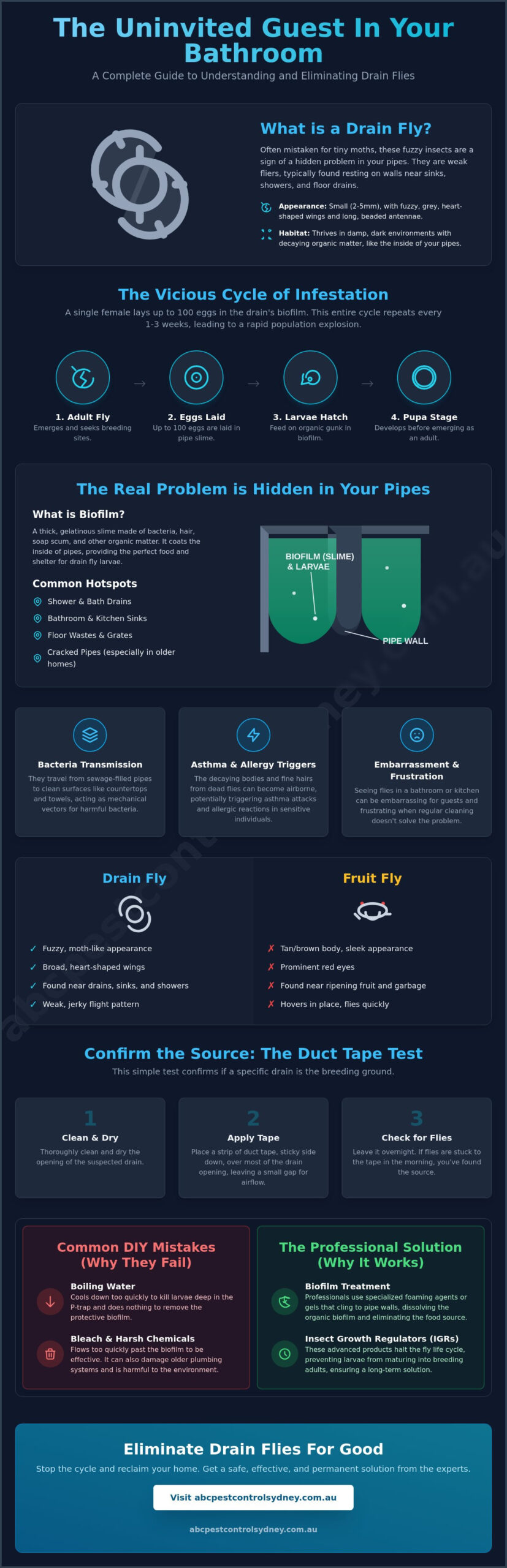
Drain Fly vs. Fruit Fly: Identifying Your Uninvited Guests
Correct identification is the most critical step in pest management. If you use the wrong treatment, the infestation will continue to grow. Most people don’t actually know the term “drain fly” when the problem starts. They search based on what the bug looks like or where it’s hanging out. Mistaking a drain fly for a fruit fly is a common error that leads to wasted money on ineffective traps. While both are small, their biology and breeding habits are worlds apart. You must look closely at their physical traits and behavior to know exactly what you’re fighting.
Fruit flies are typically tan or light brown with very distinctive, bulging red eyes. They are highly attracted to fermenting sugars, which is why you find them hovering over fruit bowls or open wine bottles. In contrast, drain flies have fuzzy, moth-like wings and a dark grey or black coloration. They ignore your fruit bowl entirely. Instead, they seek out decaying organic sewage. If you aren’t sure which pest has invaded your Sydney home, perform the “Duct Tape Test.” Place a piece of clear tape over your sink or shower drain overnight with the sticky side down. If you find fuzzy insects stuck to the tape in the morning, your pipes are the breeding site. This method is a staple in any university guide to drain fly management because it provides definitive proof of the source.
The Phorid Fly: The Dangerous Look-alike
There is a third, more concerning pest often confused with the drain fly: the Phorid fly. Also known as “scuttle flies,” these insects have a peculiar habit of running rapidly across surfaces instead of flying when disturbed. Phorid flies are a major red flag for Sydney homeowners. While drain flies live in the biofilm of your pipes, Phorid flies often breed in soil contaminated by a broken sewage line under your house’s slab. If you see tiny flies scuttling across your floor or walls rather than flying, you likely have a structural plumbing failure. This requires an immediate professional inspection to prevent serious hygiene risks and property damage.
Summary Comparison Table
Use this table to quickly distinguish between the three most common small flies found in Sydney bathrooms and kitchens.
| Pest Type | Appearance | Primary Source | Movement Style | Action Required |
|---|---|---|---|---|
| Drain Fly | Fuzzy wings, heart-shaped, grey/black | Gelatinous pipe biofilm | Short, jerky hops | Remove biofilm; use IGRs |
| Fruit Fly | Tan body, large red eyes | Fermenting fruit or sugar | Hovering, sustained flight | Remove food source; use vinegar traps |
| Phorid Fly | Humpbacked, dark brown/black | Sewage-soaked soil or rotting matter | Rapid scuttling/running | Professional sub-slab inspection |
How to Get Rid of Drain Flies: DIY Methods vs. Professional Treatment
Most people don’t actually know the term “drain fly” when the problem starts. They search based on what the bug looks like or where it’s hanging out. This leads many Sydney homeowners to try common household remedies like boiling water or bleach. You must stop using these immediately. Boiling water is a temporary fix at best. It loses its lethal temperature far too quickly to penetrate the thick, insulating biofilm where the larvae hide. Bleach is even more problematic. It is a highly corrosive chemical that damages your plumbing seals and PVC pipes. It simply flows over the protective slime layer without killing the source of the infestation.
To achieve lasting results, you must use mechanical and biological methods. A long-handled pipe brush is your best tool for manual removal. By scrubbing the interior of the pipe, you physically break apart the biofilm. Once the structural integrity of the slime is compromised, you can apply microbial or enzymatic cleaners. These products contain living bacteria or enzymes that literally eat the organic matter. Unlike harsh chemicals, these are safe for your family and the environment. You deserve a solution that works without risking your health or your home’s plumbing.
The 3-Step DIY Drain Cleanse
If you catch the problem early, follow this rigorous cleaning protocol to reclaim your bathroom. Consistency is the key to success. Don’t skip any of these steps if you want to see results.
- Step 1: Manual Debris Removal. Remove the drain grate and use a wire hook or brush to pull out hair and soap scum. This is where most larvae congregate.
- Step 2: Apply Enzymatic Gel. Pour a thick, professional-grade enzymatic cleaner down the drain. These gels are designed to cling to the vertical walls of your pipes rather than washing straight through.
- Step 3: The 24-Hour Dwell. Let the cleaner sit for at least 24 hours. Do not use the sink or shower during this time. Finally, flush the system with a large volume of hot water.
When DIY Fails: Signs of a Deep Infestation
Sometimes, the breeding ground is too deep for home methods to reach. You need to identify when the problem has escalated beyond your control. If the flies return within seven days of a thorough cleaning, you haven’t reached the source. Seeing flies in multiple rooms simultaneously suggests a systemic issue within your main sewage lines. The most urgent warning sign is seeing larvae, which look like tiny grey maggots, crawling out of the drain grate. This indicates the population is so large that the biofilm can no longer contain them. When home remedies fall short, you need an expert drain fly Sydney solution to break the cycle for good.
Professional Drain Fly Removal in Sydney: The ABC Pest Control Approach
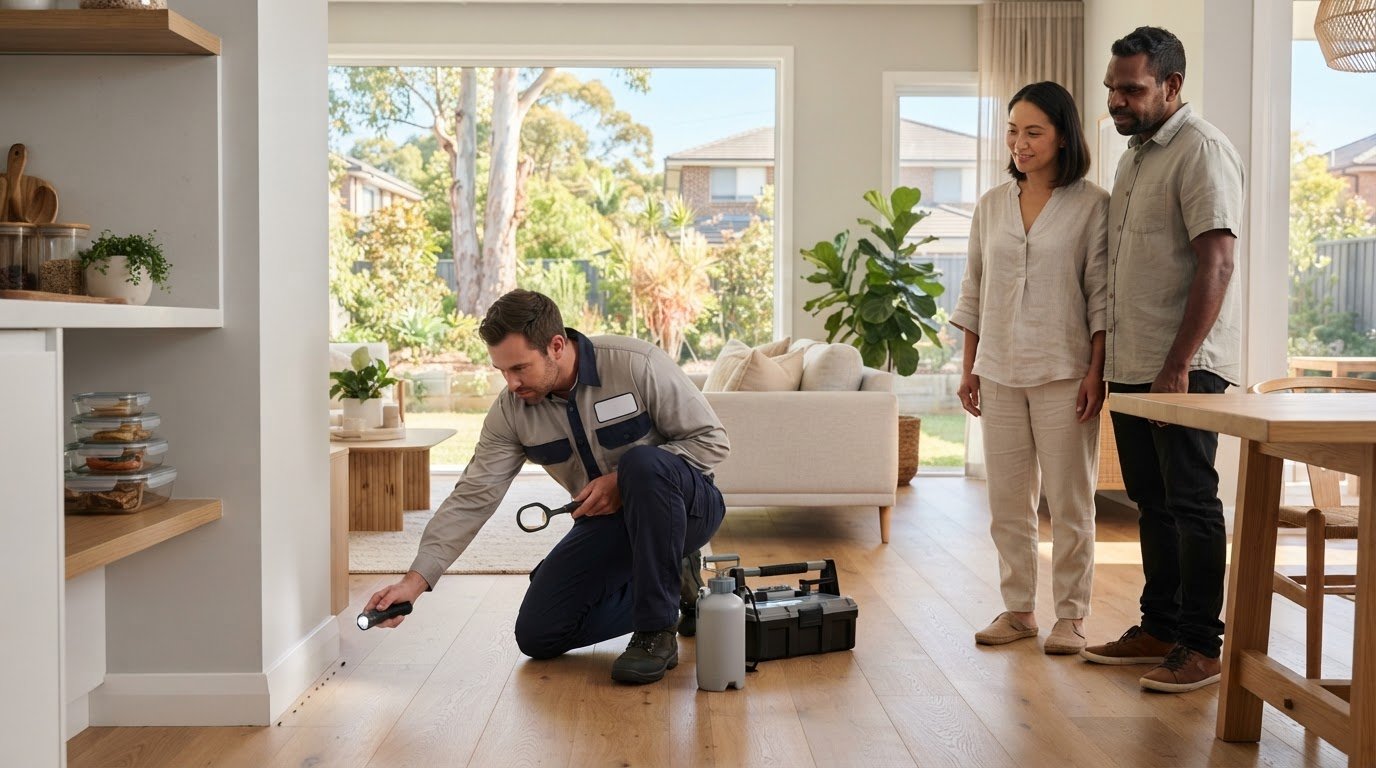
Don’t let a minor nuisance turn into a permanent infestation. Professional intervention is the only way to ensure the total elimination of the breeding source. Most people don’t actually know the term “drain fly” when the problem starts. They search based on what the bug looks like or where it’s hanging out. By the time you call a specialist, the biofilm in your pipes has likely become a multi-generational nursery. Our approach begins with a comprehensive inspection of your entire Sydney property. We don’t just look at the sink. We examine floor wastes, air conditioning condensation lines, and sub-floor drainage systems to find every hidden colony.
We use professional-grade Insect Growth Regulators (IGRs) to break the cycle. These treatments don’t just kill the adults; they prevent larvae from maturing into breeding insects. This biological interruption is far more effective than surface sprays. Our methodology prioritizes environmental responsibility. We use eco-friendly and safe treatments for families and pets in NSW. You get peace of mind knowing your home is protected without exposure to harsh, outdated chemicals. We also provide long-term prevention strategies tailored to Sydney plumbing styles, addressing the specific challenges of both heritage terraces and modern high-rises.
Why Choose ABC Pest Control Sydney?
Experience matters when dealing with resilient pests. We have over 20 years of experience handling the unique challenges of the local market. Our General Pest Control Packages provide an all-in-one solution. These plans cover drain flies and 14 other common pests, ensuring your home remains a sanctuary. We maintain strict compliance with Australian safety standards for every residential treatment. This professional rigor guarantees that your infestation is handled correctly the first time.
Book Your Inspection Today
Act now to protect your family’s health. Drain flies spread bacteria from sewage to your living spaces every time they land. Our rapid booking process is designed for urgent infestations. Don’t wait for the population to double again. Whether you live in a sprawling house or a compact apartment or unit, we have a tailored solution for you. Contact us today to eliminate your pest problem for good.
Take Control of Your Home’s Hygiene Today
Leaving a drain fly infestation untreated invites bacteria into your most private spaces. You now know that surface cleaning and boiling water cannot penetrate the thick biofilm protecting the larvae. True elimination requires breaking the biological cycle with professional grade growth regulators. Most people don’t actually know the term “drain fly” when the problem starts. They search based on what the bug looks like or where it’s hanging out. By identifying these fuzzy intruders early, you can prevent a massive population explosion in your pipes.
Don’t settle for temporary fixes that risk your plumbing’s integrity. Trust our media featured industry experts to provide a permanent solution. With over 20 years of Sydney experience, we utilize eco-friendly methods that keep your family and pets safe. It is time to reclaim your bathroom and kitchen from these persistent pests. Book Your Professional Drain Fly Treatment in Sydney Today and enjoy the peace of mind that comes with a truly clean home. You deserve an environment free from pests and the health risks they carry.
Frequently Asked Questions
How do I know if the flies are coming from my drains?
Use the clear tape test to confirm the source immediately. Secure a piece of clear adhesive tape over the drain opening before you go to bed. If you find fuzzy insects stuck to the underside in the morning, you have positively identified that specific drain as a breeding site. This simple step saves you from treating the wrong area of your home and ensures your efforts are targeted correctly.
Can drain flies live in a clean house?
Yes, these pests frequently appear in even the most spotless Sydney homes. They do not feed on crumbs or surface dust; they thrive on the biofilm hidden deep inside your plumbing. This gelatinous slime forms in any pipe that carries water, hair, and soap scum. Even a perfectly clean bathroom can have a significant buildup of organic matter within the P-trap that you cannot see from the surface.
Will pouring vinegar and baking soda down the drain kill them?
No, this popular home remedy is largely ineffective against a real infestation. While the chemical reaction creates a satisfying fizz, it lacks the power to dissolve the thick, rubbery biofilm that protects the larvae. It might clear a minor clog, but the flies will return within days. You need a specialized enzymatic cleaner to actually digest the organic matter and kill the source of the problem permanently.
How long does it take to get rid of a drain fly infestation?
Total elimination typically takes between one and three weeks with professional intervention. This duration matches the natural lifecycle of the fly from egg to adult. DIY methods often fail because they only kill the flies you see. Professional treatments use growth regulators that stop the next generation from developing, ensuring the infestation does not simply reset itself every few days as new eggs hatch.
Are drain flies the same as fruit flies?
No, they are distinct pests with very different behaviors. Most people don’t actually know the term “drain fly” when the problem starts. They search based on what the bug looks like or where it’s hanging out. Fruit flies are attracted to fermenting fruit and sugar. Drain flies, however, seek out the decaying organic matter found in sewage and stagnant plumbing systems. Treating a drain fly like a fruit fly will not work.
Can drain flies come from the toilet?
Yes, toilets in guest wings or basement bathrooms are common culprits. If a toilet is not flushed regularly, the water in the bowl and trap becomes stagnant. This allows a layer of organic film to develop on the porcelain and inside the pipes. Drain flies find these quiet, damp environments ideal for laying their eggs without being disturbed by rushing water, leading to a surprise infestation in unused rooms.
What happens if I ignore drain flies?
Ignoring the problem allows the population to grow at an alarming rate. A single female can lay up to 300 eggs every 48 hours in the right conditions. Beyond the annoyance, these flies are classified as filth flies. They physically carry pathogens from the sewer system onto your vanity, towels, and food preparation surfaces, posing a genuine health risk to your family that only worsens over time.
Do I need to leave my house during professional treatment?
No, you typically do not need to vacate your property during the process. Our professional treatments are designed to be minimally invasive and family-safe. We focus on targeted applications within the drains and plumbing rather than saturating your living areas with heavy sprays. We prioritize eco-friendly solutions that provide peace of mind while effectively terminating the infestation at its biological source without disrupting your daily routine.