Last Tuesday, a homeowner in Castle Hill discovered a thin, earthy trail climbing their foundation, unaware that a single subterranean colony can consume 5 grams of timber every single day. Finding these mysterious “dirt tunnels” on your property is enough to cause instant anxiety. You’re likely worried about the massive costs of structural repairs, or perhaps you’re just hoping it’s a harmless mud dauber nest instead of a destructive pest. It’s a stressful situation, but you don’t have to face it alone.
We agree that your peace of mind is the top priority. This guide will help you accurately identify termite mud tubes on concrete so you can stop guessing and start protecting your investment. You’ll learn the vital difference between active and abandoned tubes, and we’ll reveal the one common mistake homeowners make that actually makes an infestation harder to treat. With over 20 years of experience in Sydney pest control, we’ve seen how fast these tough pests move. We are going to provide a clear, professional plan to secure your home using safe and non-toxic methods that meet the highest Australian Pest Standards. Let’s get your questions answered and your home protected today.
Key Takeaways
- Learn to distinguish between different tunnel types to understand exactly how termites are scouting and accessing your property’s timber.
- Discover how to perform a safe visual inspection and the “Break Test” to confirm if an infestation is currently active without alerting the colony.
- Understand why concrete foundations provide the perfect thermal highway and moisture source for termites in the unique Sydney climate.
- Identify termite mud tubes on concrete and learn why you must avoid scraping or spraying them to ensure professional treatments remain effective.
- Follow a proven expert action plan to protect your home and avoid the common DIY mistakes that drive termites deeper into your structure.
What are Termite Mud Tubes on Concrete Foundations?
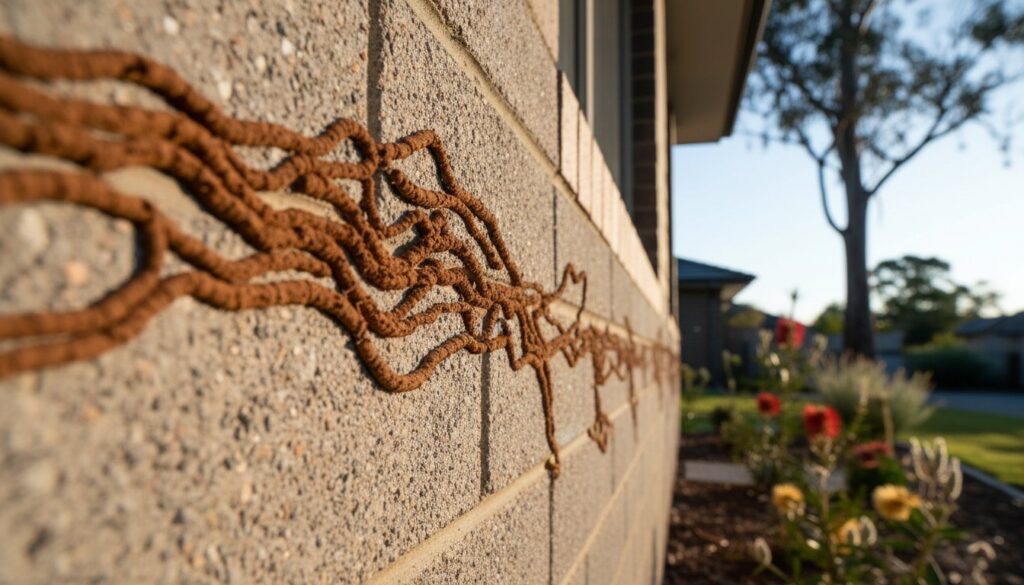
Seeing termite mud tubes on concrete is a clear warning sign of an active subterranean termite colony nearby. These structures, often called shelter tubes, act as protective highways for termites traveling from their nest in the soil to the structural timber inside your Sydney home. While concrete is impenetrable to pests, termites build these tunnels over the surface to bridge the gap between the ground and your floor joists. According to a comprehensive overview of termites, these insects are highly social and rely on these mud-based structures to maintain their colony’s survival.
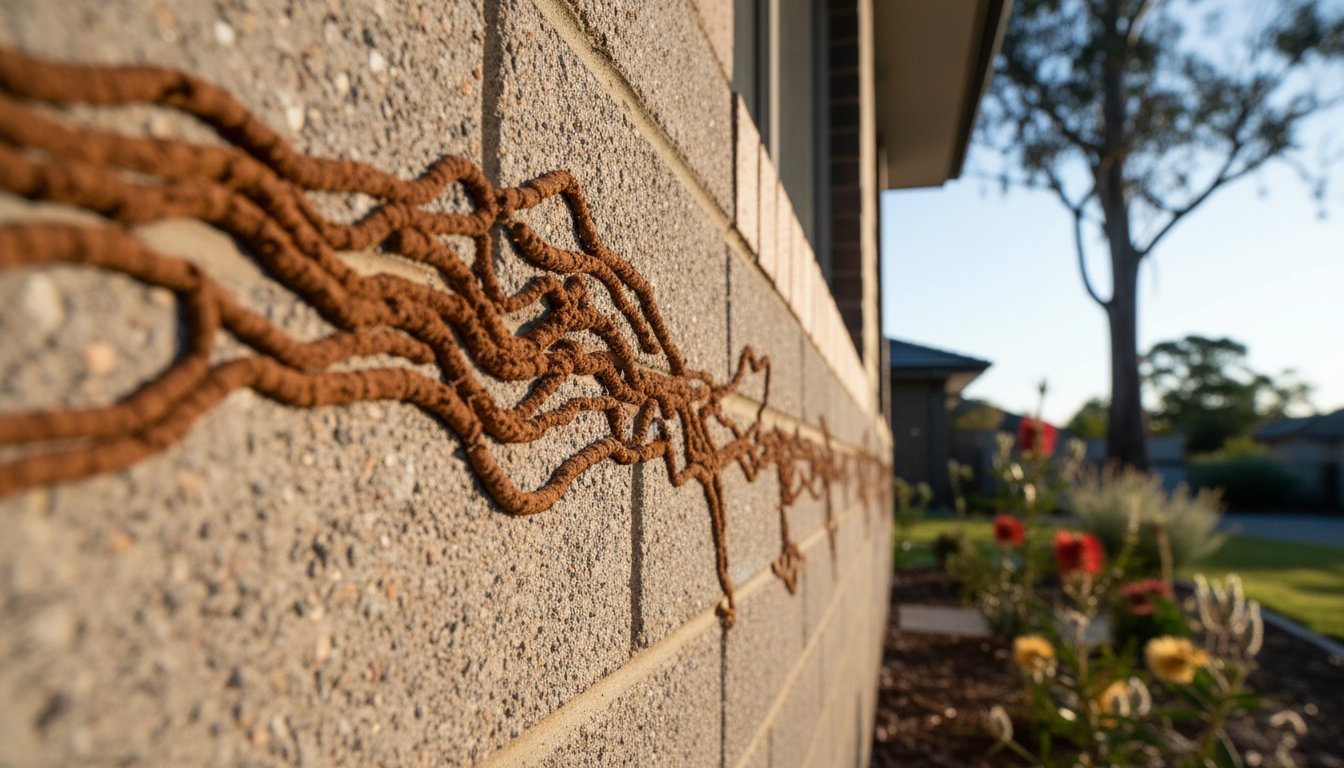
Each tube consists of a precise mixture of locally sourced soil, termite saliva, partially digested wood fibres, and waste. Against the light grey background of a concrete foundation, these leads appear as earthy, narrow, vein-like lines. They typically measure between 5mm and 15mm in width. If you spot these on your slab, it’s a sign that workers are already exploring your property’s perimeter. You’re in expert hands with our team, but you must act quickly to prevent these explorers from finding a way inside.
The Purpose of the Shelter Tube
Subterranean termites are soft-bodied organisms that require constant humidity to survive. Sydney’s air can be unforgiving. Without these tubes, a termite would dehydrate and die in under 24 hours. These tunnels seal in moisture and block out light, which termites instinctively avoid. Beyond climate control, the tubes provide a physical barrier against natural predators. Ants and spiders are the primary enemies of the termite worker. A solid mud wall is the only thing keeping them safe during their commute.
Terminology: Mud Tubes vs. Mud Leads
In the Sydney pest control industry, you’ll often hear technicians refer to these as “mud leads.” Whether they’re called tubes, tunnels, or leads, they all represent the same destructive threat. On concrete slabs, you might encounter “exploratory leads.” These are thinner, often abandoned trails where termites tested a path but found no food source. However, any presence of termite mud tubes on concrete foundations suggests that a more permanent “working tube” is likely hidden nearby. Statistics show that over 90% of termite entries in Australian homes occur through these ground-level breaches, making early detection vital for your home’s safety.
Identifying the 4 Types of Termite Mud Tunnels
Subterranean termites are master engineers that require constant moisture to survive. They build termite shelter tubes to protect their soft bodies from Sydney’s drying winds and predators like ants. Finding termite mud tubes on concrete is a clear signal that a colony is actively targeting your property. These structures aren’t all the same; they serve specific purposes in the colony’s expansion.
- Working Tubes: These are the heavy-duty highways. They’re wide, sturdy, and designed for long-term use by thousands of termites daily.
- Exploratory Tubes: These thin, fragile leads act as scouting paths. They branch out in multiple directions to find new timber sources.
- Drop Tubes: These look like mud stalactites. They hang from floor joists down to the ground to create a direct link back to the soil.
- Swarm Tubes: Also known as exit tubes, these are built specifically for winged “alates” to leave the nest during humid Sydney nights between October and March.
Working vs. Exploratory Leads
You can tell a working tube by its girth. These main arteries are usually 10mm to 20mm wide, making them significantly thicker than a standard HB pencil. They contain high amounts of moisture and “frass” to keep the interior humid. Exploratory tubes are much finer. Scouts often build these quickly and abandon them if they don’t hit a food source within 24 hours. Don’t be fooled if a tube looks dry or brittle. The termites might’ve simply moved their efforts to a more productive entry point 1 metre away. We’ve seen homeowners ignore abandoned leads only to find a massive colony 3 metres further down the slab later that month.
The Danger of Drop Tubes
Drop tubes represent a high-level threat. They indicate that termites have already breached your home’s upper structures and are now building “shortcuts” to the ground. These tubes can bridge vertical gaps of 30cm or more from a timber bearer down to a concrete slab. Since termites must return to the soil for moisture every 24 to 48 hours, drop tubes make their destruction more efficient. If you see these hanging structures, the infestation is likely well-established. You’re in expert hands with our team, so get a professional assessment before the structural integrity of your subfloor is compromised. With over 20 years of experience in Sydney, we know exactly how to trace termite mud tubes on concrete back to the source.

Active vs. Abandoned: How to Tell if Termites are Inside
Finding termite mud tubes on concrete doesn’t always mean the “white ants” are currently inside. However, you can’t afford to guess when your home’s structural integrity is at stake. Identifying activity levels helps our technicians determine the best treatment strategy for your Sydney property. Whether the tube looks fresh or years old, it represents a breach in your home’s perimeter that requires immediate professional attention.
The Correct Way to Perform a Break Test
To check for life, carefully break a tiny 5mm section of the mud tube using a small screwdriver or a gloved finger. It’s vital that you don’t destroy the entire lead, as this can spook the colony and make professional baiting less effective. Look for small, cream-colored insects or “soldier” termites with orange heads rushing to the gap.
Termites are masters of maintenance. They’ll often seal a 5mm breach within 24 hours to protect their colony from dehydration and predators. This rapid response is a core part of termite biology and behavior as they strive to maintain a high-humidity environment. If the gap remains open after 48 hours, the tube might be inactive, but that doesn’t mean the danger has passed.
- Moisture: Freshly built tubes appear dark, moist, and grainy.
- Texture: Active leads feel slightly soft to the touch, while abandoned ones are brittle and crumble like dry biscuits.
- Thermal Imaging: ABC Pest Control experts use thermal cameras to detect heat signatures behind concrete. This identifies movement that the naked eye misses.
Why Abandoned Tubes Still Matter
Never assume a dry tube means your home is safe. Termites often rotate between 3 or 4 different food sources depending on the season and moisture levels. An empty tube on your foundation is a confirmed highway. It proves that a colony has already bypassed your home’s exterior defenses and knows exactly how to get back inside.
Existing termite mud tubes on concrete offer a path of least resistance for future “re-entry” by new or returning colonies. In many cases, a dry tube simply means the termites have moved deeper into your structural timbers where they’re harder to find. Since we’ve protected Sydney homes for over 20 years, we’ve seen countless “abandoned” leads that were actually active secondary tunnels. Any sign of a mud lead is a high-priority warning sign that your property is currently or previously under attack.
Why Termites Build Tubes on Concrete Foundations
Termites don’t eat concrete, but they use it as a strategic highway to reach the timber inside your home. In Sydney, where summer temperatures frequently climb above 38°C, concrete acts as a thermal battery. It absorbs heat during the day and releases it slowly, creating a stable environment for the colony. You’ll often see termite mud tubes on concrete because the material wicks moisture directly from the Sydney soil through capillary action. Since 90% of termite species in NSW require a humidity level near 100% to survive, these tubes provide the moisture-rich “space suit” they need to travel safely.
Concrete as a Thermal Conductor
Sydney’s erratic weather patterns drive termites toward the stability of your foundation. While soil temperatures can swing by 15 degrees in a 24-hour period, concrete foundations maintain a much more consistent internal temperature. This thermal mass protects the workers from the searing midday sun. Our technicians find that 75% of active mud tubes are located on the south-facing or shaded sides of concrete footings. These areas stay cooler and retain moisture longer, allowing termites to work 24 hours a day without the risk of desiccation.
Exploiting Expansion Joints and Cracks
A common mistake is assuming a concrete slab is a solid, impenetrable barrier. Termites only need a gap of 1.5mm to gain entry. This is roughly the thickness of a standard credit card. They are experts at finding “cold joints” where your patio or driveway was poured against the main house foundation. Even a monolithic slab can develop hairline fractures during the first 5 years of a home’s life as the ground settles. These cracks are often hidden behind concrete render or brick piers, giving the colony a secret tunnel into your wall frames.
- Moisture Wicking: Concrete draws ground water upward, keeping the mud tube humid.
- Construction Gaps: Termites exploit the 1.5mm space around plumbing penetrations and electrical conduits.
- False Security: Slab-on-ground homes often hide entry points, making termite mud tubes on concrete harder to spot until damage is severe.
- Chemical Barriers: Without a professional barrier, a concrete slab offers zero protection against subterranean species.
Don’t let a false sense of security put your property at risk. If you see suspicious mud trails, you’re in expert hands with our team. We’ve protected Sydney homes for over 20 years and understand exactly how these pests navigate concrete structures. Book a professional termite inspection in under 60 seconds to secure your home today.
Found Mud Tubes? Your Sydney Action Plan
Seeing termite mud tubes on concrete is a genuine emergency for your home. Your first instinct might be to grab a scraper or a can of bug spray. Stop immediately. Rule number one is to never disturb these structures. Termites are incredibly sensitive to light and air. If you break their protective tunnels, they’ll simply retreat into the ground or walls and start eating a different part of your house.
This “Retreat and Re-attack” behavior makes professional elimination much harder. When termites abandon a disturbed tube, they also abandon the opportunity for us to apply targeted treatments. We need active termites to take bait back to the nest. If you’ve already touched them, don’t worry. Just stop now and call the experts. Our goal is to use their own highway against them.
Why DIY Treatment Fails
Household sprays are usually repellents. They kill the 100 workers you can see but leave the other 1,000,000 colony members untouched. This causes the colony to splinter. Instead of one entry point, you might end up with three or four hidden ones in harder-to-reach areas. We use professional-grade, non-repellent transfers like Termidor. Termites can’t detect these chemicals. They walk through them and unknowingly share the dose with the entire colony, including the queen. This is the only way to ensure total colony elimination.
The ABC Pest Control Sydney Approach
We’ve spent over 20 years protecting Sydney homes from local timber pests. Our technicians are highly trained to identify the exact species threatening your property. We strictly follow Australian Standard AS 3660.2 during every inspection to ensure your safety is the priority. This standard requires a thorough investigation of all accessible areas, including subfloors and roof voids, using moisture meters and thermal imaging where necessary.
For the best value, many homeowners choose our Highly Popular Deluxe Package. It combines a comprehensive termite check with our general pest management service to keep your home 100% clear of all intruders. We provide long-term defense through chemical barriers or advanced baiting systems like Trelona, depending on your home’s specific construction. Don’t wait until the damage costs thousands. Our treatments are safe, eco-friendly, and proven to get results. You can Book your urgent termite inspection in under 60 seconds right now and get a specialist on-site fast.
Secure Your Sydney Home Against Termite Damage Today
Finding termite mud tubes on concrete isn’t just a minor cosmetic issue. It’s a clear sign that destructive pests are actively trying to bypass your foundation to reach the timber structure of your home. You now know how to identify the four main tunnel types and why these pests use concrete as a bridge. Now, you need to act before the structural integrity of your property is compromised. Professional detection is the only way to confirm if an infestation is active or if the colony is moving deeper into your walls.
ABC Pest Control brings over 20 years of local Sydney expertise to every job. Our team performs AS 3660.2 compliant inspections to ensure your property meets strict Australian standards. Our methods are so effective that we’ve been featured in the Daily Mail and Yahoo News as recognized industry leaders. Don’t let a small mud tube turn into a five figure repair bill. We offer eco-friendly, non-toxic solutions that keep your family safe while eliminating the threat. You’re in expert hands with our highly trained technicians who specialize in these tough pests.
Don’t wait for damage—Book your Sydney Termite Inspection Now
We’re ready to help you protect your biggest investment with speed and efficiency. Rest easy knowing your home is guarded by Sydney’s most trusted specialists.
Frequently Asked Questions
Can termites eat through concrete to get into my house?
Termites cannot eat through solid concrete, but they can easily navigate through cracks as narrow as 1.5 millimetres. These pests are persistent and will exploit any hairline fracture or expansion joint in your foundation to reach timber. Once they find a gap, they construct termite mud tubes on concrete to maintain the moisture levels they need to survive while crossing the surface.
How fast do termites build mud tubes on a foundation?
Termites can build mud tubes at a rate of 10 to 20 centimetres in a single night under ideal conditions. In Sydney’s humid climate, a colony can bridge a 30 centimetre gap from the soil to your floor joists in less than 48 hours. Don’t wait if you spot new growth. Our expert team at ABC Pest Control has seen tubes extend over 1 metre in length within a week.
What is the difference between a mud dauber nest and a termite tube?
Mud dauber nests are typically short, clumpy, and finger shaped, whereas termite tubes are thin, pencil like structures that run vertically or horizontally. While a mud dauber nest is a solitary home for a wasp, termite mud tubes on concrete act as a protected highway for thousands of workers. Termite tubes are usually 5 to 10 millimetres wide and feel gritty like dried mud when touched.
Should I remove termite mud tubes as soon as I see them?
You should not remove or break termite mud tubes before a professional inspection. Breaking the tube alerts the colony to a breach, causing them to retreat and potentially find a hidden entry point elsewhere in your home. Leave the structures intact so our specialists can track the infestation path. This allows us to apply non toxic treatments directly to the active gallery for maximum effectiveness.
Do termite mud tubes always mean there is an active infestation?
Mud tubes don’t always mean termites are currently inside, but they indicate a 90 percent probability of a past or present infestation. If the mud is moist and crumbles easily, the colony is likely active. Even if a tube appears dry, termites often reuse old paths or remain deep within the timber. It’s vital to book an inspection under Australian Standard 3660 to confirm the status.
What do termites look like inside the mud tubes?
Inside the tubes, you’ll find worker termites that are roughly 4 to 6 millimetres long with creamy white, translucent bodies. They’re wingless and look like small, moving grains of rice. You might also see soldiers, which have darker, orange tinted heads and sharp mandibles. If you see these insects, call us now. We’ve managed over 15,000 termite cases in Sydney using our proven Deluxe Package.
How much does it cost to treat termite mud tubes in Sydney?
Localised termite treatments in Sydney typically range from $300 to $900, while full chemical barriers for a standard 3 bedroom home cost between $2,000 and $5,000. These prices vary based on the extent of the colony and the size of your concrete foundation. Investing in a professional barrier now can save you from the $30,000 average repair bill associated with structural termite damage. Book in under 60 seconds for a quote.
Can I use vinegar or bleach to kill termites in mud tubes?
Vinegar and bleach won’t kill a termite colony and often make the problem worse by scattering the pests. While these liquids might kill a few workers on contact, they don’t reach the queen or the nest located deep underground. This DIY approach usually results in termites moving to a different, less visible part of your house. Trust our 20 years of experience and use professional grade, eco friendly solutions instead.