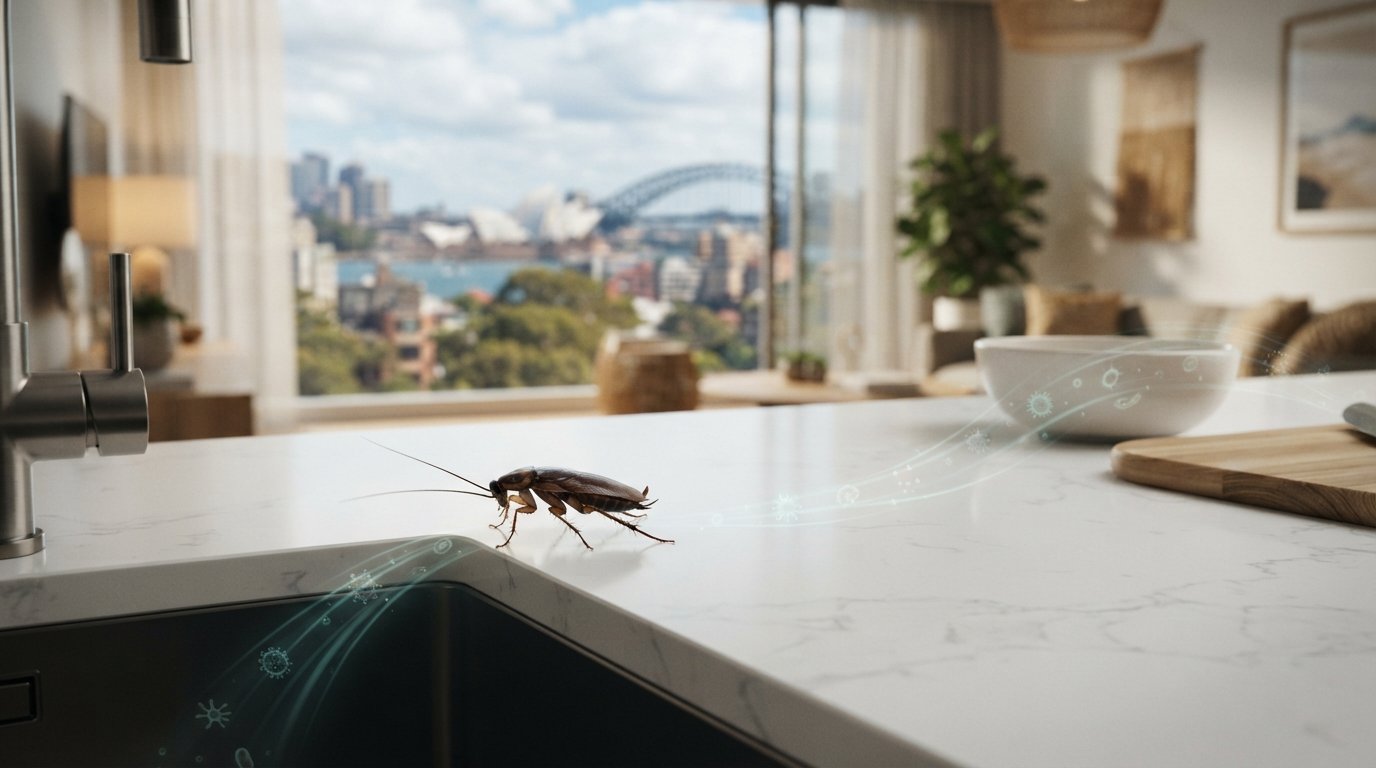

By the time you can see termite damage, they’ve already been eating your home for months. That’s the brutal reality facing Sydney homeowners, and it’s why thermal imaging termite detection has become one of the most important tools in modern pest control. If you’ve ever wondered whether infrared technology is a genuine breakthrough or just an expensive add-on, you’re asking exactly the right question.
Your concern is completely valid. Termites cause an estimated billions of dollars in structural damage across Australia every year, and the worst part is that the most destructive activity happens completely out of sight, inside walls, under floors, and within timber frames. A standard visual inspection simply can’t reach these hidden zones without drilling, probing, or causing damage of its own.
That’s where this guide comes in. Drawing on over 20 years of Sydney-specific experience, we’ll show you exactly how infrared thermal imaging works, why it’s particularly effective against the subterranean termite species most common in the Sydney metro area, and what a professional inspection report should actually look like. By the end, you’ll have everything you need to make a confident, informed decision about protecting your most valuable asset.
Key Takeaways
- Thermal imaging termite detection uses infrared technology to reveal hidden termite activity inside walls, floors, and ceilings — without a single drill hole or invasive probe.
- Termites introduce moisture into timber structures, and understanding how this creates detectable heat signatures is the key to catching an infestation before it becomes catastrophic damage.
- A professional infrared inspection delivers far more than a standard visual check — you’ll discover exactly how the two methods compare and why the difference can be worth thousands of dollars.
- Knowing how to prepare your home before an inspection directly affects the accuracy of the results — and most homeowners skip this critical step entirely.
- Experience interpreting thermal data matters just as much as the technology itself — learn what separates a genuinely comprehensive inspection report from a basic scan.
What is Thermal Imaging Termite Detection and Why Does It Matter?
Put simply, thermal imaging termite detection is a non-invasive inspection method that uses infrared camera technology to identify temperature anomalies behind walls, under floors, and inside ceilings. Where a standard visual inspection stops at the surface, an infrared camera sees what’s happening in the hidden zones where termites do their most destructive work. No drilling. No guesswork. Just data.
Termites earned the title of ‘silent destroyers’ for a reason. Active colonies can consume timber from the inside out for months before a single visible sign appears. By the time you notice a hollow-sounding floorboard or a bubbling paint surface, the structural damage is already significant. That’s the window thermal imaging closes.
How Infrared Cameras Spot Hidden Termites
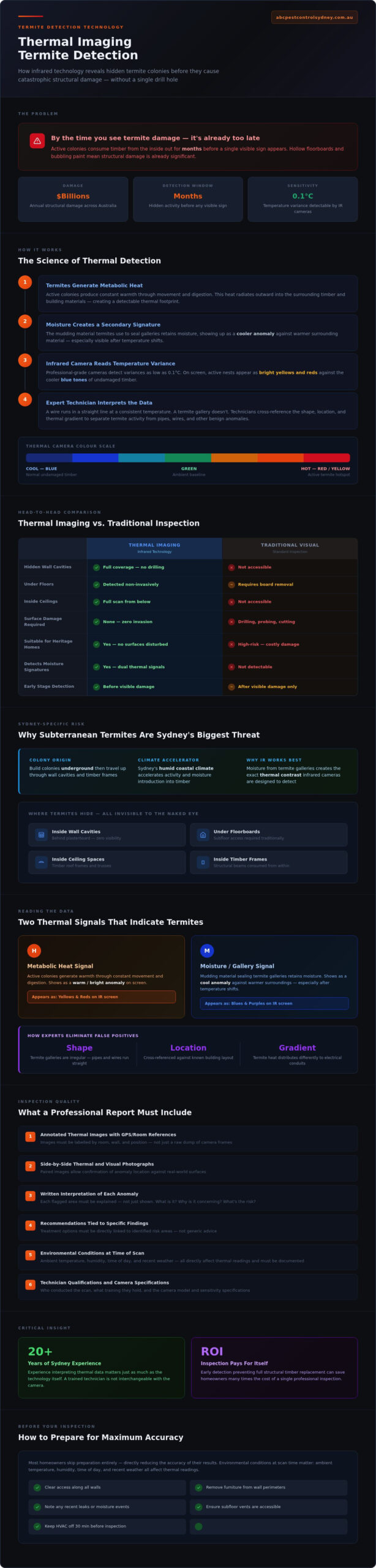
Termites are surprisingly warm creatures. Active colonies generate metabolic heat through constant movement and digestion, and that heat radiates outward into surrounding building materials. A professional-grade infrared camera can detect temperature variances as low as 0.1 degrees Celsius, making it sensitive enough to distinguish a termite hotspot from normal ambient variation in a wall cavity.
On screen, an active nest or moisture-laden gallery shows up as a distinct colour contrast, typically brighter yellows and reds against the cooler blue tones of undamaged timber. These thermal signatures are precise enough to give an experienced technician a clear picture of where activity is concentrated, without touching a single wall.
The Sydney Subterranean Factor
This is where the technology becomes especially critical for Sydney homeowners. The subterranean termite species most common across the Sydney metro area build their colonies underground and travel up through wall cavities and timber frames, spaces that are completely inaccessible to a visual check. Sydney’s humid coastal climate accelerates their activity, and the moisture they introduce into timber creates the exact kind of thermal contrast that infrared cameras are designed to detect.
Most inspection guides treat thermal imaging as a general pest tool. It isn’t. For Sydney’s specific subterranean species, it’s the most targeted detection method available.
The Non-Invasive Advantage for Homeowners
Traditional detection methods often mean pulling up floorboards, probing cavities, or cutting into drywall just to confirm a suspicion. For Sydney homes with high-end finishes, polished timber floors, or heritage features, that’s a costly and stressful process before treatment has even begun.
Thermal imaging eliminates that first step entirely. A thorough scan delivers actionable intelligence without disturbing a single surface. And when early detection prevents full structural timber replacement, the inspection pays for itself many times over.
The Science of Heat: How We ‘See’ Termites Through Walls
Infrared cameras don’t see termites directly. What they detect is the thermal footprint termites leave behind, and understanding that distinction is everything. Different building materials conduct and retain heat at different rates, a property called thermal conductivity. Brick holds heat longer than timber. Plasterboard releases it faster than insulation. A skilled technician reads these differences in real time, building a mental map of what’s normal for your specific home before identifying what isn’t.
Metabolic Heat vs. Moisture Signatures
Two distinct thermal signals can indicate termite activity, and confusing them leads to missed infestations or false alarms. Active termite colonies generate metabolic heat through constant movement and digestion, producing a subtle but measurable warmth in the surrounding timber. Separately, the mudding material termites use to seal their galleries retains moisture, which can show up as a cooler anomaly against warmer surrounding material, particularly after a temperature shift. An experienced technician distinguishes a termite signature from something benign, like an electrical conduit or a plumbing pipe, by cross-referencing the shape, location, and thermal gradient of the anomaly. A wire runs in a straight line and follows a consistent temperature; a termite gallery doesn’t.
Environmental Factors in Sydney Homes
Sydney’s climate creates a specific set of variables that directly affect thermal imaging termite detection results. High coastal humidity can compress the temperature difference between affected and unaffected building materials, making anomalies harder to distinguish. That’s why the time of day an inspection is conducted matters more than most homeowners realise.
The ideal window is early morning or late afternoon, when the external temperature is shifting. That transition creates the maximum thermal contrast between the interior and exterior of your walls, making hidden activity far easier to read on screen. Midday inspections in full Sydney summer heat can wash out subtle signatures entirely.
Wall construction type adds another layer of complexity:
- Brick veneer homes retain solar heat for longer, which can mask termite-generated warmth during hotter months and requires careful baseline calibration.
- Timber frame homes respond more quickly to temperature changes, often producing sharper thermal contrast and clearer anomaly signatures.
- Homes with wall insulation can suppress heat transfer in both directions, requiring the technician to adjust interpretation accordingly.
This is the gap most generic guides miss entirely. The camera is a tool. The expertise is what makes it reliable. With over 20 years of Sydney-specific inspections, our technicians have developed an understanding of how local construction styles, microclimates, and seasonal patterns interact with thermal data in ways that no equipment manual can teach. If you’d like to understand what a thorough inspection looks like for your specific home type, speak with our team about a comprehensive termite inspection tailored to your property.
Thermal Imaging vs. Traditional Termite Inspections
A standard visual inspection is reactive by design. A technician walks through your home looking for surface evidence: mudding trails along skirting boards, blistered paint, sagging timber, or the hollow thud of a tapped floorboard. These are all signs of termite activity that has already progressed far enough to break through to the surface. By that point, significant structural damage has typically occurred behind the scenes.
Thermal imaging termite detection flips that dynamic entirely. Instead of waiting for damage to reveal itself, an infrared camera reads the thermal signature of what’s happening inside your walls right now. It’s the difference between treating a symptom and catching the disease.
What a Visual Inspection Misses
The gaps in a visual-only approach aren’t minor. They’re the exact spaces where termites thrive:
- Intact wall studs being eaten from within. Termites consume timber from the inside out, often leaving a paper-thin outer layer completely undamaged. A visual check sees the paint. The infrared camera sees what’s behind it.
- Active colonies in sub-floor areas and roof voids. These spaces are dark, confined, and often physically inaccessible. A torch and a mirror aren’t enough. Thermal imaging covers these zones systematically.
- Hidden entry points behind built-in cabinetry. Wardrobes, kitchen cabinets, and bathroom vanities are frequently installed flush against walls, blocking the very surfaces where termites gain access. A visual inspection stops at the cabinet face. An infrared scan doesn’t.
The Tapping Test vs. Thermal Imaging
The ‘donger’, the tapping tool used to detect hollow timber, is a legitimate and useful instrument. But it’s fundamentally reactive. It confirms damage that already exists. Thermal imaging identifies thermal anomalies before the timber has fully hollowed out, giving you a proactive window to act. Used together, they’re far more powerful: the infrared scan flags the area of concern, and the tapping tool verifies the finding at the surface level.
Moisture meters add a third layer of confirmation. When a thermal anomaly appears, a moisture reading can distinguish between a termite gallery and a minor plumbing leak, two very different problems that can produce similar heat signatures without experienced interpretation.
Identifying moisture is also the first step in preventing secondary issues like fungal growth; for those interested in how professional inspections handle such risks, check out My Pure Environment SF for insights into comprehensive environmental testing.
Why an Integrated Approach is Best
The most effective termite inspection in Sydney doesn’t rely on a single method. It combines thermal imaging, moisture metering, and physical verification into a single, structured process that meets the requirements of Australian Standard AS 3660, the national benchmark for termite inspection and reporting. Compliance with AS 3660 isn’t just a quality marker; it ensures the inspection report carries genuine weight if you ever need to make an insurance claim or disclose findings during a property sale.
Technology without expertise is just a camera. What makes an integrated inspection reliable is the experience to know which anomalies matter, which don’t, and what the next step should be for your specific home.
What to Expect During a Professional Thermal Inspection
Knowing what happens during an inspection removes the guesswork and helps you prepare your home properly. That preparation directly affects the accuracy of the results. Most homeowners don’t realise this until after the fact.
The process starts before the technician even enters your home. For reliable thermal imaging termite detection, your home needs to have been at a stable internal temperature for at least an hour before the inspection begins. That means air conditioning and heating systems should be off, and windows and doors should be closed. Any significant temperature fluctuation in the hour prior can compress the thermal contrast between normal and anomalous areas, reducing the camera’s ability to distinguish a termite signature from background variation.
The Inspection Checklist
A structured walkthrough covers every zone where termite activity is statistically most likely, not just the areas that look suspicious. Here’s what a thorough inspection addresses:
- Wet areas first. Bathrooms, laundries, and kitchens are primary entry points. The moisture present in these zones attracts subterranean termites, and the junction between wet area tiling and adjacent timber framing is one of the most commonly missed risk zones in a visual-only check. High-resolution sensors scan these walls systematically, not just the visible surfaces.
- Door frames, window sills, and skirting boards. These junctions between different building materials are exactly where termites transition from one zone to another. Each one is checked with the same precision as the broader wall scan.
- Sub-floor and roof void. These spaces are inspected for structural heat variances that indicate active galleries or moisture-laden timber. The sub-floor is particularly critical in Sydney homes built on stumps or with suspended timber floors, where ground contact creates a direct termite pathway.
- External perimeter, garden beds, and fences. Termite activity rarely starts inside the home. The inspection includes an external sweep of the perimeter, checking landscaping timbers, fence posts, and garden beds that may be hosting a colony feeding toward your structure.
Understanding Your Thermal Report
A professional report doesn’t just hand you a series of heat images and leave you to interpret them. Every thermal anomaly is documented with a side-by-side comparison: the infrared image alongside a standard digital photograph of the same location. That pairing gives you a clear reference point for where each finding is located in your home.
You’ll also notice that thermal reports use different colour palettes. The two most common are Rainbow, which maps temperature across a full spectrum from blue through to red, and Ironbow, which uses a higher-contrast black-to-orange gradient. Neither is inherently better; they serve different purposes depending on the lighting conditions and wall type during the scan. Your report will specify which palette was used and why.
Pay close attention to how findings are classified. There’s a meaningful difference between a suspected anomaly, which flags an area for further investigation, and a confirmed infestation, which is verified through moisture metering and physical checks. A credible report distinguishes between the two clearly. Any inspection that marks everything as confirmed without verification steps isn’t following the integrated methodology that makes results reliable.
If your report returns a confirmed infestation, the next step is immediate action. Our comprehensive termite treatment guide walks you through exactly what happens after a positive finding and what your options are.
Thermal imaging is a diagnostic tool. The report it produces is only as useful as the expertise behind it. With over 20 years of Sydney inspections, our technicians know the difference between a reading that warrants urgent treatment and one that simply needs monitoring. Book a professional thermal inspection and get a report you can actually act on.
Secure Your Property with ABC Pest Control Sydney
Thermal imaging termite detection is only as reliable as the person holding the camera. The technology is sophisticated, but it doesn’t interpret itself. That’s the gap ABC Pest Control Sydney fills, and it’s a gap that matters enormously when you’re making decisions about your home’s structural integrity.
Why Experience Beats Technology Alone
Over 20 years of Sydney-specific inspections means our technicians have built something no equipment manufacturer can replicate: a detailed, suburb-by-suburb understanding of where termite activity concentrates across the metro area. From older weatherboard homes in Penrith to terrace houses in the inner west and coastal properties near the CBD, each construction style and microclimate produces its own thermal fingerprint. Knowing what’s normal for your specific home type is what separates a meaningful finding from a false alarm.
Our technicians are specifically trained in infrared thermography interpretation, not just camera operation. Every inspection uses industry-leading FLIR technology, recognised globally as the benchmark for professional thermal imaging. But the camera confirms what experience already suspects. That combination is what makes our findings reliable enough to act on.
We’re also committed to eco-friendly, family-safe methods at every stage. Detection is just the beginning. When findings require treatment, our approach prioritises targeted solutions that protect your household and the surrounding environment, not broad-spectrum applications that go further than the problem requires.
And protection doesn’t stop at detection. Our comprehensive termite service covers the full protection cycle:
- Thermal imaging inspection to locate hidden activity before it becomes structural damage
- Chemical barrier treatments applied to create a protective zone around your home’s perimeter
- Baiting systems that target the colony at the source, not just the activity visible in your walls
Book Your High-Tech Inspection Today
Visible damage is expensive damage. By the time a hollow floorboard or blistered paint surface appears, the repair bill has already grown. A proactive thermal inspection is the cheapest form of protection available, and it’s far less disruptive than what follows if an infestation goes undetected.
Booking is straightforward. Our team moves quickly, and you’ll receive a detailed digital report with thermal images, paired photographs, and clearly classified findings, giving you everything you need to make an informed decision fast.
Don’t wait for the damage to introduce itself. Book your thermal termite inspection with ABC Pest Control Sydney now and get the peace of mind that comes from knowing exactly what’s inside your walls.
Your Home Deserves Better Than a Surface-Level Check
Termites don’t wait, and neither should you. This guide has shown you exactly why thermal imaging termite detection outperforms visual-only methods, how Sydney’s climate and construction styles create specific detection challenges, and what a genuinely comprehensive inspection report should include.
The core takeaway is straightforward: catching termite activity early is the difference between a manageable inspection finding and a costly structural repair. The technology makes early detection possible. Experience makes it reliable. That’s the combination that matters.
With 20+ years of Sydney-specific inspections, advanced FLIR thermal technology, and fully licensed and insured technicians, ABC Pest Control Sydney delivers findings you can actually act on. Every inspection follows Australian Standard AS 3660 and produces a detailed digital report, so you’re never left guessing.
Don’t wait for the damage to show itself. Protect your home with a Thermal Termite Inspection and book now. Peace of mind is closer than you think.
Frequently Asked Questions About Thermal Imaging Termite Detection
Is thermal imaging 100% accurate for detecting termites?
No detection method is 100% accurate, and any inspector who claims otherwise isn’t being straight with you. Thermal imaging termite detection is highly effective at identifying thermal anomalies that indicate hidden activity, but it requires expert interpretation to distinguish a termite signature from a plumbing leak, electrical conduit, or simple moisture variation. That’s why professional technicians cross-reference infrared findings with moisture meters and physical checks before classifying a result.
The accuracy of a thermal scan depends heavily on conditions: wall construction type, time of day, and seasonal temperature shifts all influence what the camera can resolve. Experienced technicians account for these variables in real time. The camera is a powerful diagnostic tool; the expertise behind it is what makes the findings reliable enough to act on.
Can termites see the infrared light from the camera?
No. Infrared thermal cameras don’t emit any light at all, visible or otherwise. They’re passive instruments that simply measure the heat radiating from surfaces. Termites are completely unaware the inspection is happening, which is actually one of the method’s advantages: their behaviour isn’t disturbed during the scan, so the thermal signatures they produce remain accurate and undisturbed throughout the process.
Does thermal imaging work through brick or concrete walls?
Thermal imaging reads surface temperature variations rather than penetrating solid material directly. Brick and concrete walls do present a challenge because they retain solar heat for extended periods, which can compress the thermal contrast between normal and anomalous areas. A skilled technician compensates by carefully calibrating the baseline for your specific wall construction and scheduling inspections during optimal temperature transition windows, typically early morning or late afternoon.
Brick veneer homes are inspectable, but they require more careful interpretation than timber frame structures. This is one of the reasons Sydney-specific experience matters. Our technicians have inspected hundreds of brick veneer properties across the metro area and understand how local construction styles interact with thermal data in ways that a generic approach simply can’t replicate.
How much extra does a thermal imaging termite inspection cost?
We don’t publish pricing here because inspection costs vary depending on your property’s size, construction type, and access requirements. What we can tell you is that thermal imaging is typically included as part of a comprehensive termite inspection rather than billed as a standalone add-on. Contact our team directly for a clear, specific quote based on your property. Comparing the cost against the potential expense of undetected structural damage puts the investment in sharp perspective.
Can I use a cheap thermal camera for a DIY termite inspection?
Consumer-grade thermal cameras exist, but they’re not a reliable substitute for a professional inspection. Entry-level devices have significantly lower thermal sensitivity than professional FLIR equipment, meaning they can miss the subtle temperature variances that indicate early-stage termite activity. More importantly, the camera is only part of the equation. Interpreting what you’re seeing accurately requires training in thermography and an understanding of how your specific home’s materials, insulation, and construction style affect thermal readings.
A DIY scan might flag an obvious hotspot, but it’s just as likely to produce false alarms or, worse, miss genuine activity entirely. For a decision with this much financial consequence, professional interpretation isn’t optional.
What happens if the thermal camera finds a ‘hotspot’ in my wall?
A hotspot is classified as a suspected anomaly until it’s verified. The technician will cross-reference the thermal image with a moisture meter reading and, where accessible, a physical check of the area. This step distinguishes a termite gallery from a benign heat source like a pipe or electrical conduit. If the finding is confirmed as termite activity, you’ll receive a detailed digital report with the thermal image, a paired standard photograph, and a clear recommendation for next steps.
A confirmed finding means prompt action is needed. The report gives you everything required to move straight into treatment planning, with no ambiguity about where the problem is located or how serious it appears to be.
Is thermal imaging safe for my family and pets?
Completely. Thermal imaging is a passive, non-contact technology. The camera emits nothing; it only reads existing heat signatures. There’s no radiation, no chemicals, and no physical disturbance to your home’s surfaces. Your family and pets can remain in the home during the inspection without any health or safety concern. It’s one of the most genuinely non-invasive diagnostic tools used in residential pest control today.
How often should I have a thermal termite inspection in Sydney?
Australian Standard AS 3660 recommends termite inspections at least once every 12 months for most residential properties. In Sydney, where subterranean species are active year-round due to the humid coastal climate, annual inspections are a minimum, not a ceiling. Properties with a history of termite activity, significant timber construction, or dense surrounding vegetation may benefit from more frequent checks. If your home is currently protected by a baiting or barrier system, your technician will advise on the appropriate inspection schedule to keep that protection effective.