One in three homes in Sydney will be affected by termites at some point during its lifetime. If you have just discovered a hollowed-out timber beam or a crumbling skirting board, it is natural to feel a surge of anxiety about structural collapse and hidden repair costs. You are likely wondering if the invaders are still there or if you are looking at scars from a battle fought years ago.
We understand that distinguishing between active threats and historical damage is vital for your peace of mind and your bank account. This guide explains exactly how to tell if termite damage is old or new by revealing the specific visual and physical markers that professional inspectors use. You will learn how to identify the difference between brittle, dusty mud tubes and the moist, active tunnels that signal an immediate emergency.
We will also cover why DIY poking can backfire by sending termites deeper into your home’s structure. By the end of this article, you will have a clear action plan to verify the status of your property and stop further destruction before it spreads. Use these expert insights to protect your Sydney home and regain control over your property’s safety.
Key Takeaways
- Identify the critical differences between active colonies and dormant damage to prioritize your home’s structural repairs.
- Discover how to tell if termite damage is old or new by inspecting the moisture content and integrity of mud tunnels and timber galleries.
- Perform a safe visual and physical scan using the tapping method to detect hollow sections without triggering a colony relocation.
- Learn why professional technology like thermal imaging is necessary to find active infestations hidden deep within wall cavities.
- Gain peace of mind by following a professional verification plan that aligns with current Australian Standards for pest management.
Identifying Termite Damage in Sydney: Why “Old” vs. “New” Matters
Finding damaged timber in your home is a gut-wrenching moment. Your first instinct is likely to grab a screwdriver and start poking at the wood, but you should stop immediately. Knowing how to tell if termite damage is old or new is the difference between a controlled professional treatment and a structural catastrophe. New damage means an active colony is currently compromising your home’s structural integrity. It means they are eating your investment right now. Old damage suggests a past infestation that may have been treated or naturally abandoned. Distinguishing between the two prevents unnecessary panic while ensuring actual threats are neutralized before they spread further.
In Sydney, our unique environmental conditions make this diagnosis difficult. High moisture levels and humidity can make old, weathered wood look deceptively fresh. This often leads to confusion for homeowners trying to assess the risk themselves. You don’t want to ignore a live threat, but you also don’t want to pay for expensive treatments if the danger passed years ago. Professional clarity is the only way to be certain.
The Economic Impact of Misdiagnosis
Ignoring active termites for even six months can lead to thousands in structural repairs. According to current data, termites cause over $1.5 billion in damage to Australian homes every year. Mistaking old damage for new can also be costly. It leads to unnecessary treatment expenses that drain your maintenance budget. An active infestation is specifically defined as the presence of live termites or fresh, moist mudding. If you misread these signs, you risk facing the average repair cost of $10,000 per house. Reliable verification ensures you only invest in the solutions you actually need.
Sydney’s Termite Pressure in 2026
Climate shifts in New South Wales have altered termite activity cycles, making them more resilient and aggressive than in previous decades. Subterranean termites are particularly prevalent in Sydney suburbs like the North Shore and Western Sydney. These areas have established trees and humid gullies that provide perfect breeding grounds. For a comprehensive overview of termite biology and their role as pests, understanding their constant need for moisture is essential. These “white ants” are a year-round threat in the Australian landscape. They don’t take winter breaks. In 2026, one in three homes in Sydney will be affected by termites. This high pressure means any sign of damage requires immediate professional scrutiny. Learning how to tell if termite damage is old or new is your first line of defense in a high-risk region.
Signs of Active Termite Damage: The Red Flags of a “New” Infestation
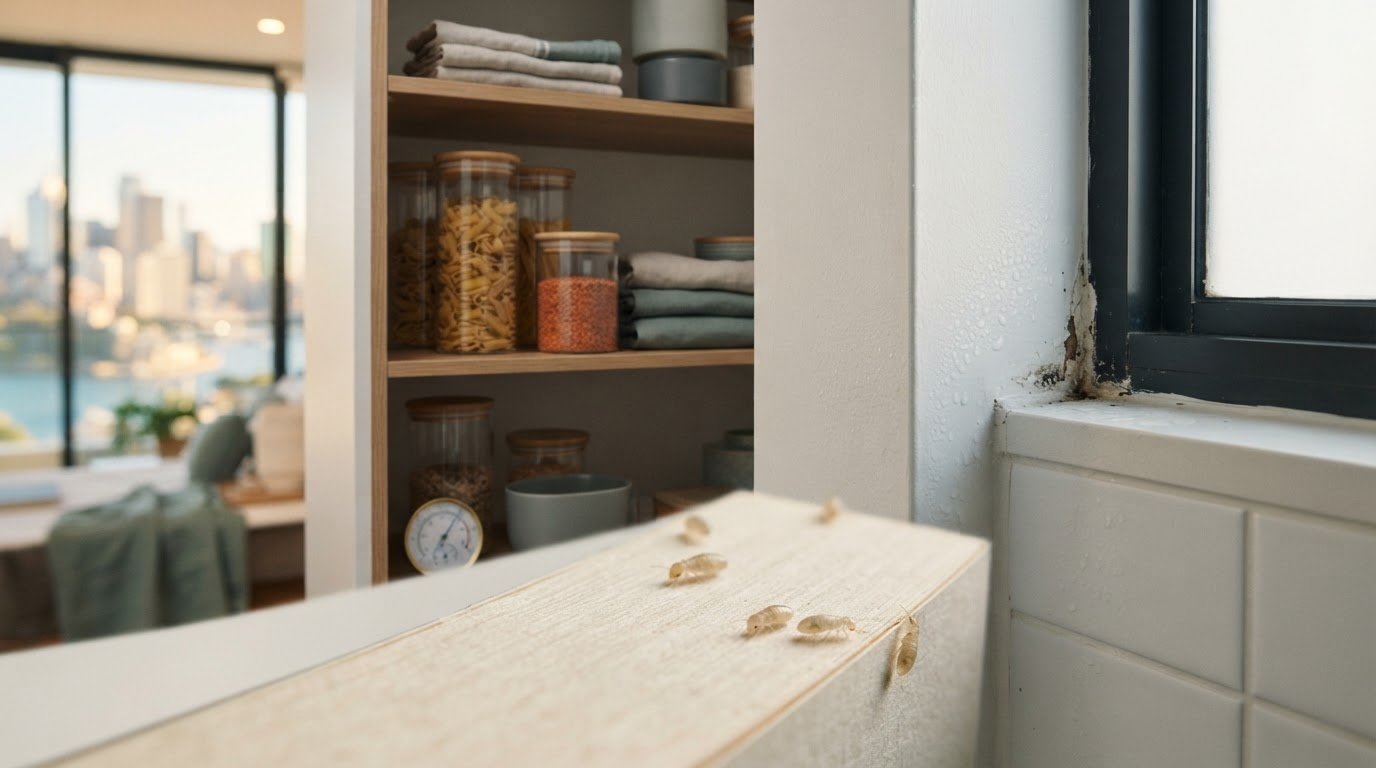
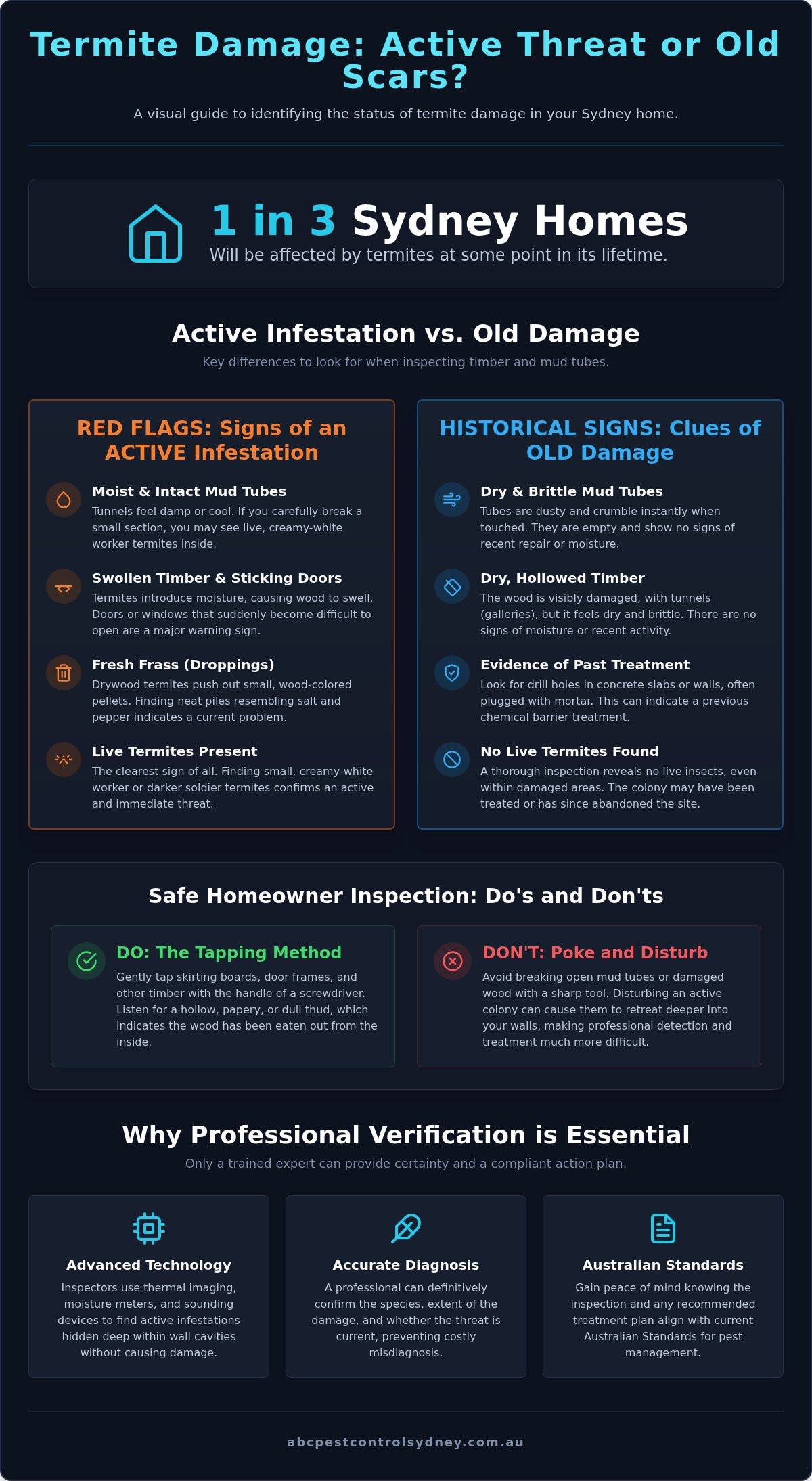
Nothing confirms an active threat faster than seeing live insects. If you find small, creamy-white workers or darker soldiers with distinct mandibles, the colony is active. These insects are light-sensitive and rarely leave their tunnels, so seeing them usually means you have breached a live gallery. Identifying these Signs of Active Termite Damage early is the only way to prevent structural failure.
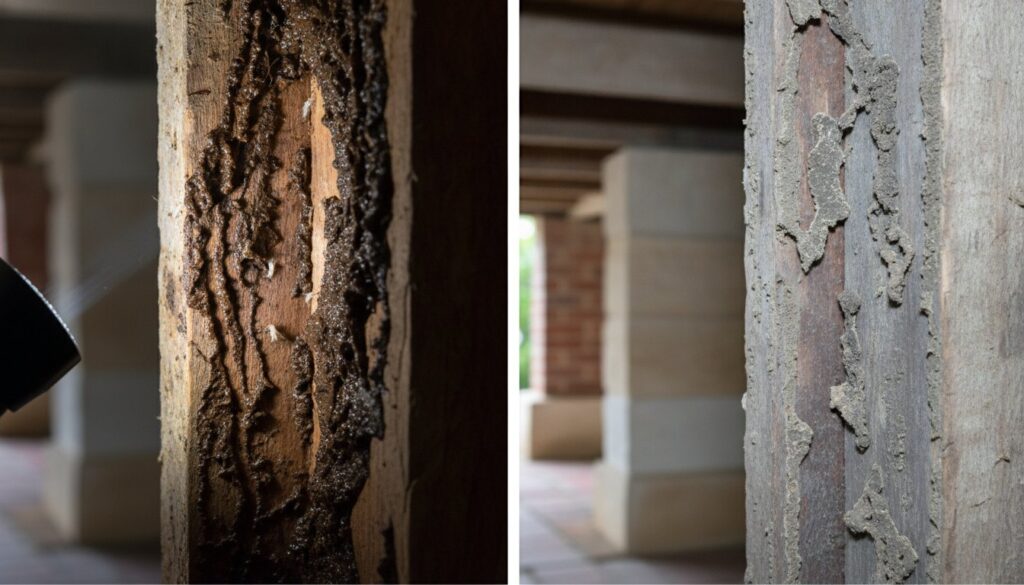
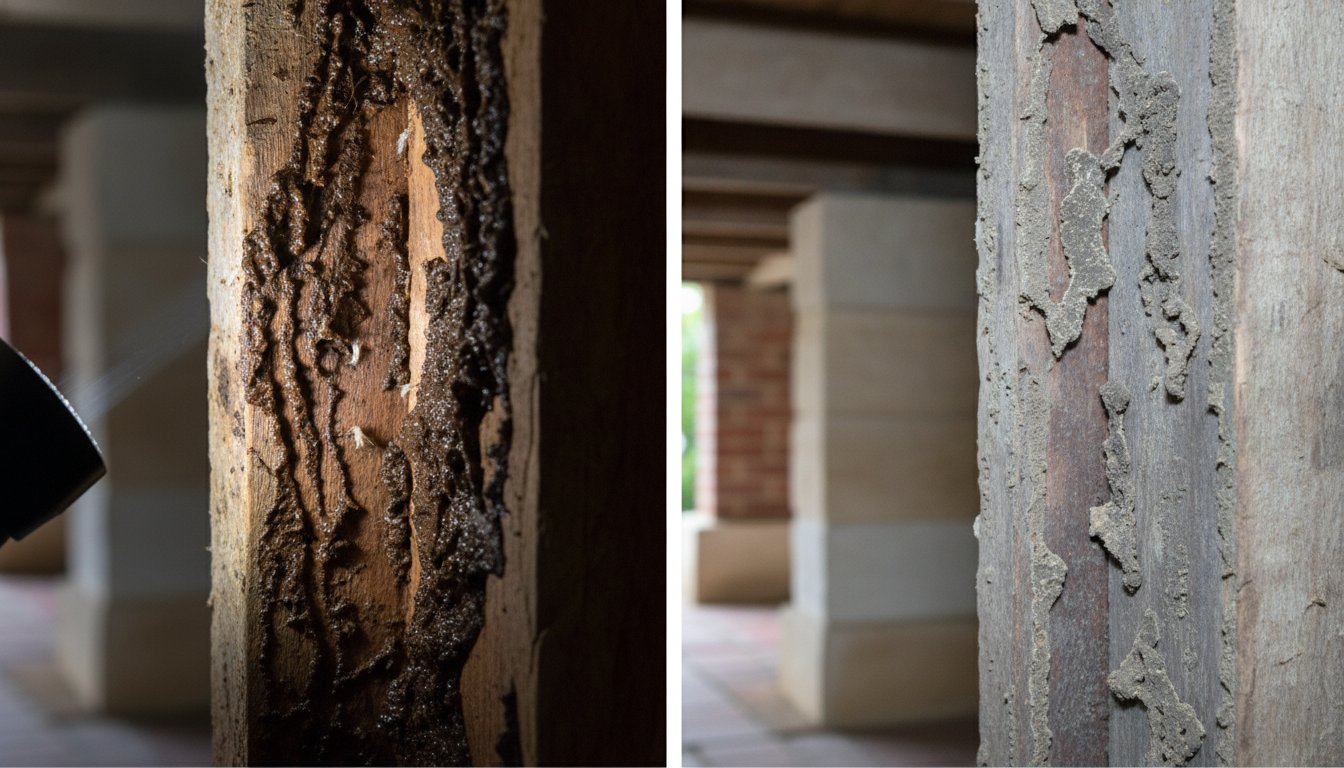
When investigating how to tell if termite damage is old or new, focus on the moisture levels. Subterranean termites, which are common across Sydney, require high humidity to survive. Their mud tubes will feel damp or cool to the touch when active. If the mud is dry and crumbles into dust instantly, it might be historical damage, but you cannot assume the threat has left the property entirely.
Stuck windows or doors are another major red flag. As termites consume wood and build galleries, they introduce significant moisture into the timber. This causes the wood to swell, making frames tight or difficult to operate. If a door that used to swing freely is suddenly sticking in its frame, it is often a sign of a current, active infestation rather than old structural settling.
Drywood termites leave behind “frass,” which are small, wood-coloured droppings. These appear in neat, salt-and-pepper like piles near infested timber. Unlike subterranean termites that use their waste for construction, drywood species push it out of tiny kick-out holes. Finding fresh piles of frass is a clear indicator of a current problem that requires immediate attention.
Analysing Mud Tubes and Tunnels
You can test a mud tube by carefully breaking a one-centimetre section. If it is an active lead tunnel, the termites will likely begin repairing the breach almost immediately. Check the spot again after 24 to 48 hours. If the gap is sealed with fresh, wet mud, you have a confirmed “new” infestation. Exploratory tubes are thinner and may be abandoned, but established lead tunnels are thick and always occupied.
Swarmers and Discarded Wings
Discarded wings on windowsills or near light fixtures are a definitive sign of recent activity. These are left by “alates” or swarmers looking to establish new colonies. Termite wings are all the same size, unlike flying ants which have larger front wings. If you find these wings inside your home, the colony is likely already established within your walls. Professional verification is the only way to find the source. You should consider booking a detailed termite inspection to ensure your property remains safe and secure.
Characteristics of Old Termite Damage and How to Spot It
Spotting structural decay doesn’t always mean you have a current crisis. Old damage represents an infestation that has either been successfully treated or abandoned by the colony. When determining how to tell if termite damage is old or new, the most obvious sign is the texture and moisture of the affected timber. Old galleries are typically bone-dry and brittle. They crumble into a fine, sand-like dust when touched. There is no moisture, no fresh mudding, and no sign of life within the tunnels.
Look for painted-over mud tunnels. If you find mud tubes on a foundation wall or skirting board that match the exact colour of the surrounding paint, it’s a clear sign of historical activity. Previous owners may have treated the problem and simply painted over the evidence. For more detailed Characteristics of Old Termite Damage, professional inspectors also look for the absence of worker activity over extended periods. If multiple spot checks across different weather conditions reveal no movement, the site is likely inactive.
Always check your electrical meter box. In Sydney, it’s standard practice for pest controllers to leave a compliance sticker or certificate after a treatment or the installation of a barrier. If you find a sticker dated within the last few years, the damage you see might be the remnants of that recorded event. However, an expired sticker is a warning sign. It means your protection is no longer active and a new colony could have easily moved in.
Termite Damage vs. Wood Rot (Dry and Wet)
The Danger of “Dormant” Colonies
Never assume that a lack of movement means the threat is gone. Termites are masters of survival. They might abandon a site temporarily during a dry Sydney summer only to return when the humidity rises. DIY poking at a gallery is dangerous. It can spook the colony, causing them to retreat into the wall cavities or relocate to a different part of your home. Professional verification is the only way to confirm a colony is truly dead rather than just dormant. Don’t risk your home’s safety on a guess.
The Homeowner’s DIY Inspection: Testing Wood Integrity Safely
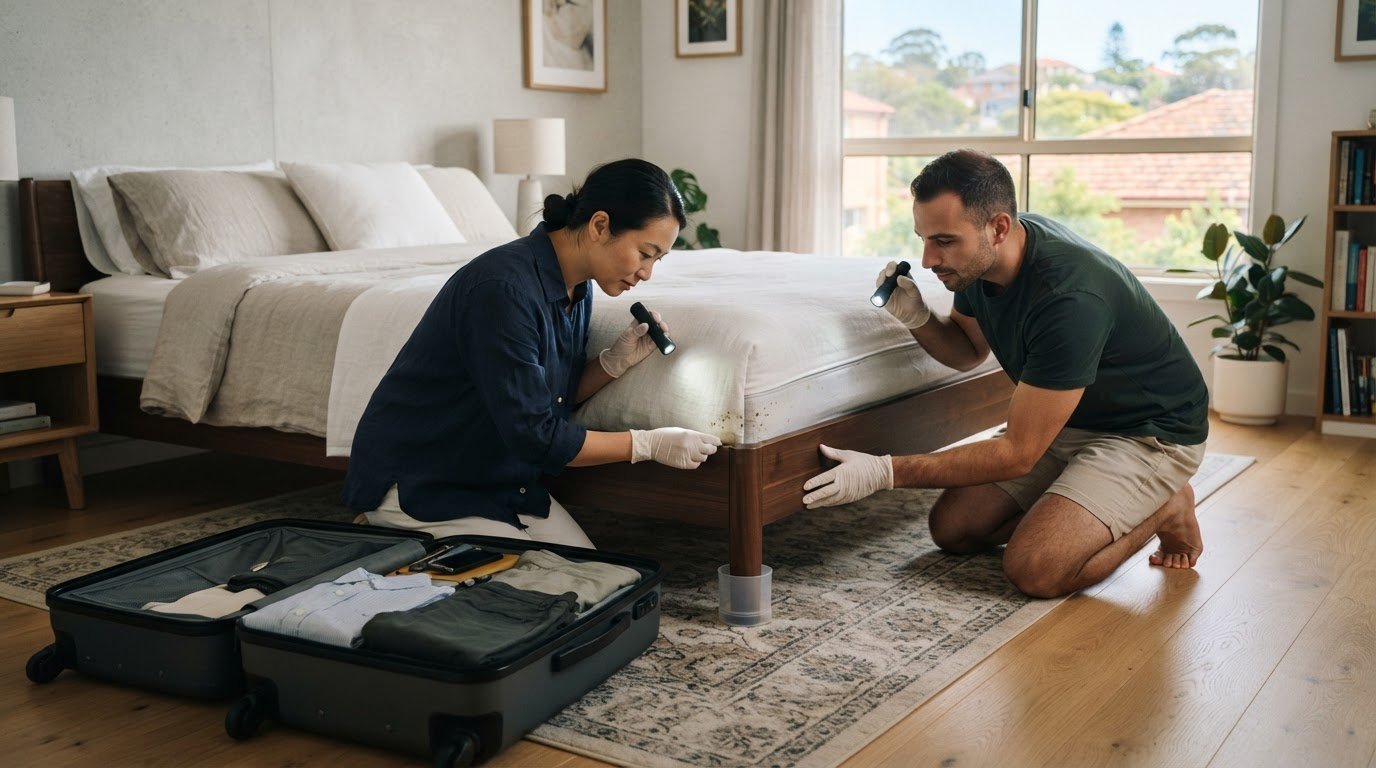
Conducting your own preliminary check is a smart way to monitor your property between annual professional visits. However, you must be careful. Aggressive poking or breaking open galleries with a knife can “spook” a colony. This causes them to retreat deeper into the structure or move to a different room entirely. Follow these controlled steps to gather information without escalating the problem.
- Step 1: Visual Scan. Walk the perimeter of your home. Look for “mudding” on the slab edge or foundation. These are the primary entry points for subterranean termites.
- Step 2: The Tapping Test. Use the plastic handle of a screwdriver to tap along skirting boards and door frames. Listen for hollow echoes.
- Step 3: Moisture Check. Look for bubbling or peeling paint that resembles water damage. Check for drywall that looks “bruised” or slightly indented.
- Step 4: Integrity Check. Carefully scrape a tiny section of suspected mudding. If it is moist and dark, it is likely new. If it is dry and light, it may be old. This is a key way how to tell if termite damage is old or new.
- Step 5: Documentation. Take clear, high-resolution photos of any suspicious areas. If you need to mark specific spots or dates on walls to monitor movement, you can check out PoscART for professional-grade paint markers that are perfect for labeling various surfaces. This helps a professional provide an accurate assessment later.
The Tapping Test: What Does Hollow Wood Sound Like?
Healthy timber produces a solid, dull thud when struck. In contrast, termite-damaged wood sounds papery or produces a distinct hollow echo. A hollow sound often means the “meat” of the timber has been consumed, leaving only a thin outer veneer. Focus your efforts on window reveals, door frames, and skirting boards. These are often the first places termites attack because they are close to soil entry points.
Common Inspection Blind Spots
Don’t just look at the living areas. You must check sub-floors and roof voids where termites can work undisturbed for months. Sydney’s sandstone foundations are notorious for hiding subterranean entry points through small cracks or gaps in the mortar. Additionally, garden mulch and firewood piles stacked against the house act as a bridge for termites. If you find something suspicious during your walk-around, book a professional termite inspection immediately to confirm the status of your home. Knowing how to tell if termite damage is old or new is useful, but only a professional toolset can guarantee your safety.
Why Professional Termite Inspections are Essential in Sydney
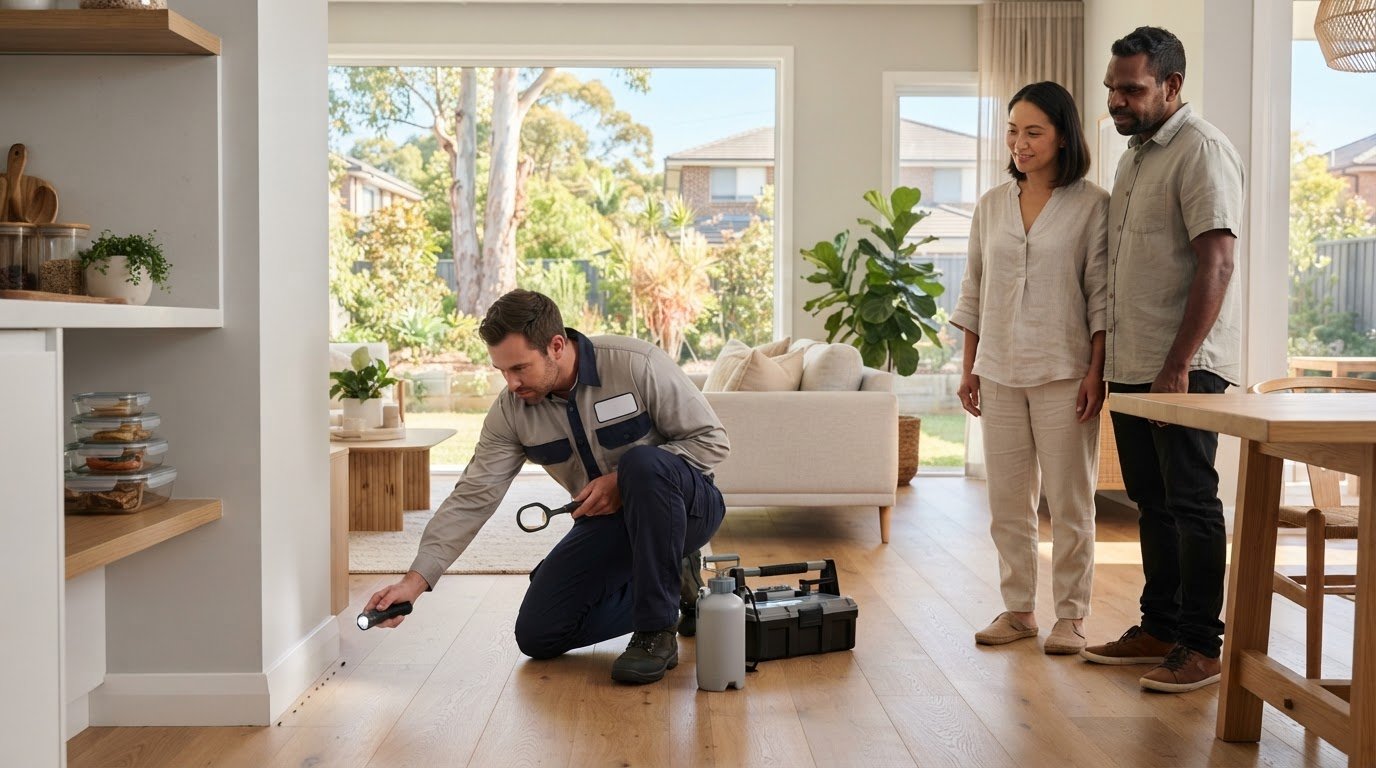
While learning how to tell if termite damage is old or new is a vital skill for every homeowner, it is not a substitute for specialized equipment. Visual signs only tell half the story. Professional tools like Thermal Imaging cameras allow our team to see the heat signatures generated by a live, active colony hidden behind your walls. We also use moisture meters to detect the high humidity levels that subterranean termites maintain within their active galleries. Without these tools, you are essentially guessing about the safety of your home.
Adherence to Australian Standard AS 3660.1 is critical for any management plan. This standard ensures that the inspection is rigorous and follows national safety benchmarks. An expert can also identify the specific species of termite attacking your property. Some species, like Coptotermes acinaciformis, are significantly more aggressive and destructive than others. Knowing the enemy is the first step in creating an effective elimination strategy that actually works for your specific Sydney suburb.
Advanced Diagnostic Technology
We utilize Termatrac technology. This uses radar to detect movement through solid walls without the need for demolition. This non-invasive approach protects your home while giving us a clear picture of what is happening inside the timber. Borescopes allow us to peek into internal wall cavities with minimal disruption to your drywall or plaster. A visual-only DIY check is never 100% reliable. Termites often travel through the center of beams, leaving the exterior looking perfectly normal to the naked eye. Professional verification removes the guesswork and provides a definitive answer on whether your home is currently under attack.
Securing Your Sydney Property with ABC Pest Control
ABC Pest Control Sydney has a 20-year history of protecting local homes from the “silent destroyer.” We understand the unique environmental pressures of the Sydney metro area, from the humid North Shore to the high-pressure zones in Western Sydney. Our customized termite inspection Sydney reports provide the detailed documentation required for insurance claims and pre-sale requirements. We don’t just find the problem; we solve it completely.
Our path from inspection to total protection includes the installation of robust chemical barriers and advanced baiting systems. We use industry-leading products to ensure your property remains a fortress against future infestations. Don’t wait for a structural collapse or high repair bills to take action. Secure your peace of mind and book your professional verification today. Our team is ready to provide the expert intervention you need to protect your investment for years to come.
Secure Your Sydney Home Against the Silent Destroyer
Protecting your property starts with vigilance. You now know that active infestations thrive on moisture, leaving behind damp mud tubes and swollen timber, while historical damage remains dry and brittle. Understanding how to tell if termite damage is old or new is your first step toward protecting your investment. However, even the most thorough DIY check cannot replace the precision of advanced diagnostic technology like thermal imaging and radar detection.
ABC Pest Control Sydney brings over 20 years of local expertise to every property we visit. Our fully licensed and insured technicians provide detailed reports following Australian Standard AS 3660.2, ensuring you have the legal and structural documentation you need for total peace of mind. Don’t let a dormant colony or a hidden entry point turn into a major repair bill. Stop the uncertainty and take control of your home’s safety right now.
You have the tools and the knowledge to spot the warning signs. By acting quickly and choosing expert verification, you can ensure your Sydney home stays safe, solid, and termite-free for years to come.
Frequently Asked Questions
Can termites go away on their own?
Termites rarely abandon a reliable food source permanently without professional intervention. They might relocate to a different part of your home if they are disturbed or if the immediate timber becomes too dry, but the colony remains a threat. You shouldn’t assume a lack of visible activity means the insects have left your property for good.
Does termite damage look like water damage?
Termite damage frequently mimics water damage by causing bubbling paint, sagging drywall, and swollen wood. The primary difference lies in the internal structure of the timber. Termites leave behind a “honeycomb” pattern and mud residue, whereas water damage typically causes the wood to become soft, mushy, and discoloured without any internal tunneling.
How fast do termites eat through a Sydney home?
An aggressive colony of subterranean termites can cause significant structural damage within six to twelve months. In Sydney’s humid climate, these pests work 24 hours a day, 365 days a year. Because they eat from the inside out, the destruction is often advanced by the time a homeowner notices the first external sign.
Will insurance cover termite damage in Australia?
Most standard home and contents insurance policies in Australia do not cover termite damage. Insurance providers generally classify termite infestations as a preventable maintenance issue rather than an accidental event. This means the financial burden of repairs, which averages $10,000 per affected house, falls entirely on the homeowner.
What color is active termite mudding?
Active termite mudding is typically dark brown or charcoal and feels moist to the touch. It has a glistening appearance because the termites maintain high humidity within the tubes. As mudding ages and becomes inactive, it turns into a lighter, sandy tan colour and becomes extremely brittle, crumbling into dust at the slightest pressure.
Is it safe to live in a house with old termite damage?
Safety depends entirely on the structural integrity of the remaining timber. Even if the termites are long gone, the hollowed-out beams may no longer be able to support the weight of the structure. You must have a professional inspector or structural engineer verify that the load-bearing components are still safe before occupying the home.
How often should I get a termite inspection in Sydney?
Australian Standard AS 3660.2 recommends a professional termite inspection at least every 12 months for most properties. If you live in a high-risk area near bushland or have a history of infestations, you should increase this to every six months. Regular checks are the most effective way to understand how to tell if termite damage is old or new before the situation escalates.