

In April 2026, a Sydney restaurant and its director were fined $37,500 after a health inspection uncovered rodent activity linked to a Salmonella outbreak. It’s a nightmare scenario that proves a single lapse in documentation can lead to financial ruin and a permanent spot on the NSW Food Authority’s “Name and Shame” list. You’ve worked tirelessly to build your reputation. The last thing you need is a mountain of confusing paperwork standing in the way of your success.
Managing a compliant pest control logbook for restaurants shouldn’t be a constant source of anxiety. We understand that your time is better spent in the kitchen than deciphering complex Food Standards Code requirements. This guide will help you master your food safety obligations and ensure you ace your next health inspection with total confidence. We’ll break down the essential records you must maintain, from bait station maps to chemical safety data sheets. You’ll learn how to implement a “set and forget” professional system that protects your brand from heavy fines and keeps your doors open for business.
Key Takeaways
- Learn how to align your business with the NSW Food Act 2003 to protect against heavy penalties and “Name and Shame” listings.
- Discover the critical components of a compliant pest control logbook for restaurants, including mandatory site maps and licensed technician reports.
- Avoid the common “gap trap” mistakes that cause health inspectors to issue infringements during routine food safety audits.
- Compare digital and physical record-keeping systems to determine which method offers the fastest access during high-pressure inspections.
- Implement a professional commercial pest management plan to secure a “set and forget” compliance system for your venue.
What is a Pest Control Logbook and Why is it Mandatory in Sydney?
A pest control logbook for restaurants is much more than a simple folder on a back-office shelf. It’s a comprehensive, central record that tracks every pest sighting, every chemical treatment, and every preventative action taken within your venue. Think of it as your primary line of defense during a crisis. In Sydney, this document provides the physical proof that you are taking “all practicable measures” to keep your kitchen safe. It serves as the foundation for any robust Hazard Analysis and Critical Control Points (HACCP) plan. Without it, you aren’t just risking a pest outbreak; you’re risking your legal right to operate.
Under the NSW Food Act 2003 and the Food Regulation 2015, food businesses have a non-negotiable duty to eradicate pests and prevent their entry. Local Sydney Council health inspectors don’t just look for physical signs of activity during an audit. They demand to see your service register immediately. This living document proves your due diligence. It shows a consistent history of professional intervention rather than a reactive, DIY approach. If an inspector arrives and your records are missing or outdated, they will assume your pest management is non-existent. You must treat this logbook as a legal diary of your commitment to public safety.
The Legal Consequences of Poor Record-Keeping
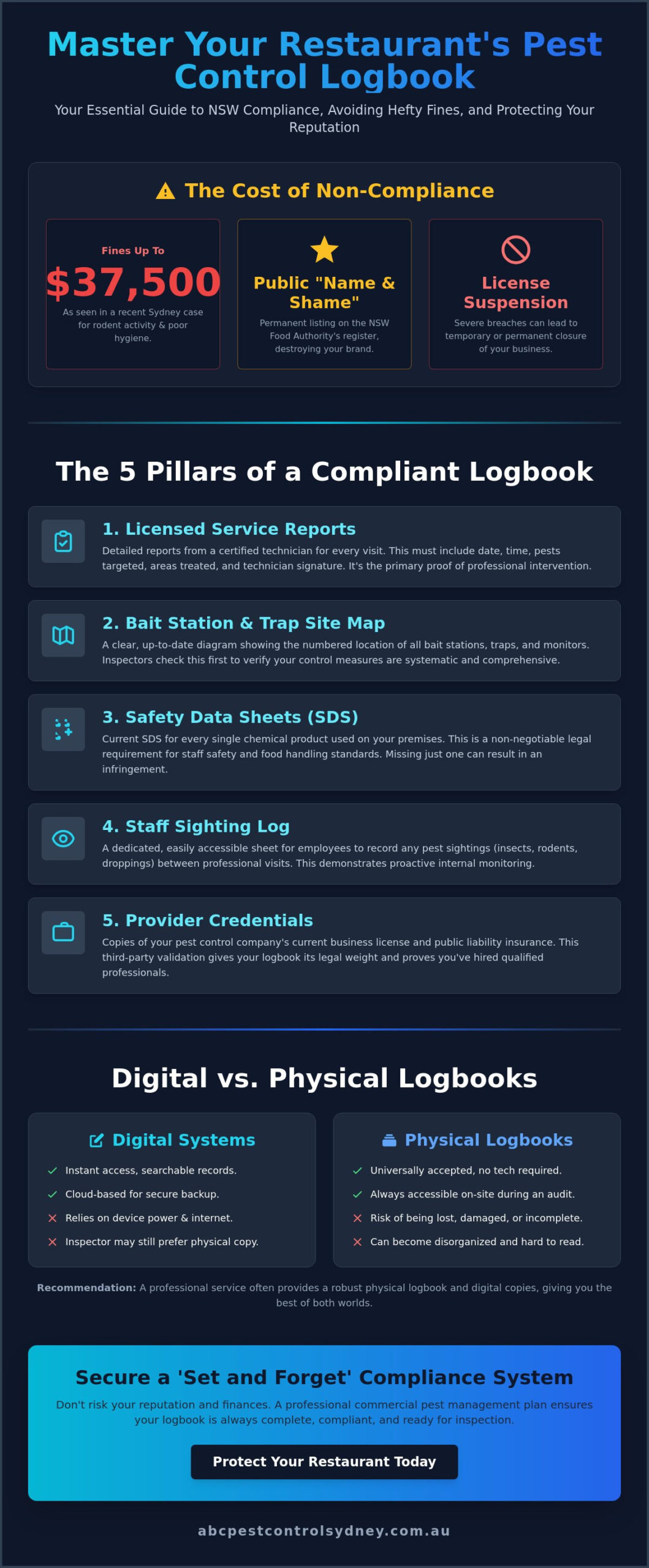
The risks of negligence are public, permanent, and expensive. The NSW Food Authority maintains a “Name and Shame” register that can destroy a brand’s reputation overnight. In April 2026, a Sydney restaurant faced a massive $37,500 fine for various breaches, including rodent excrement and poor hygiene. Missing entries in your pest control logbook for restaurants often lead to immediate Improvement Notices. If you don’t address these issues, on-the-spot fines follow. In severe cases, your restaurant license can be suspended or revoked. Compliance isn’t optional; it is a survival requirement for your business.
Who is Responsible for the Logbook?
While the business owner carries ultimate legal liability, the Food Safety Supervisor usually manages the daily upkeep. They must ensure the logbook is accessible on-site at all times for unannounced inspections. You cannot tell an officer the records are at your accountant’s office or in a remote storage unit. A professional pest controller must sign off on every service entry, providing their license number and details of all chemicals used. This third-party validation gives the logbook its legal weight. Keep it current, keep it organized, and keep it ready for the next knock on your door.
Essential Components of a Compliant Restaurant Pest Logbook
A pest control logbook for restaurants is a technical dossier, not a collection of random receipts. To satisfy a local council inspector, your records must be organized and comprehensive. Missing a single Safety Data Sheet or an outdated technician license can trigger a non-compliance report. You need a system that proves your venue is under professional supervision at all times. Don’t settle for a generic folder from a retail store. Those often lack the professional documents required for true Sydney restaurant compliance.
Every folder must contain these five pillars to be considered legally sufficient:
- Licensed Service Reports: Detailed reports from a certified Sydney technician for every visit.
- Bait Station Site Map: A clear, numbered diagram showing the location of all traps and monitors.
- Safety Data Sheets (SDS): Current documents for every chemical applied on your premises.
- Staff Sighting Log: A dedicated sheet for employees to record activity between professional treatments.
- Provider Credentials: Copies of your pest controller’s current license and public liability insurance.
Integrating these elements into your Commercial Pest Management strategy ensures you’re never caught off guard during an unannounced audit.
Mapping Your Defences: The Site Plan
Inspectors look for a numbered bait station map first. It shows you know exactly where your traps are located and that they are being monitored regularly. You must distinguish between internal monitoring stations and external perimeter baiting points. If you renovate your kitchen or move a large cool room, update this map immediately. An inaccurate map suggests a lack of control over your premises and can lead to an infringement notice.
The Sighting Log: Empowering Your Staff
Your staff are your eyes and ears on the ground. Train them to record the date, time, and specific location of any pest sightings. This data allows your technician to target resilient pests like German cockroaches with surgical precision. Learning to differentiate between an “occasional invader” like a stray cricket and signs of a brewing infestation can save you thousands in remediation costs. A well-maintained sighting log proves to inspectors that your team is proactive, not just reactive.
Common Mistakes That Lead to Failed Pest Inspections
Even the most spotless kitchen in Sydney can receive a failing grade if the documentation is flawed. Inspectors from the local council look for specific patterns of neglect that indicate a lack of control. A common error is the “Gap Trap.” This occurs when a business misses several months of records. It suggests that pest management is only a priority when a problem is visible. A compliant pest control logbook for restaurants must show a continuous, uninterrupted history of professional oversight. If your records stop and start, you are inviting an infringement notice.
Inspectors hate ambiguity. If they cannot read the scribbled handwriting of a previous technician, they will treat that service entry as if it never happened. Illegible or incomplete notes are a major red flag. Similarly, your logbook must be a reflection of your current reality. Keeping Safety Data Sheets (SDS) for discontinued chemicals is a mistake. It tells the inspector that your system is stagnant and unmanaged. Your physical traps on the floor must match your site map exactly. If an inspector finds a bait station that isn’t on your map, or vice versa, it proves your documentation is unreliable.
The Danger of Inconsistent Service Intervals
One-off treatments do not satisfy Sydney health inspectors. High-risk environments like the Sydney metropolitan area require a proactive schedule. Gaps in service suggest a reactive food safety culture. This violates the Australian Food Safety Standards, which demand “all practicable measures” to prevent pest entry. Regular intervals show you are managing risks before they become infestations. Establish a fixed schedule with your provider. Don’t wait for a sighting to book your next visit.
Missing Chemical Documentation
You must maintain current Australian Safety Data Sheets (SDS) for every bait or spray used. These documents must be easily accessible during an audit. Using chemicals not approved for food-handling areas is a critical failure. Verify that your technician is licensed to use commercial-grade baits. Their credentials should be clearly displayed in your pest control logbook for restaurants. This protects your staff, your customers, and your business license. Check your folder today. Ensure every chemical mentioned in your service reports has a corresponding, up-to-date SDS.
Digital vs. Physical Logbooks: Choosing the Best System
There is a massive difference between a generic “bought book” and a professional managed service logbook. A pest control logbook for restaurants purchased from a retail store is often just a collection of blank templates. It puts the entire burden of compliance on you. If a technician forgets to sign a page or a staff member loses a sheet, your defense disappears. A managed system, however, is a proactive compliance tool. It ensures every service is recorded, every chemical is documented, and every sighting is tracked without you having to micromanage the process.
Modern Sydney venues are moving toward digital systems, but many still rely on the “on-the-shelf” reliability of physical folders. You must decide which system fits your kitchen’s high-pressure environment. ABC Pest Control Sydney integrates digital reporting to provide a seamless experience that satisfies even the strictest health inspectors. We ensure your records are always audit-ready, regardless of the format you choose.
The Advantages of Professional Digital Reporting
Digital systems offer a level of precision that paper simply cannot match. When a service is completed, a timestamped report is sent directly to your management email. This provides an instant, unalterable record of work. You can access high-resolution photos of problem areas or proof of service from any device. For multi-site restaurant groups in Sydney, digital logs allow you to monitor compliance across all locations from a single dashboard. You no longer have to travel to each venue to check if their records are current.
- Instant digital timestamps for every technician visit.
- Cloud-based storage that acts as a permanent backup.
- Searchable history for rapid data retrieval during audits.
- Direct email delivery to owners and food safety supervisors.
Why Traditional Folders Still Have a Place
Physical folders remain popular for one reason: immediate visibility. When an inspector walks through the door, they often look for the “pest folder” on the office shelf. A physical pest control logbook for restaurants doesn’t rely on Wi-Fi or tablet battery life. It is always there, ready to be flipped through. Many Sydney operators prefer a hybrid approach. They use professional digital reports but print them out to keep a physical onsite folder. This ensures you have a backup system that works even during a power outage or technical glitch.
Don’t leave your compliance to chance with a blank store-bought book. Secure your venue with our expert Commercial Pest Management packages designed for Sydney’s hospitality industry.
Secure Your Sydney Restaurant with Professional Pest Management
Don’t leave your reputation to chance. ABC Pest Control Sydney specializes in commercial pest management, bringing over 20 years of experience to high-pressure kitchens across the city. We understand the intense demands of the Sydney hospitality scene and the stress that comes with a surprise inspection. Our team builds your pest control logbook for restaurants from the ground up. We ensure every legal requirement is met before an inspector ever walks through your door. You need a partner who knows the local regulations as well as you know your menu.
Our setup process is designed for speed and total accuracy. We start with a comprehensive site audit to identify entry points and high-risk zones. Following this, we install a customized monitoring system and provide you with a fully populated, compliant service register. Whether you choose our General Pest Control Packages or a more intensive management plan, we handle the technical paperwork. This allows you to focus on your food and your customers while we maintain your “set and forget” compliance system.
Tailored Solutions for Sydney Eateries
Every venue has unique vulnerabilities. A boutique cafe in Surry Hills faces different challenges than a large-scale dark kitchen in Alexandria. We provide customized treatment plans for all types of food businesses. Many older buildings in the Sydney CBD and Inner West are particularly prone to infestations. We excel at rodent control in these complex, heritage structures. Our methods are safe, effective, and eco-friendly. We protect your customers and your reputation without using intrusive or dangerous chemicals in your prep areas.
Ready for Your Next Inspection?
Stop worrying about the NSW Food Authority’s “Name and Shame” list. Professional, audit-ready documentation gives you the peace of mind to welcome health inspectors with confidence. A well-maintained pest control logbook for restaurants is your best defense against heavy fines and business closures. It proves you are a responsible operator who prioritizes public health. We provide the expert validation needed to pass your inspections with zero pest-related infringements.
Take control of your food safety today. Book a comprehensive site audit and logbook setup with our expert team. We offer rapid response times across the entire Sydney metropolitan area to ensure your business stays protected. Secure your reputation and your revenue with a professional system that works as hard as you do. For hospitality leaders who want to see how top-tier event production can further enhance their brand, visit CG Event Pro.
Master Your Compliance and Protect Your Brand
A failed health inspection is a risk your business simply cannot afford. By maintaining a compliant pest control logbook for restaurants, you’ve taken the most critical step toward securing your venue’s future. You now understand that professional documentation is your best defense against the NSW Food Authority’s “Name and Shame” list. Whether you choose a digital system or a traditional physical folder, consistency and accuracy are non-negotiable. Don’t let a single missing signature or an outdated site map lead to an expensive infringement notice.
With over 20 years of Sydney metropolitan experience, we specialize in high-compliance commercial environments. We use eco-friendly and food-safe extermination methods that protect both your customers and your reputation. Our team is ready to help you implement a “set and forget” system that leaves you audit-ready at all times. Stop worrying about the next surprise visit from a council inspector and get back to running your kitchen.
Secure your restaurant and book your professional pest audit today! We’re here to ensure your documentation is flawless and your premises remain pest-free. Your success is our priority.
Frequently Asked Questions
Is a pest control logbook legally required for all Sydney restaurants?
Yes, it is a non-negotiable legal requirement. The NSW Food Act 2003 mandates that every food business takes all practicable measures to prevent pest activity. Your logbook serves as the physical proof of this compliance during an unannounced council audit. Without these records, you have no way to prove you are meeting your legal obligations under the Food Standards Code.
How often should a pest technician visit my restaurant to remain compliant?
Service frequency is determined by your specific risk profile and location. Most Sydney restaurants require at least monthly or quarterly visits to maintain a proactive defense. High-density areas with older infrastructure often need more frequent monitoring to prevent resilient infestations. We assess your venue to establish a schedule that satisfies both your safety needs and local health regulations.
What happens if a health inspector finds pests but my logbook is up to date?
An up-to-date logbook acts as your legal defense by proving due diligence. While the presence of pests may still result in an Improvement Notice, your detailed records demonstrate that you have a professional management system in place. This often prevents the much harsher penalties, such as immediate closure or heavy fines, that businesses without a pest control logbook for restaurants face.
Can I use a DIY logbook from an online retailer like Amazon?
You can use a retail book, but it is often a risky choice. DIY folders usually lack critical professional documents like Australian Safety Data Sheets (SDS) and technician license copies. A professional managed logbook is tailored to your site and includes the exact technical data that Sydney health inspectors expect to see during a formal assessment.
Do I need to keep records of “natural” or “eco-friendly” pest treatments?
Yes, every treatment must be documented regardless of its ingredients. Even eco-friendly or natural treatments require a formal service report and a corresponding Safety Data Sheet. Inspectors need to verify exactly what substances are being used in your food preparation areas to ensure they don’t pose a contamination risk to your customers.
How long do I need to keep old pest control records in my logbook?
You should retain your pest control records for at least two years. Inspectors look for historical trends to ensure you aren’t just reacting to problems as they arise. Keeping a long-term history proves a consistent commitment to food safety and shows that your preventative measures are effective over time.
What are the most common pests Sydney inspectors look for in kitchens?
German cockroaches and rodents are the primary targets for Sydney health officers. These pests are high-risk carriers of diseases like Salmonella. Inspectors also check for signs of flies and stored product pests in dry goods. We focus our treatments on these specific threats to ensure your kitchen remains clean and compliant.
Can ABC Pest Control Sydney help me set up a new logbook after a failed inspection?
We absolutely can. If you’ve received a negative report or an Improvement Notice, we provide rapid response services to fix the issues immediately. We’ll set up a new, fully compliant pest control logbook for restaurants and provide the professional sign-offs required to get your business back on track. Don’t wait for a follow-up inspection to secure your venue.